
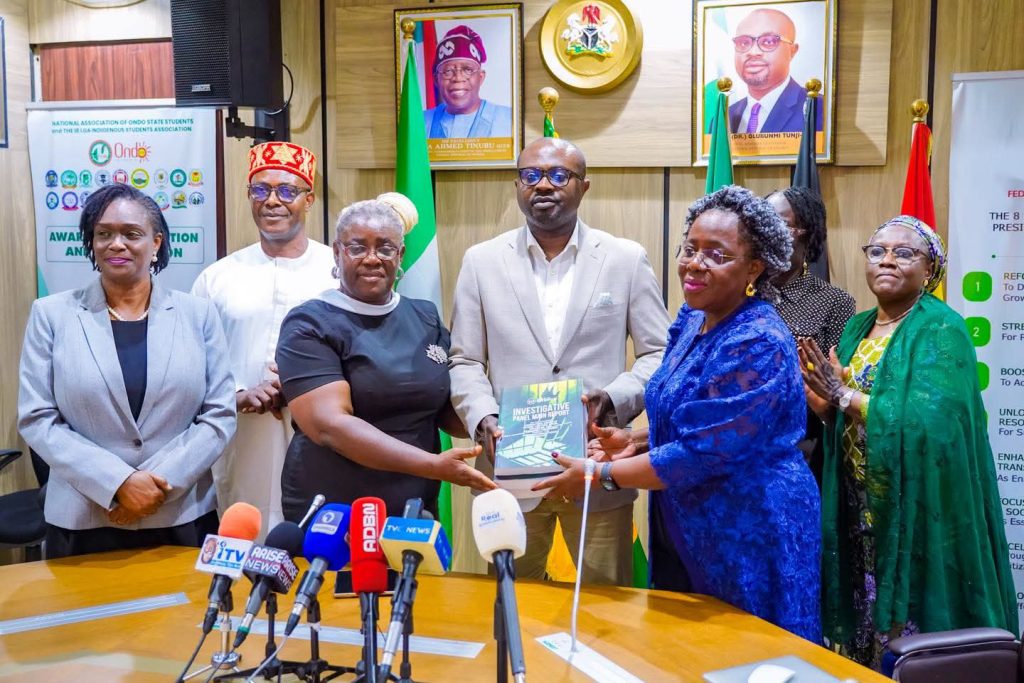
The Independent Investigative Panel on Allegations of Corruption and Gross Violations Against the Nigerian Correctional Service was established by the Honorable Minister of Interior and inaugurated on Monday, 30th September 2024. The Panel comprises distinguished professionals with extensive experience across public administration, correctional reform, law, forensic investigation, human rights, and inter-agency coordination.
Dr. Magdalene Ajani
Chairperson
Associate Prof. Uju Agomoh
Secretary
Mrs. Omotese Eva
Member
Alhaji Nasir Usman
Member
Dr. Ikechukwu Ezeugo
Member
DCG Modupe Anyalechi (Rtd.)
Member
(Co-opted)
Mrs. Asmau Adaji
Member
(Co-opted)
FINAL REPORT
The Independent Investigative Panel on the Alleged Corruption, Abuse of Power, Torture, Cruel, Inhumane, and Degrading Treatment Against the Nigerian Correctional Service
MARCH 2026
COPYRIGHT MINISTRY OF INTERIOR
FEDERAL REPUBLIC OF NIGERIA
©2026
Contents
Contents 2
Acronyms & Abbreviations 8
EXECUTIVE SUMMARY 9
- THE ULTIMATE PURSUIT: A FOUNDATION FOR HOLISTIC REFORM
- THE MANDATE AND STRATEGIC SCOPE
- PHASE TWO FINDINGS: THE NATIONAL SYSTEMIC AND HUMANITARIAN CRISIS
- PHASE ONE FINDINGS: CASES AS SYSTEMIC MICROCOSMS
- THE STAFF WELFARE NEXUS: VIOLATIONS AGAINST OFFICERS
- THE TÜRKIYE MODEL: A STRATEGIC BENCHMARKING BLUEPRINT
- PRIORITY RECOMMENDATIONS (THE ACTIONABLE ROADMAP)
- FINAL STATEMENT: DELIVERING ENDURING RESULTS
Chapter 1: Introduction 12
1.1. Background & Context for Establishing the Panel 12
1.1.1. The Constitutional and Statutory Role of the NCoS 12
1.1.2. The Immediate Trigger: The Bobrisky Case 12
1.1.3. The Concurrent Trigger: The Maina Allegations 12
1.1.4. National Implications and Government Response 12
1.1.5. The Ultimate Pursuit: Beyond Individual Misconduct 13
1.2. Panel’s Mandate, Composition & Terms of Reference 13
1.2.1. Establishment and Inauguration 13
1.2.2. Composition of the Panel 13
1.2.3. Mandate of the Panel 13
1.2.4. Scope of the Panel’s Work 14
1.2.5. Institutions, Actors, and Facilities Covered 15
1.2.6. Structure of the Investigation: A Phased Approach 15
1.3. Objectives of the Investigation 15
1.4. Structure of the Report 16
Chapter 2: Legal Framework & Methodology 18
2.1. Governing Legal & Policy Framework 18
2.1.1. Nigerian Correctional Service Act, 2019 18
2.1.2. Constitutional & International Human Rights Standards 19
2.1.3. Standing Orders & Internal Policies 21
2.2. Investigative Methodology 22
2.2.1. Overview of the Methodological Approach 22
2.2.2. Phased Approach: Diagnostic Cases to Systemic Review 23
2.2.3. Field Visits & Facility Inspections (86 Centres, 23 States) 23
2.2.3.1. Scope and Scale of Visits 23
2.2.4. Interviews and Stakeholder Consultations 24
2.2.5. Public Hearings, Stakeholder Consultations & Evidence Analysis 25
2.2.6. Strategic Cross-Country Study Mission to the Republic of Türkiye 27
2.2.7. Ethical Standards, Confidentiality & Witness Protection 28
2.2.8. Legal and Documentary Review 28
2.2.9. Conclusion on Methodology 29
Chapter 3: Diagnostic Case Analysis – Phase I Findings 30
3.1. Case of Mr. Idris Okuneye (Bobrisky) 30
3.1.1. Findings on Custody, Transfers & Documentation Violations 30
3.1.2. Findings on Privileges, Potential Corruption & Discrimination 33
3.1.2.1. On whether Okuneye Idris Olanrewaju had special privileges while
in custody 33
3.1.3. Broader Implications: Data Privacy, Social Media & Defamation 36
3.2. Case of Kuje Custodial Centre (Abdulrasheed Maina) 38
3.2.1. Findings on Financial Exploitation & Unethical Conduct 38
3.2.2. Findings on Management of High-Profile Inmates & Systemic Lapses 40
3.3. Cross-Cutting Issues Identified from Diagnostic Cases 42
3.3.1. Inmates’ provision of support to other inmates 42
3.3.2. Commercialization of welfare and other services to inmates 42
3.3.3. Operation of Markets in Correctional Centre Cells and Premises 43
3.3.4. Bribery and Extortion 43
3.3.5. Procurement Irregularities 43
3.3.7. Corruption in Staffing and Promotions 43
3.3.8. Poor Administration of Award and Supply of Inmates’ Food 43
3.3.9. Incentive to have a high number of inmates in custody for financial
reasons linked to supply of food 44
3.3.10. Connivance between some correctional officers with some
prosecutors and some judicial officers 44
3.3.11. Payment of Regular and Periodic “Welfare Funds” by in-charge custodial
Centre and in-charges of field operational positions to superior officers 44
3.3.12. Inadequate provision of the funding for the administration of correctional
service is seen as official endorsement of corruption 44
3.3.13. General Lack of Discipline Amongst Correctional Service Officers 45
3.3.14. Use of Civil Society Organizations to bridge the legitimate and illegitimate
gaps in the funding of Correctional Services 45
3.3.15. Lack of adequate concern for the security of custodial Centres 45
3.3.16. Understaffed and Overworked Staff 46
3.3.17. Systemic Issues Contributing to Corruption Identified from Phase I 46
3.4. Immediate Actions & Recommendations from Phase I 46
3.4.1. Recommendations for Immediate Action: NCoS Officials 46
3.4.2. Recommendations for Immediate Action: Others 48
3.4.3. Recommendations for Immediate Action: Institutional Reforms 48
Chapter 4: Consolidated Systemic Findings – Phase II 50
4.1. Patterns of Corruption & Financial Abuse 50
4.1.1. Financial Exploitation of Inmates and Families 50
4.1.2. Abuse of Authority and Coercive Control 50
4.1.3. Collusion and Bribery 51
4.1.4. Resource Diversion and Informal Economies 51
4.1.5. Fiscal Irregularities in Procurement and Welfare Funds 52
4.2. Torture, Ill-Treatment & Abuse of Authority 53
4.2.1. Identified Categories of Torture and Ill-Treatment 53
4.2.2. Enabling Conditions 54
4.2.3. Violations of National and International Standards 54
4.3. Organizational Culture, Oversight Failures & Lack of Discipline 56
4.3.1. Command Responsibility and Leadership Gaps 56
4.3.2. Weak Supervision and Internal Controls 56
4.3.3. Gaps in Operational Clarity and Standardization 56
4.3.4. Accountability, Oversight, and Disciplinary Mechanisms 57
4.3.5. Fear of Reporting and Retaliation 58
4.4. Humanitarian Crisis: Inmate Welfare & Living Conditions 58
4.4.1. Extreme Overcrowding 58
4.4.2. Healthcare Crisis 60
4.4.3. Sanitation Crisis 62
4.4.4. Nutrition Crisis 62
4.4.5. Infrastructure Decay 64
4.4.6. Water, Sanitation and Hygiene (WASH) Deficits 65
4.5. The “Privilege Economy” & Discriminatory Practices 65
4.5.1. Commercialization of Human Rights 65
4.5.2. Extortion by Welfare Officers 66
4.5.3. Socio-Economic Discrimination 66
4.5.4. Unregulated Internal Economy 66
4.6. Staff Welfare, Capacity Constraints & Operational Challenges 66
4.6.1. The Staff Welfare Nexus: Violations Against Officers 66
4.6.2. Specific Findings on Staff Welfare Violations 67
4.6.3. Understaffing and Overwork 71
4.6.4. Inadequate Professional Competence 71
4.7. Human Rights Impact Assessment (HRIA) of Violations 71
4.7.1. Purpose and Scope of the HRIA 71
4.7.2. IDENTIFIED HUMAN RIGHTS RISKS AND IMPACTS 72
4.7.3. IMPACT ON VULNERABLE GROUPS 74
4.7.4. SYSTEMIC AND INSTITUTIONAL IMPACTS 76
4.7.5. HRIA CONCLUSION 76
4.8. THE CONSOLIDATED TABLE OF FINDINGS 76
Chapter 5: Assessment of the NCoS Act 2019 & Implementation Gaps 103
5.1. Alignment of the Act with International Best Practices 103
5.1.1. Overview of the Nigerian Correctional Service Act, 2019 and Paradigm Shift 103
5.1.2. Reform Objectives and Paradigm Shift under Section 2(1) 103
5.1.3. Alignment with International Correctional Standards 104
5.1.4. Overall Assessment of the Act’s Policy and Legal Adequacy 105
5.2. Critical Analysis of Implementation Failures 105
5.2.1. Implementation of Section 2(1) Objectives 105
5.2.2. Critical Analysis of Section 12: The Decongestion Mandate 107
5.2.3. Perverse Financial Incentives Against Decongestion 108
5.2.4. Disconnect Between Legal Provisions and Day-to-Day Practice 108
5.2.5. Enforcement and Internalization of Standing Orders 109
5.3. Institutional, Financial & Operational Constraints 109
5.3.1. Budgetary Allocation, Funding Gaps, and Resource Constraints 109
5.3.2. Staffing, Capacity Distribution, and Operational Workload 110
5.3.3. Infrastructure, Logistics, and Support Systems 111
5.3.4. Data Management, Monitoring, and Inter-Agency Coordination 112
5.3.5. Leadership, Oversight, and Accountability Constraints 113
5.3.6. Use of Civil Society Organizations to Bridge Funding Gaps 114
5.3.7. Summary: The Implementation Gap 114
Chapter 6: A Blueprint for Reform: The Strategic Roadmap 115
6.1. The Foundational Philosophy: From Punitive Custody to Correctional
Enterprise 115
6.2. Immediate Actions (0–6 Months) – Halting the Crisis and Enforcing
Accountability 116
6.2.1. Accountability: Disciplinary & Legal Actions for Indicted Officers 116
6.2.2. Crisis Intervention: Decongestion, Healthcare & Sanitation 117
6.2.3. Operational Halts: Decommercialization, “Mammy Markets” and Racketeering 118
6.3. Medium-Term Reforms (6–24 Months) – Building the Pillars of a Modern System 119
6.3.1. The Digital Justice & Decongestion Pillar: Adopting the Türkiye Model
(SEGBİS/UYAP) 119
6.3.2. The Institutional Strengthening Pillar: Whistleblower Protection,
Transparent Procurement, Staff Training & Welfare Reform 121
6.3.3. The Rehabilitation Activation Pillar: Revitalizing Farms, Industries
& Vocational Training 122
6.4. Long-Term Transformation (2–5 Years) – Architecting the Future 124
6.4.1. The Correctional Enterprise Model: Establishing a Unified Partnership
& Enterprise Directorate for PPPs (Inspired by Türkiye’s İşyurtları) 124
6.4.2. Infrastructure Modernization: Adopting the “Campus” Model for New
Facilities 125
6.4.3. Legislative & Policy Advocacy: Budget Reform, Sentencing Review,
Juvenile Justice Act 126
6.4.4. Strategic International Partnership: Formalizing Technical Cooperation
with the Republic of Türkiye 127
6.5. Recommendations’ Master Register 129
6.6. Multi-Layer Application Framework: Strategic Directives for Different
Levels of Execution 148
6.6.1. For Top Executives of Government & the Ministry of Interior (Strategic
Policy & Investment Decisions) 148
6.6.2. For the Civil Defence, Correctional, Fire and Immigration Services Board
(CDCFIB) (Governance & Oversight Tracking) 149
6.6.3. For the Nigerian Correctional Service Leadership & Departmental Heads (Operational Execution) 150
6.6.4. For All Staff, Civil Society, and the Public (Accountability & Performance Benchmarking) 151
6.7. The Four-Pillar Reform Blueprint Summary 152
6.8. Concluding Imperative: From Blueprint to Implementation 154
Chapter 7: Conclusion 156
7.1. Synthesis of Findings: A System at Crossroads 156
7.2. The Imperative for Holistic, Sustained Reform 158
7.3. The Panel’s Final Charge to Stakeholders 160
Appendices 169
Appendix A: List of Facilities Visited 169
Appendix B: Public Hearing Schedule & Witness List 175
Appendix C: Summary of Panel Decisions on Individual Complaints
Appendix E: Terms of Reference & Panel Composition 190
Appendix D: Photographic Evidence (Selected) 190
Annexure 193
Overcrowding in Custodial Centres 193
Health and Sanitation/ Water Issues/Clinics 202
Food Matters (Poor Feeding) 215
Vocational Training, Rehabilitation and Reintegration 224
Evidence of Torture (Human Rights Abuse) 239
Infrastructure Decay 241
Special Cells 273
Vehicles/Logistics 276
Environment/Equipment 282
Trading 287
Contrabands/Illegal Substances 302
Record Keeping 304
Farming Centres 310
Field Work Preparations 321
Public Hearings 323
Third Public Hearings 329
Visit to Turkey 330
Group Picture of the Field Visits 338
Acronyms & Abbreviations JAMB Joint Admissions and Matriculation Board
JICS Judicial Inspectorate for Correctional Services (South Africa) LACON Legal Aid Council of Nigeria
LOI Letter of Intent
MCC Medium Correctional Centre
MDA Ministries, Departments and Agencies MoU Memorandum of Understanding
MSCC Medium Security Custodial Centre
NABTEB National Business and Technical Examinations Board NACP Nigerian Association of Clinical Psychology
NASS National Assembly
NBA Nigerian Bar Association
NBA-SPIDEL Nigerian Bar Association – Section on Public Interest and Development Law NBTE National Board for Technical Education
NCoS Nigerian Correctional Service
NCSA Nigerian Correctional Service Act, 2019 NDLEA National Drug Law Enforcement Agency NDPR Nigeria Data Protection Regulation, 2019 NECO National Examinations Council
NGO Non-Governmental Organization
NGOs Non-Governmental Organizations (Plural) NHIS National Health Insurance Scheme
NHRC National Human Rights Commission
NITDA National Information Technology Development Agency NJC National Judicial Council
NJI National Judicial Institute
NMA Nigerian Medical Association
NOUN National Open University of Nigeria NPF Nigerian Police Force
NPM National Preventive Mechanism NYSC National Youth Service Corps
OIC Officer-in-Charge
OICs Officers-in-Charge (Plural)
OPCAT Optional Protocol to the Convention Against Torture OPD Office of the Public Defender
PED Partnership and Enterprise Directorate PENCOM National Pension Commission
PI Preliminary Investigation
PMIS Prison Management Information System POS Point of Sale
PPP Public-Private Partnership
PPE Personal Protective Equipment
PRAWA Prisoners’ Rehabilitation and Welfare Action R&D Research and Development
ROLAC Rule of Law and Anti-Corruption Programme SCC Satellite Custodial Centre
SEGBİS Audio-Visual Information System (Türkiye – Ses ve Görüntü Bilişim Sistemi) SEPF Strategic Engagement & Partnership Framework
SOP Standard Operating Procedure
SOPs Standard Operating Procedures (Plural) SPV Special Purpose Vehicle
SWAT Special Weapons and Tactics (Police Unit) TAP Transparency & Accountability Portal
TB Tuberculosis
ToR Terms of Reference
TSA Treasury Single Account
TSD Training and Staff Development
TVET Technical and Vocational Education and Training UN United Nations
UNICEF United Nations Children’s Fund
UNODC United Nations Office on Drugs and Crime UTI Urinary Tract Infection
UYAP National Judiciary Informatics System (Türkiye – Ulusal Yargı Ağı Projesi) VAPP Violence Against Persons (Prohibition) Act, 2015
WAEC West African Examinations Council WASH Water, Sanitation and Hygiene
EXECUTIVE SUMMARY
The ultimate pursuit of this inquiry transcends the mere adjudication of individual misconduct; it is a strategic diagnostic exercise designed to provide a solid foundation for a holistic reform of the Nigerian Correctional Service (NCoS). By performing a “deep-cut” investigation into the institutional fabric of the Service, the Panel has sought to uncover the systemic root causes of decay rather than merely treating its symptoms. This report provides a roadmap for addressing these issues effectively, ensuring that the consequential reforms deliver sustainable and enduring results for the Service and the security of the Nigerian nation.
Inaugurated on 30th September 2024, the Panel’s mandate synthesized two interlocking phases:
Phase One: A microscopic investigation into high-profile administrative failures, specifically the “Culture of Privilege” exemplified by the incarceration of Mr. Idris Okuneye (Bobrisky) and the financial misconduct involving Abdulrasheed Maina
Phase Two: A comprehensive assessment of 86 facilities across 23 States, evaluating the welfare, rights, and operational conditions of the custodial population, supplemented by public hearings and a strategic study mission to the Republic of Türkiye.
The audit revealed a state of foundational paralysis -The NCoS custodial centres as system of “Human Warehousing” exhibiting the following:
• Decongestion Bottleneck & Infrastructure Decay: Overcrowding reaches 500% in urban hubs, violating Section 12 of the NCoS Act 2019. Inmates inhabit dilapidated structures and endure a sanitation crisis, including the manual handling of human waste.
• Commercialization of Human Rights: A pervasive “Privilege Economy” exists where rights are sold as commodities. Inmates “self-fund” the service, paying for bed spaces (up to ₦150,000), court transportation, and family visits—a practice driven by systemic underfunding and a culture of impunity.
• Humanitarian Catastrophe: The Panel documented widespread clinical failure, including maggot-infested wounds and tuberculosis outbreaks. Mental health support is virtually non-existent; mentally ill inmates are routinely chained or isolated, violating the UN Mandela Rules.
• Perverse Incentives: A direct link between inmate numbers and lucrative food supply contracts creates a systemic disincentive for decongestion, undermining the implementation of non-custodial measures.
During the Phase One, the findings shows that the investigation into high-profile cases served as a diagnostic tool to expose the “procedural rot” within the system:
• The Case of Mr. Idris Okuneye Olanrewaju (Bobrisky): While physical custody was confirmed (April 12 – August 5, 2024), the stay was defined by procedural laxity. Unauthorized privileges—including a furnished cell, humidifier, and television—highlight a discriminatory “Socio-Economic Tier” of justice. Transfers were undocumented and backdated in violation of Standing Orders 168/169.
• The Case of Abdulrasheed Maina: The Panel confirmed a total ethical collapse at Kuje Custodial Centre, where DCC Kelvin Iloafonsi Ikechukwu received financial transfers
from Maina’s son into his personal account. This exemplifies the “Commercialization of Services” found nationwide.
Examining the nexus between staff welfare and violations by officers shows that holistic reform is impossible without addressing the crisis of morale among correctional staff. Officers face unpaid allowances, delayed promotions, and inadequate housing. This environment of neglect makes informal, corrupt practices a survival mechanism, directly undermining institutional integrity.
The study mission to Türkiye provided examples of some good practices, namely: Digital Justice (UYAP/SEGBİS): Integrated systems that reduced pre-trial detention to 14% Prison Industrialization (İşyurtları): A Public-Private Partnership (PPP) model that transforms inmates into productive assets.
• Technical Pipeline: The Panel secured an agreement in principle for technical collaboration, offering a direct pathway for pilot programs in digital justice and electronic monitoring.
The Priority Recommendations are as follows:
A. Judicial Emergency: Establish permanent Mobile Courts and “Bail Clinics” at Maximum Security hubs to process the 50,000+ Awaiting Trial detainees. Massive reduction in pretrial detention, adopting imprisonment as a measure of last resort and increased utilization of non-custodial measures.
B. Fiscal & Infrastructure Revolution: Launch an Emergency Infrastructure and Sanitary Task Force to rehabilitate infrastructure. This should also include prohibition of manual handling of waste and adoption of waste recycling and other related innovations aimed at creating wealth from waste and energy renewal.
C. The Correctional Enterprise (Low-Hanging Fruit): Immediately reactivate NCoS agricultural lands and dormant workshops as the foundation for sustainability. This includes:
i. Food Security: Mechanizing farm Centres to supply inmate food, reducing the feeding budget and dependency on external vendors. Establish mechanism to remove incentives linking custodial centre population to increase in profit margin from food ration awards. Transition into NCOS producing food for its inmates incrementally. The recent concurrent placement of correctional service in constitution should be immediately activated by setting up a process for the State to fund the upkeep and rehabilitation of those detained on state offences. Adjusting feeding cost in line with current economic realities. A recommendation of ₦3,000/day is made and should be reviewed with targets and incentives given for the NCoS to produce and sustain the feeding of inmates.
ii. Revenue Generation: Commercializing surplus produce to create new revenue streams for the Service.
iii. Inmate Earning: Implementing Section 14 of the Act to ensure inmates receive profit shares, providing “starter packs” for reintegration.
D. Healthcare & Vulnerable Groups: Implementation of Sections 24, 34, and 35 of the Nigerian Correctional Service Act 2019 in relation to treatment of mentally ill, young offenders and female inmates. Remove all minors from adult facilities; establish dedicated psychiatric and other special health needs care wings; and
E. Digital Foundation (DCMS): Mandate a Digital Correctional Management System to prevent the manual manipulation and backdating of records.
It is important to deliver enduring results. Investigation without transformation is a hollow exercise. This report identifies that the NCoS is crippled by a triple crisis: judicial congestion, financial strangulation, and moral neglect. To deliver enduring results for the nation, the Ministry of Interior must execute a twin-track strategy: a technological assault on the trial backlog and a long-term investment in a new ecosystem of professionalized staff and productive facilities. By addressing the root causes identified in this “deep-cut” investigation, the NCoS can finally be transformed from a punitive warehouse into a productive campus that enhances national security and restores human dignity.
Chapter 1: Introduction
1.1. Background & Context for Establishing the Panel
1.1.1. The Constitutional and Statutory Role of the NCoS
The Nigerian Correctional Service (NCoS) occupies a critical position within Nigeria’s criminal justice system, with statutory responsibility for the safe custody, rehabilitation, and reintegration of persons deprived of their liberty, as well as the implementation of noncustodial measures in line with the Nigerian Correctional Service Act, 2019. In recent years, however, persistent allegations of corruption, abuse of authority, torture, and other forms of cruel, inhuman, and degrading treatment within correctional facilities have continued to raise serious concerns about compliance with national laws and international human rights standards.
1.1.2. The Immediate Trigger: The Bobrisky Case
The incident leading to the constitution of this Investigative Panel began with the arrest of Nigerian social media influencer, Okuneye Idris Olanrewaju (Bobrisky), by the Economic and Financial Crimes Commission (EFCC) on March 24, 2024, for defacing or mutilating the Nigerian currency. On April 5, 2024, Bobrisky pleaded guilty to the charges, and by April 12, 2024, the Federal High Court in Lagos sentenced him to six months imprisonment without the option of a fine to commence from April 12, 2024. The initial EFCC investigation focused on money laundering allegations, but Bobrisky was later charged with mutilating naira notes.
In some audio recordings that went viral, Bobrisky allegedly claimed to have paid fifteen million naira (₦15,000,000) as a bribe to EFCC officials to have the initial charges dropped. This stirred up serious public controversy. The EFCC responded to this by asserting that the charges were dropped based on an appeal from Bobrisky’s legal team. The controversy deepened when social media activist Martins Vincent Otse, popularly known as ‘Very Dark Man’, promoted these audio recordings as fact with inciting comments. The recordings alleged that Bobrisky had bribed his way out of the more severe money laundering charges and that influential figures within the Nigerian Correctional Service (NCoS) had facilitated his serving his custodial (prison) sentence outside the Nigerian Correctional Service Custodial Centre (the prison), reportedly in a private apartment. These claims ignited widespread public outrage and fueled speculation of systemic corruption, reinforcing the notion that wealthy individuals could avoid serving their imprisonment/time in custody in designated Nigerian Correctional Service Custodial Centres. In the recordings, Bobrisky boasted to friends that his “godfather” had arranged for him to serve his sentence outside the correctional Centre.
1.1.3. The Concurrent Trigger: The Maina Allegations
Furthermore, there was another troubling claim. This is in relation to Abdulrasheed Maina’s allegations of extortion by the Officer in Charge of the Kuje Custodial Centre.
1.1.4. National Implications and Government Response
These allegations, amplified through media reporting, civil society advocacy, and public discourse, generated significant public concern and underscored broader anxieties regarding accountability, transparency, and human rights protection within correctional institutions.
Beyond the specific incidents cited, the allegations resonated with longstanding systemic challenges, including custodial congestion, weak oversight mechanisms, limited internal accountability structures, and gaps in the effective implementation of correctional reforms envisaged under the NCoS Act, 2019.
Given the national implications of these concerns—particularly their impact on public confidence in the justice system, Nigeria’s human rights obligations, and the credibility of ongoing correctional reforms—the Honourable Minister of Interior – Hon. (Dr) Olubunmi Tunji-Ojo set up an Independent Investigative Panel to investigate these and other related issues and proffer effective and comprehensive solutions. The establishment of the Panel reflects the Government’s recognition of the seriousness of the allegations and its commitment to ensuring that correctional administration operates in a manner that upholds the dignity, rights, and welfare of all persons in custody.
1.1.5. The Ultimate Pursuit: Beyond Individual Misconduct
The ultimate pursuit of this inquiry transcends the mere adjudication of individual misconduct; it is a strategic diagnostic exercise designed to provide a solid foundation for a holistic reform of the Nigerian Correctional Service (NCoS). By performing a “deep-cut” investigation into the institutional fabric of the Service, the Panel has sought to uncover the systemic root causes of decay rather than merely treating its symptoms.
1.2. Panel’s Mandate, Composition & Terms of Reference
1.2.1. Establishment and Inauguration
In response to the reports and allegations that surfaced regarding corruption, violations of laid down rules, abuse of authority, torture, cruel, inhumane, and degrading treatment by officers of the Nigerian correctional officers, the Honourable Minister of Interior constituted this Independent Investigative Panel. The Panel members were inaugurated on Monday 30th September, 2024 by the Honourable Minister of Interior with a charge to commence their investigation immediately, which they did.
1.2.2. Composition of the Panel
The Panel is composed as follows:
Panel Members at inauguration:
- Dr. Magdalene Ajani, The Permanent Secretary, Ministry of Interior (Chairperson).
- Mrs. Omotese Eva, Director – Legal Services – Ministry of Interior
- Alhaji Nasir Usman, Director, Former Director – Joint Services, Ministry of Interior
- Associate Prof. Uju Agomoh, President, Prisoners’ Rehabilitation and Welfare Action (PRAWA) – (Secretary)
- Dr. lkechukwu Ezeugo, Forensic Investigator, Principal Consultant of Mc2ibp Consulting Limited, and Consultant lyke of Brekete Family/Human Rights Radio, and Television.
Co-opted Members: - Mrs. Modupe Sule Anyalechi – Special Adviser to the Minister of Interior on Paramilitary
- Mrs. Asmau Adaji – Director, Joint Services, Ministry of Interior
1.2.3. Mandate of the Panel
The Independent Investigative Panel on Allegations of Corruption and Gross Violations Against the Nigerian Correctional Service was established by the Honourable Minister of Interior with a clear and defined mandate to conduct an independent, impartial, and comprehensive inquiry
into allegations of misconduct within the Nigerian Correctional Service (NCoS). In accordance with the Terms of Reference (ToR), the Panel was mandated to:
i. Investigate allegations of corruption, torture, cruel, inhuman, and degrading treatment of inmates by correctional officers, including specific cases formally referred to the
Panel,
ii. Examine violations of laid down rules, regulations, and standards governing the conduct of correctional officers and the treatment of inmates,
iii. Identify systemic, institutional, and operational factors that may contribute to corruption, abuse of authority, and human rights violations within correctional facilities,
iv. Assess obstacles to the effective implementation of the Nigerian Correctional Service Act, 2019, with particular reference to the objectives outlined under Section 2(1), including compliance with international human rights standards, implementation of non-custodial measures, rehabilitation and reintegration of offenders, and reduction of the awaiting-trial population,
v. Identify activities, practices, and processes within the correctional system that enable or perpetuate corruption, poor welfare conditions, and rights violations affecting inmates and staff, and
vi. Propose immediate, medium-term, and long-term recommendations aimed at addressing identified violations, strengthening accountability mechanisms, improving correctional administration, and aligning practices with national laws and international best practices.
In carrying out its mandate, the Panel was empowered to access correctional facilities, summon individuals, request documents, conduct inspections including unannounced visits, and engage relevant stakeholders as necessary to fulfil its responsibilities.
1.2.4. Scope of the Panel’s Work
The scope of the panel’s work, as defined by the Terms of Reference, is as follows:
i. Investigate the two specific cases assigned to the panel.
ii. Review and document all cases of corruption, torture, cruel, inhumane, or degrading treatment reported by inmates or other credible sources brought to the attention of the Investigative Panel.
iii. Investigate whether correctional officers acted outside the scope of the law and correctional regulations.
iv. Examine the organizational culture, policies, and practices within correctional facilities that may contribute to human rights violations.
v. Investigate any form of collusion or failure of oversight mechanisms that may have allowed these abuses to occur.
vi. Engage with victims, correctional officers, administrators, relevant government agencies, and human rights organizations to gather information and evidence.
vii. Propose immediate measures to address abuses.
viii. Recommend comprehensive reforms for the medium and long term to ensure compliance with national laws and international human rights standards.
1.2.5. Institutions, Actors, and Facilities Covered
The Panel engaged with and examined the roles of multiple actors and institutions relevant to correctional administration, including:
• Correctional officers at various levels of responsibility,
• Custodial facility administrators and senior management within the NCoS,
• Inmates and former inmates,
• Family members of inmates,
• Civil Society Organizations, legal practitioners.
Field visits and inspections were conducted in 86 custodial centres across 23 States.
1.2.6. Structure of the Investigation: A Phased Approach
The Panel’s mandate synthesized two interlocking phases:
• Phase One (Integrity Inquiry): A microscopic investigation into high-profile administrative failures, specifically the “Culture of Privilege” exemplified by the incarceration of Mr. Idris Okuneye (Bobrisky) and the financial misconduct involving Abdulrasheed Maina at Kuje Custodial Centre.
• Phase Two (National Systemic Audit): A comprehensive assessment of 86 facilities across 23 states, evaluating the welfare, rights, and operational conditions of the custodial population, supplemented by public hearings and a strategic study mission to the Republic of Türkiye.
1.3. Objectives of the Investigation
The objectives of the Investigation, as set out in the Terms of Reference (ToR), guided the scope, focus, and outcomes of the Panel’s work. The Panel was established to achieve the following core objectives:
i. To investigate specific allegations of corruption, torture, and other forms of mistreatment of inmates by correctional officers, including the cases expressly assigned to the Panel by the Honourable Minister of Interior.
ii. To identify systemic, institutional, and operational factors within the Nigerian Correctional Service that may contribute to corruption, abuse of authority, and violations of inmates’ rights.
iii. To examine compliance with existing laws, regulations, and policies governing correctional administration, particularly the Nigerian Correctional Service Act, 2019, the Standing Orders, and relevant circulars.
iv. To recommend concrete and actionable measures for the immediate redress of identified violations, including steps to protect inmates from further harm and to address misconduct where established.
v. To propose medium- and long-term policy, institutional, and administrative reforms aimed at preventing recurrence, strengthening accountability, and improving correctional governance in line with international best practices.
In fulfilling these objectives, the Panel sought not only to address individual incidents, but also to contribute to sustainable reforms that would enhance the integrity, effectiveness, and human rights compliance of Nigeria’s correctional system.
1.4. Structure of the Report
This Report is organized into seven chapters, each addressing a distinct aspect of the Panel’s investigation, findings, and recommendations, moving from specific diagnostic cases to systemic analysis and ultimately to a comprehensive blueprint for reform.
• Chapter 1: Introduction. This chapter provides the background and context for the establishment of the Panel, outlines its mandate, composition, and Terms of Reference, states the objectives of the investigation, and describes the structure of the Report.
• Chapter 2: Legal Framework & Methodology. This chapter sets out the governing legal and policy framework for correctional administration in Nigeria, including the NCoS Act 2019, Constitutional provisions, and international human rights standards. It also details the multi-layered, evidence-driven investigative methodology employed by the Panel, including field visits, public hearings, and ethical standards.
• Chapter 3: Diagnostic Case Analysis – Phase I Findings. This chapter presents the detailed findings from the investigation into the two specific cases assigned to the Panel: the case of Mr. Idris Okuneye (Bobrisky) and the allegations involving DCC Kelvin Iloafonsi Ikechukwu at Kuje Custodial Centre. It analyses the procedural violations, privileges, and ethical breaches identified, and presents cross-cutting issues and immediate recommendations arising from Phase I.
• Chapter 4: Consolidated Systemic Findings – Phase II. This chapter presents the comprehensive findings from the national systemic audit of 86 custodial centres across 23 States. It consolidates findings into thematic areas including patterns of corruption and financial abuse; torture and ill-treatment; organizational culture and oversight failures; the humanitarian crisis affecting inmate welfare; discriminatory practices; staff welfare constraints; and a Human Rights Impact Assessment (HRIA) of the violations documented.
• Chapter 5: Assessment of the NCoS Act 2019 & Implementation Gaps. This chapter critically examines the alignment of the NCoS Act 2019 with international best practices and provides a detailed analysis of the significant implementation failures that have prevented the realization of its progressive objectives, including Section 2(1) and Section 12 on congestion. It also assesses the institutional, financial, and operational constraints contributing to these gaps.
• Chapter 6: A Blueprint for Reform: The Strategic Roadmap. This chapter constitutes the Panel’s core reform agenda. It articulates the foundational philosophy for transforming the NCoS from a punitive custody system to a correctional enterprise. It presents a detailed, time-bound roadmap of Immediate (0-6 Months), Medium-Term (6-24 Months), and Long-Term (2-5 Years) strategic recommendations, drawing on lessons from the Turkish model and integrating all recommendations from the diagnostic cases, systemic audit, public hearings, and complaints. It includes the Master Register of Recommendations.
• Chapter 7: Conclusion. This chapter synthesizes the Panel’s findings, presenting the NCoS as a system at a crossroads. It underscores the imperative for holistic, sustained reform and delivers the Panel’s final charge to all stakeholders—executive, legislative,
judicial, and civil society—to commit to the urgent implementation of this reform agenda.
• Appendices. The Report is supplemented by appendices containing supporting documentation, including the list of facilities visited, the public hearing schedule and witness list, a summary of Panel decisions on individual complaints, selected photographic evidence, and the full Terms of Reference and Panel composition.
The first phase report, submitted to the Honourable Minister of Interior on 21st October, 2024, focused on the preliminary findings concerning the two alleged cases of corruption. This final report includes additional findings and recommendations based on the full terms of reference, incorporating the comprehensive Phase II audit, public hearings, and strategic study mission, to provide a comprehensive scope on the issues aimed at providing long-term sustainable solutions.
Chapter 2: Legal Framework & Methodology
2.1. Governing Legal & Policy Framework
The work of the Panel was anchored in a comprehensive review of Nigeria’s legal and policy framework governing correctional administration, as well as relevant international and regional human rights standards.
2.1.1. Nigerian Correctional Service Act, 2019
2.1.1.1. Overview and Paradigm Shift
The Nigerian Correctional Service Act, 2019 constitutes a fundamental reform of Nigeria’s correctional legal framework. Enacted to replace the Prisons Act, Cap P29 Laws of the Federation of Nigeria 2004, the Act marks a deliberate shift away from a custodial, punishment-driven prison system toward a correctional model anchored in rehabilitation, reintegration, respect for human dignity, and public safety. The Act establishes the Nigerian Correctional Service as a unified institution with responsibility for both custodial and noncustodial corrections (Section 1), thereby institutionalizing alternatives to imprisonment as an integral part of Nigeria’s criminal justice system rather than as peripheral or discretionary measures. This structural reform aligns Nigeria’s correctional framework with contemporary international standards, which emphasize proportionality, rehabilitation, and the reduction of unnecessary deprivation of liberty.
In addition, the Act expressly affirms the obligation of the Nigerian Correctional Service to operate in accordance with international human rights norms and correctional best practices, thereby providing a statutory bridge between domestic correctional administration and Nigeria’s international treaty obligations.
2.1.1.2. Reform Objectives under Section 2(1)
The Reform paradigm shift introduced by the NCoS Act is most clearly articulated in Section 2(1), which sets out the objectives of the Nigerian Correctional Service. These objectives collectively redefine the purpose of corrections in Nigeria and establish a rights-based and rehabilitative framework:
• Section 2(1)(a): The Act mandates the Service to “ensure compliance with international human rights standards and correctional best practices”. This provision is significant in that it elevates compliance with international norms from a policy aspiration to a statutory duty, reinforcing constitutional guarantees under Sections 34 and 35 of the 1999 Constitution (as amended), which protect human dignity and personal liberty.
• Section 2(1)(b): The Act requires the Service to “provide an enabling platform for the implementation of non-custodial measures”. This provision represents a departure from the historical over-reliance on incarceration and reflects global correctional trends favouring community-based sanctions, particularly for minor and non-violent offences.
• Section 2(1)(c): The Act places emphasis on “corrections and the reformation, rehabilitation and reintegration of offenders”, affirming that incarceration should not merely be punitive but corrective. This objective is further reinforced by provisions of section 14 of the Act on education, vocational training, and welfare services within custodial centres.
• Section 2(1)(d): The Act mandates the Service to “establish institutional, systematic and sustainable mechanisms to address the high number of persons awaiting trial”.
This objective directly responds to longstanding concerns regarding prolonged pretrial detention and custodial congestion, which have been repeatedly criticized by domestic courts, treaty bodies, and human rights mechanisms.
Taken together, these objectives reflect modern correctional philosophy and situate Nigeria’s correctional law within a global movement toward humane, proportionate, and rehabilitative justice systems.
2.1.1.3. Duties, Powers, and Safeguards
The Act also outlines the duties, powers, and responsibilities of correctional officers, as well as safeguards for the welfare, treatment, and rights of inmates. The Panel assessed the extent to which these statutory provisions are being effectively implemented in practice and the challenges impeding their realization.
2.1.2. Constitutional & International Human Rights Standards
2.1.2.1. Constitutional and Domestic Human Rights Framework
The Panel also considered relevant provisions of the Constitution of the Federal Republic of Nigeria, 1999 (as amended), particularly those guaranteeing:
• The right to dignity of the human person (Section 34),
• Freedom from torture and inhuman or degrading treatment (Section 34),
• The right to personal liberty (Section 35), and
• The right to fair hearing and due process (Section 36).
These constitutional guarantees apply equally to persons deprived of their liberty and form the baseline for lawful correctional administration.
2.1.2.2. International and Regional Human Rights Standards
Nigeria is a STATE PARTY to several international and regional human rights instruments relevant to correctional administration, including:
• The United Nations Convention Against Torture and Other Cruel, Inhuman or Degrading Treatment or Punishment (CAT);
• The Optional Protocol to the Convention Against Torture (OPCAT);
• The United Nations Standard Minimum Rules for the Treatment of Prisoners (the Mandela Rules);
• The United Nations Standard Minimum Rules for Non-Custodial Measures (the Tokyo Rules);
• The United Nations Rules for the Treatment of Women Prisoners and Non-Custodial Measures for Women Offenders (the Bangkok Rules);
• The African Charter on Human and Peoples’ Rights.
These instruments impose obligations on the State to prevent torture, ensure humane conditions of detention, establish independent oversight mechanisms, and provide effective remedies for violations. The Panel assessed Nigeria’s correctional practices against these standards, with particular attention to prevention, accountability, and safeguards for vulnerable groups.
2.1.2.3. Alignment with the Mandela Rules
The Mandela Rules establish universally accepted minimum standards for the humane treatment of persons deprived of liberty. Several provisions of the NCoS Act mirror these standards, including:
• The emphasis on respect for human dignity and prohibition of torture and inhuman or degrading treatment, consistent with Rules 1 and 43 of the Mandela Rules;
• Provisions relating to healthcare, welfare, and humane living conditions, which align with Rules 24–35 on medical services and Rule 13 on accommodation;
• Requirements for classification and separation of inmates, reflecting Rules 11 and 12, which call for separation based on gender, age, legal status, and vulnerability;
• Oversight, inspection, and accountability mechanisms, consistent with Rules 83–85, which emphasize independent inspection and transparency.
The Act’s statutory recognition of these principles demonstrates Nigeria’s formal commitment to minimum international standards for custodial treatment.
2.1.2.4. Alignment with the Tokyo Rules
The Tokyo Rules encourage the use of non-custodial sanctions at all stages of the criminal justice process in order to reduce reliance on imprisonment. The NCoS Act aligns closely with these principles by:
i. Establishing a Non-Custodial Directorate within the Nigerian Correctional Service (Sections 1 and 37–44);
ii. Recognizing community service, probation, parole, and restorative justice approaches as legitimate correctional measures;
iii. Emphasizing supervision, reintegration, and community involvement, consistent with Rules 1.5, 2.3, and 10 of the Tokyo Rules.
By embedding non-custodial measures within its statutory framework, the Act advances the Tokyo Rules’ objective of promoting alternatives to incarceration while safeguarding public safety.
2.1.2.5. Alignment with the Bangkok Rules
The United Nations Rules for the Treatment of Women Prisoners and Non-Custodial Measures for Women Offenders (the Bangkok Rules) call for gender-responsive correctional policies that recognize the distinct needs, circumstances, and vulnerabilities of women in contact with the criminal justice system. These include safeguards relating to dignity, healthcare, pregnancy and motherhood, and the prioritization of alternatives to detention where appropriate.
The Nigerian Correctional Service Act 2019, reflects some elements of these principles, particularly through:
a) Provisions requiring humane treatment, respect for dignity, and access to healthcare for all inmates, which apply equally to women;
b) Recognition of vulnerable categories of inmates, including women, pregnant women,
and nursing mothers, within the broader framework of inmate welfare and custodial management.
However, the Act does not expressly incorporate gender-specific non-custodial measures, nor does it provide detailed operational guidance tailored to the distinct pathways, risks, and rehabilitation needs of women offenders, as envisaged under the Bangkok Rules. While the Act establishes a general framework for non-custodial measures applicable to all offenders, it does not explicitly prioritize or adapt these measures for women.
The Panel therefore finds that although the NCoS Act demonstrates some alignment with the Bangkok Rules at the level of principles of dignity and welfare, significant gaps remain in the explicit integration and operationalization of gender-responsive correctional and non-custodial approaches. Addressing these gaps would require targeted policy guidance, operational standards, and implementation measures to ensure that the distinct needs of women offenders are adequately reflected in practice.
2.1.2.6. Overall Assessment of the Act’s Policy and Legal Adequacy
From a legal and policy perspective, the Panel finds that the Nigerian Correctional Service Act, 2019 is comprehensive, progressive, and largely consistent with international correctional standards. The Act provides a solid legal framework for humane custody, the use of noncustodial measures, rehabilitation-focused corrections, and institutional accountability.
The Panel further observes that the systemic challenges identified during the investigation do not arise primarily from shortcomings in the law itself. Rather, they are largely the result of weaknesses in implementation, including limited translation of statutory provisions into day-to-day practice, inadequate funding and resources, weak oversight mechanisms, and insufficient coordination among relevant institutions.
Accordingly, the effective achievement of the objectives of the NCoS Act depends less on further legislative reform and more on strengthened implementation, improved enforcement, clearer operational guidance, enhanced accountability structures, and sustained political and administrative commitment.
2.1.3. Standing Orders & Internal Policies
2.1.3.1. Overview and Purpose
The Nigerian Correctional Service Standing Orders (Custodial and Non-custodial), operational circulars, and internal policies provide detailed guidance on custodial management, discipline, use of force, inmate welfare, classification, and administrative procedures. These instruments are intended to operationalize the provisions of the NCoS Act and ensure uniform standards across correctional facilities.
2.1.3.2. Scope of Panel Examination
The Panel examined these instruments to determine:
• Whether they are consistent with international standards;
• The level of awareness and compliance among correctional personnel; and
• The adequacy of enforcement, oversight, and disciplinary mechanisms.
2.1.3.3. Specific Provisions Referenced in Findings
The following provisions of the Standing Orders (Custodial) were central to the Panel’s assessment of compliance in specific cases and systemic practices:
• Section 86: Governs inmate privileges, requiring that “Information Cards notifying inmates of their privileges, obligations and duties while in Custodial Centre shall be exhibited in the reception cells. In the case of an illiterate inmate, the cards shall be read over to him/her in the language he/she understands.”
• Section 163(a): Grants transfer authority: “The Controller-General or any person acting on his/her behalf may, for security or administrative reasons, order in writing the transfer of any inmate (convicted or un-convicted) to a suitable custodial centre…”
• Section 163(f): State-level transfer authority: “Controllers of Corrections, State Commands are authorized to approve transfers within their respective States and the Controller-General of Corrections shall be notified of such transfers.”
• Section 164: Mandates medical examination prior to transfer: “All inmates for transfer shall be examined by the Medical Officer within twenty-four hours of the transfer and shall be certified fit to travel.”
• Section 168: Governs transfer documentation: “The written authority to transfer shall be copied to the receiving Custodial Centre but the actual date of the transfer shall be notified by the transferring Custodial Centre not earlier than twenty-four hours before the transfer takes place.”
• Section 169: Prescribes pre-transfer procedures: (a) Inmate for transfer shall be seen by the Superintendent-in-charge on the day before the transfer; (b) All documentation shall be completed on the morning of transfer; (c) It shall be the responsibility of the Custodial Centre keeper to detail and check the escort.
2.1.3.4. Relationship with the NCoS Act
The provisions of the Standing Orders mirror and operationalize specific sections of the NCoS Act 2019, particularly Section 16 which governs the transfer of inmates.
2.2. Investigative Methodology
2.2.1. Overview of the Methodological Approach
In fulfilling its mandate, the Panel adopted a multi-layered, qualitative, and evidence-driven methodology aimed at ensuring independence, objectivity, credibility, and fairness. The methodology was designed to enable the Panel to establish factual clarity in respect of specific allegations, while also examining broader systemic, institutional, and operational issues within the Nigerian Correctional Service (NCoS).
The approach combined legal and policy review, field-based inquiry, direct engagement with stakeholders, public hearings, and analytical review of available data and records. The methods employed were consistent with the Panel’s Terms of Reference and guided by principles of transparency, due process, and respect for human rights.
The Panel deployed various approaches in undertaking the tasks assigned to it. To date, the following methodologies were employed:
• Inspection visits to several correctional facilities.
• Interviews with correctional officers, inmates, administrators, and other stakeholders.
• Interviews of alleged victims of the corrupt practices and other interested parties (where possible).
• Review of documents, records and files.
• Engagement of confidential informants and whistleblower reports/receiving individual and group complaints.
• Call for submission of memorandum.
• Public Hearings.
• Thematic consultations.
2.2.2. Phased Approach: Diagnostic Cases to Systemic Review
The Panel’s mandate synthesized two interlocking phases, and the methodology reflected this duality:
2.2.2.1. Phase One (Integrity Inquiry)
A microscopic investigation into high-profile administrative failures, specifically the “Culture of Privilege” exemplified by the incarceration of Mr. Idris Okuneye (Bobrisky) and the financial misconduct involving Abdulrasheed Maina at Kuje Custodial Centre. This phase focused on:
• Establishing factual clarity regarding the specific allegations.
• Assessing compliance with applicable legal and institutional standards.
• Determining responsibility where violations were established.
2.2.2.2. Phase Two (National Systemic Audit)
A comprehensive assessment of correctional facilities nationwide, evaluating the welfare, rights, and operational conditions of the custodial population. This phase extended to:
• Reviewing complaints, petitions, and information received from inmates, former inmates, civil society organizations, legal practitioners, and other credible sources;
• Assessing patterns of conduct, operational practices, and institutional arrangements that may contribute to corruption, abuse, or violations of inmates’ rights;
• Examining organizational culture, internal controls, oversight mechanisms, disciplinary processes, and accountability frameworks within the NCoS;
• Evaluating the effectiveness of existing policies, resources, and inter-agency coordination in supporting humane custody, rehabilitation, reintegration, and the implementation of non-custodial measures.
2.2.3. Field Visits & Facility Inspections (86 Centres, 23 States)
2.2.3.1. Scope and Scale of Visits
The Panel conducted field visits to correctional facilities as a central component of the investigation. These visits enabled first-hand observation of detention conditions, operational practices, and treatment of inmates.
This final report includes information from the field visits to 86 correctional centers across 23 States. A total of 23 states covering 86 Custodial centers in all the geopolitical zones were visited during this period. While some centers were listed in the initial scope, some were inaccessible due to environmental hazards or insecurity.
2.2.3.2. Methodology of Inspections
During these visits, the Panel:
• Inspected living conditions, infrastructure, and general welfare arrangements;
• Observed interactions between correctional officers and inmates;
• Examined compliance with Standing Orders and established procedures;
• Engaged directly with facility leadership and operational staff; and
• Verified information obtained through desk review and petitions.
Both announced and unannounced visits were conducted where necessary, to support objective assessment and reduce the risk of staged compliance.
2.2.3.3. States and Facilities Covered
The field report outlines the findings of the Independent Investigative Panel’s field visits to custodial centres across Nigeria between late 2024 and mid-2025. The following states were examined: Abia, Anambra, Adamawa, Edo, Kano, Lagos, Plateau, FCT (Kuje, Suleja), Nasarawa (Keffi), Akwa Ibom, Kaduna, Delta, Rivers, Sokoto, Borno, Ebonyi, Enugu, Gombe, Imo, Oyo, Kwara, Ondo, and Ogun.
(Note: Detailed state-by-state findings are presented in Chapter 4 and Appendix A. This section establishes the methodological scope.)
2.2.4. Interviews and Stakeholder Consultations
The Panel engaged in direct interviews and consultations to obtain first-hand accounts and contextual insights. These engagements were conducted without the use of formal questionnaires and were instead guided by the issues arising from the Terms of Reference and field observations.
2.2.4.1. Modalities of Engagement
Interviews were conducted primarily:
i. During field visits to correctional facilities; and
ii. Through targeted follow-up engagements, including telephone consultations, where physical meetings were not feasible.
2.2.4.2. Categories of Persons Engaged
Persons engaged included:
• Inmates and former inmates;
• Correctional officers across different cadres;
• Custodial Facility administrators and senior officials;
• Family members of affected inmates;
• Legal practitioners.
2.2.4.3. Approach and Objectives
The interviews were conducted in a manner that allowed respondents to:
• Freely narrate experiences;
• Clarify factual issues;
• Provide context to documented complaints; and
• Highlight systemic challenges and operational realities.
This flexible engagement approach allowed the Panel to balance structure with responsiveness, ensuring that relevant issues were explored while remaining sensitive to the circumstances of participants.
2.2.5. Public Hearings, Stakeholder Consultations & Evidence Analysis
2.2.5.1. Purpose and Rationale
In furtherance of transparency and public accountability, the Panel organized public hearings to receive testimonies, submissions, and representations from individuals and organizations with relevant knowledge of the allegations and broader correctional challenges.
The public hearings provided an open forum for affected persons and stakeholders to be heard, enhanced public confidence in the independence of the inquiry, and complemented information obtained through field visits and interviews.
2.2.5.2. Structure and Participation
The Public Hearings were highly participatory, involving diverse stakeholders, including representatives from:
• Federal Ministry of Justice (FMoJ)
• National Judicial Institute (NJI)
• Nigerian Police Force (NPF)
• National Drug Law Enforcement Agency (NDLEA)
• Legal Aid Council of Nigeria (LACON)
• National Human Rights Commission (NHRC)
• Civil Defence, Correctional, Fire, and Immigration Services Board (CDCFIB)
• House Committee on Reformatory Institutions
Additionally, international and civil society organizations participated, such as:
• UNICEF
• UNODC
• Prisoners’ Rehabilitation and Welfare Action (PRAWA)
• Prison Fellowship Nigeria,
• Care Foundation,
• Inmates Educational Foundation,
• CURE Nigeria
Professional Associations represented included:
• Nigerian Bar Association (NBA)
• Association of Psychiatrists in Nigeria (APN)
• Nigerian Association of Clinical Psychology (NACP)
• Pharmaceutical Society of Nigeria
2.2.5.3. Sessions and Thematic Focus
The public hearings were conducted in three distinct sessions:
A. The First Public Hearing (11-12 December, 2024): Custodial Audit and State-Level Findings
The inaugural hearing focused on audit reports from teams that visited custodial centres in Anambra, Adamawa, Edo, FCT, Kano, Lagos, and Plateau. Major discussions included judicial and logistical bottlenecks, overcrowding, and hygiene crises.
B. The Second Public Hearing (March 3–14, 2025): Stakeholder Consultation and Individual Complaints
This session focused on access to justice, healthcare, and individual petitions from staff, inmates and members of the public. Key issues included the dominance of Awaiting Trial Persons (ATPs), the healthcare crisis, and specific complaints of corruption and extortion.
C. The Third Public Hearing: Thematic Reform and Specialized Demographic Assessments
The concluding public hearing session focused on reforms pertaining to juveniles, women, inmates on death row (IDR), and non-custodial measures. Issues addressed included functional deficiencies in Borstal institutions, gender-specific concerns, and the failure to implement Section 14 profit-sharing.
2.2.5.4. Categories of Testimonies Received
Testimonies received during the hearings fell into several categories, including:
i. Allegations of abuse, torture, intimidation, and corruption;
ii. Accounts of systemic failures and oversight gaps;
iii. Submissions on legal, policy, and institutional weaknesses; and
iv. Recommendations for reform and accountability.
All testimonies were documented and assessed alongside other evidence gathered by the Panel.
2.2.5.5. Complaint Adjudication
The investigative panel heard 27 complaints ranging from unlawful detention, ill-treatment of detainees, corruption, illicit trafficking, abuse of authority, discriminatory practices, employment
and pension-related disputes to systematic failures in oversight and accountability. The Panel reviewed key issues, issued directives, and ordered actions aimed at investigation, remedial action and institutional reform.
2.2.5.6. Data Collection and Analysis
The Panel analyzed available qualitative and administrative data relating to:
• Complaints and petitions;
• Reported incidents of abuse or misconduct;
• Disciplinary processes and outcomes;
• Operational practices within correctional facilities.
Through this analysis, the Panel identified:
• Recurring patterns of abuse and misconduct;
• Structural and institutional weaknesses;
• Risk factors enabling corruption and rights violations; and
• Gaps between legal standards and operational practice.
The analytical process supported the development of findings and informed the formulation of immediate, medium-term, and long-term recommendations.
2.2.6. Strategic Cross-Country Study Mission to the Republic of Türkiye
2.2.6.1. Rationale and Objectives
After conducting extensive domestic assessments — including on-the-spot visits to correctional facilities, public hearings, and engagement with officers, inmates, and the public
— the Panel neared the conclusion of its findings. It became expedient, however, that for its final recommendations to be truly transformative and sustainable, they must be benchmarked against proven, global best practices.
This initiative was therefore not merely an observational visit, but a critical, actionable step directly linked to the Panel’s core mandate. This study tour was positioned to extract genuine value that could meaningfully strengthen Nigeria’s correctional transformation agenda, moving from observation to active partnership.
The objectives of the mission were:
• To establish immediate, effective measures to halt and address documented abuses;
• To formulate a comprehensive, medium-to-long-term blueprint for correctional reform that guarantees compliance with both national laws and international human rights standards.
2.2.6.2. Institutions Visited
The delegation was granted extensive access to a wide range of Turkish correctional and judicial institutions, providing a holistic and integrated view of the nation’s justice system. The institutions and directorates visited included:
- The Ankara Training Centre for the Staff of Penal Institutions and Prisons;
- Sincan Penal Institutions Campus (Sincan Open Penal Institution, Sincan Women’s Closed Penal Institution, Ankara Juvenile Education House, Sincan Juvenile and Youth Closed Penal Institution, Sincan No. 4 L-Type Closed Penal Institution);
- The Directorate General of Prisons and Detention Houses (CTE);
- Şaşmaz Social Facilities;
- Ankara Probation Branch Directorate;
- Ulucanlar Prison Museum.
2.2.6.3. Outcome
The delegation successfully moved from observation to partnership, securing indications of interest from the Turkish Directorate General for collaboration on specific, high-impact pilot programs.
(Note: Detailed findings and recommendations from the Türkiye mission are presented in Chapter 6.)
2.2.7. Ethical Standards, Confidentiality & Witness Protection
Throughout the inquiry, the Panel adhered to strict ethical standards to safeguard the integrity of the process and the safety of participants.
2.2.7.1. Key Measures
Key measures included the following:
• Confidentiality: The Panel ensured that sensitive information and the identities of witnesses requesting anonymity were protected throughout the investigation.
• Voluntary Participation: Engagement with inmates and staff was conducted on a voluntary basis, with clear explanation of the purpose of the inquiry.
• Non-Retaliation: The Panel remained mindful of the vulnerabilities of inmates and other participants and ensured that engagement processes respected dignity, safety, and due process.
• Independence: All methodologies were designed to ensure independence from institutional influence and to guarantee objectivity in fact-finding.
2.2.7.2. Safeguards for Vulnerable Participants
Special precautions were taken when interviewing vulnerable persons, including minors, women, and inmates with mental health challenges, to prevent re-traumatization and ensure informed consent.
2.2.7.3. Whistleblower Framework
The Panel received and treated confidential informant reports and whistleblower submissions, recognizing the absence of a formal whistleblower protection framework within the NCoS as a critical gap. Recommendations for the creation of such a framework are detailed in Chapter 6.
2.2.8. Legal and Documentary Review
Following the completion of field visits, interviews, stakeholder engagements, and the receipt of
submissions, the Panel undertook a comprehensive review and legal analysis of relevant legal, policy, and documentary materials to contextualize its findings and support the preparation of this Final Report.
2.2.8.1. Purpose of Review
This review was conducted to:
• Assess observed practices and documented allegations against applicable legal and regulatory standards;
• Ensure that the Panel’s conclusions and recommendations were firmly grounded in national laws and international human rights obligations.
2.2.8.2. Materials Reviewed
The materials reviewed included, but were not limited to:
• The Nigerian Correctional Service Act, 2019;
• The Nigerian Correctional Service Standing Orders (custodial and non-custodial), circulars, and internal policies;
• Relevant constitutional provisions relating to human dignity, personal liberty, fair hearing, and humane treatment;
• Nigeria’s international human rights obligations, including the United Nations Standard Minimum Rules for the Treatment of Prisoners (the Mandela Rules), the Convention against Torture (CAT), the Tokyo Rules, the Bangkok Rules, and related international and regional standards;
• Petitions, complaints, and written submissions received by the Panel.
2.2.8.3. Analytical Outcomes
This review and analysis enabled the Panel to:
• Clarify the legal and policy standards applicable to the issues examined;
• Assess the extent to which observed practices and reported conduct aligned with, or deviated from, these standards; and
• Situate its findings and recommendations within national and international correctional best practices.
2.2.9. Conclusion on Methodology
The methodology adopted by the Panel provided a robust and credible foundation for the findings and recommendations set out in this Report. By combining legal analysis, field based inquiry, stakeholder engagement, and ethical safeguards, the Panel ensured that its conclusions are evidence-based, balanced, and aligned with its Terms of Reference.
Chapter 3: Diagnostic Case Analysis – Phase I Findings
3.1. Case of Mr. Idris Okuneye (Bobrisky)
3.1.1. Findings on Custody, Transfers & Documentation Violations
3.1.1.1. Investigation into whether Mr. Okuneye Idris Olanrewaju (widely known as Bobrisky) served his sentence in the designated custodial Centre:
The following were the findings:
i. Mr. Okuneye Idris Olanrewaju (Charge no: FHC/L/244C/2024) was sentenced to 6 months imprisonment at Ikoyi Custodial Centre by the Federal High Court Ikoyi, Lagos on 12th April, 2024.
ii. Mr. Okuneye Idris Olanrewaju was presented at the Ikoyi Custodial Centre on 12th April, 2024. He arrived at the Ikoyi Custodial Centre at 3.30 PM on the 12th of April, 2024. The Panel was informed that he was taken out of Ikoyi Custodial Centre by
6.30 PM after completing the necessary documentation. It was explained that this is for the purpose of transferring him to the Medium Security Custodial Centre.
iii. Mr. Idris Okuneye was reportedly assigned to a single cell on P-Block (P2) upstairs at the Medium Security Custodial Centre. The panel inspected the room, which has a private bathroom and was occupied by one inmate at the time.
iv. On the 22nd of April, 2024, Mr. Okuneye Idris Olanrewaju was transferred from the Medium Security Custodial Centre Kirikiri Lagos to the Maximum-Security Custodial Centre Kirikiri Lagos.
v. Mr. Idris Okuneye was reportedly assigned to a single cell (Cell 12) on Block 2 in the Maximum-Security Custodial Centre Kirikiri Lagos. The room, located upstairs, had wallpaper and a padded door, unlike the other single cells on the floor. It shared a bathroom with the other rooms on the floor. The panel inspected the room, which was occupied by one inmate at the time.
vi. The warrant (Criminal Form F) no 48787 states “the LDR as 4/10/2024 (i.e. Latest Day of Release and EDR as 5/8/2024”, and that the CM (convicted male – Okuneye Idris Olanrewaju) was discharged on 5/8/2024.
vii. The inmate number for Okuneye Idris Olanrewaju is indicated as S-682/2024.
viii. Based on the review of correctional service records and interviews with correctional officers and inmates, the panel has found no evidence to indicate that Mr. Idris Okuneye slept outside the Custodial Centre during his imprisonment.
3.1.1.2. The officer that ordered the transfer of Mr. Okuneye Idris
From the information gathered by the Panel through interviews and review of Correctional Service Records and Forms, the Panel noted as follows:
The decisions to transfer Mr. Okuneye Idris Olanrewaju from Ikoyi Custodial Centre, Lagos to the Medium Security Custodial Centre Kirikiri, Lagos on the 12th of April, 2024 and from the Medium Security Custodial Centre Kirikiri, Lagos to the Maximum Security Custodial Centre Kirikiri, Lagos on 22nd April 2024 were made by Mr. Ben Rabbi-Freeman
who was the State Controller Lagos State Command at that time. He is the current Assistant Controller General of Corrections (ACG) Zone “A”.
3.1.1.3. Investigation on whether the Controller of Corrections Lagos State Command, In charge Ikoyi Custodial Centre, In-charge Medium Security Custodial Centre Kirikiri, and In-charge Maximum Custodial Centre Kirikiri, Lagos acted in contravention of the Nigerian Correctional Service extant law and Standard Operational Procedure (SOPs)
A. On whether the former Controller of Lagos State Command had the right to transfer Mr. Okuneye Idris Olanrewaju from Ikoyi Custodial Centre, Lagos to the Medium Security Custodial Centre on the 12th of April 2024.
The Nigerian Correctional Service Standing Order Custodial section 163(a) states that: “The Controller-General or any person acting on his/her behalf may, for security or administrative reasons, order in writing the transfer of any inmate (convicted or un-convicted) to a suitable
custodial centre whether or not the custodial Centre is named in the warrant or order of detention and such order by the officer aforesaid shall be sufficient authority for such transfer”.
The provision is the same as section 16(1) of the Nigerian Correctional Service Act 2019.
Section 163(f) of the Nigerian Correctional Service Standing Order Custodial states that: “Controllers of Corrections, State Commands are authorized to approve transfers within their respective States and the Controller-General of Corrections shall be notified
of such transfers”.
From the above provision of both the Nigerian Correctional Service Act 2019 and the Nigerian Correctional Service Standing Order Custodial, Mr. Rabbi-Freeman acted within the law to authorize the transfer of Mr. Okuneye Idris from Ikoyi Custodial Centre, Lagos to the Medium Security Kirikiri, Lagos.
B. On whether the former Controller of Lagos State Command had the right to transfer Mr. Okuneye Idris Olanrewaju from the Medium Security Custodial Centre Kirikiri, Lagos to the Maximum Security Custodial Centre Kirikiri, Lagos on the 22nd of April 2024.
Section 16(4) of the Nigerian Correctional Service Act 2019 states that:
“Nothing in this Act shall be construed as authorizing the:
(a). Transfer or removal of an inmate to a Correctional Centre of a different security category from that in which he was previously confined; or
(b). Keeping or detaining of an inmate in a building or place in which there are confined inmates of a different class from that in which the inmates belong except where, for security and other reasons in the opinion of the Correctional Centre, the conduct of the inmate necessitates transfer to a Correctional Centre of a different class.”
From the above provision of both the Nigerian Correctional Service Act 2019 and the Nigerian Correctional Service Standing Order Custodial, Mr. Rabbi-Freeman did not act within the law in authorizing or/and transferring of Mr. Okuneye Idris from the Medium Security Custodial Centre Kirikiri, Lagos to the Maximum-Security Custodial Centre Kirikiri, Lagos. Being a first offender, it is expected that Mr. Okuneye Idris should not be held in the Maximum-Security Custodial Centre. His actions violated section 16(4)(a) and (b).
Also, there is no evidence that the Controller-General was notified about the transfer of Mr. Okuneye Idris from the Medium Security Custodial Centre to the Maximum-Security Custodial Centre Kirikiri, Lagos as required under section 163(f) of the Nigerian Correctional Service
Standing Order Custodial.
C. On whether the procedure for the transfer of inmate was followed
(i) Medical Examination Prior to Transfer of the Inmate:
Section 164 of the Standing Order Custodial states that:
“All inmates for transfer shall be examined by the Medical Officer within twenty-four hours of the transfer and shall be certified fit to travel.”
There is no evidence that medical examinations were conducted at any of the custodial Centres prior to Mr. Idris Okuneye’s transfers, as required by Standing Orders. According to some correctional officers, he was examined by a medical officer upon arrival at the Ikoyi Custodial Centre and the Medium Security Custodial Centre Kirikiri, Lagos, to confirm his sex.
A photocopy of an ‘NCoS Health Screening Form for Inmates’ shows that Okuneye Idris Olanrewaju was seen by Dr. Okpaluba I. A. on April 13, 2024. The attached handwritten medical report is unclear and includes dates that may be 7/4/24, 9/4/24, and 2/4/24. The original document should be reviewed to verify if these dates are actually 17/4/24, 19/4/24, and 22/4/24.
(ii) Proper Documentation of the Transfer:
Section 168 of the Nigerian Correctional Service Standing Order Custodial states that:
“The written authority to transfer shall be copied to the receiving Custodial Centre but
the actual date of the transfer shall be notified by the transferring Custodial centre not earlier than twenty-four hours before the transfer takes place.” Section 169 of the Standing Order Custodial states as follows:
(a). Inmate for transfer shall be seen by the Superintendent – in-charge on the day before the transfer is due to take place.
(b). All documentation shall be completed on the morning of transfer
(c). It shall be the responsibility of the Custodial centre keeper to detail and check the escort prior to departure on the following:
(d). Ensure that the escort is of sufficient strength but not excessive according to the size and types of inmate(s) being escorted.”
Proper documentation for Mr. Idris Okuneye’s transfers between custodial Centres was not followed. Evidence suggests that forms 5 and 5A were completed weeks or months after the transfers occurred.
For example, DCC Sikiru Kamoru Adekunle, who became head of the Maximum-Security Custodial Centre on June 9, 2024, signed form 5 dated April 23, 2024. In his unsigned deposition, suspended DCC Sikiru Adekunle stated:
“I DCC Sikiru Adekunle signed the transferred form and letter sent from the office of the Controller in respect of Okuneye Idris Olanrewaju been transferred from Medium Custodial Centre, Kirikiri, Lagos to Maximum Custodial Centre, Kirikiri, Lagos which was received in the Registry Office on Tuesday 24th, September 2024. I signed on behalf of former officer in-charge DCC BALOGUN, Sikiru back dated 23-04-2024. Herein attached is the photocopy of Registry book leaf”.
The photocopy of the Registry book leaf shows an entry on 24th September 2024, for the receipt of LSCH: 23/CON/XXXIII/22B addressed to DCC Medium Security Custodial Centre, subject matter of the case against Okuneye Idris Olanrewaju Charge No: FHC/L/244C/2024.
Secondly, on the photocopied Form 5A provided to the Panel which was signed by the Controller of Corrections and dated 12th April 2024 there were some mutilations. It is not clear whether the indicated custodial centre is the Medium Security or the Maximum-Security Custodial Centre that the inmate should be transferred to.
D. Panel Findings on Documentation Violations
From the above findings, the Panel states as follows:
(a) Proper documentation of Okuneye Idris was not made prior, or as he was being transferred from Ikoyi Custodial Centre to Medium Security Custodial Centre, and from Medium Security Custodial Centre Kirikiri, Apapa, Lagos to the Maximum-Security Custodial Centre Kirikiri, Apapa, Lagos.
(b) It is unlawful to produce the transfer papers of an inmate transferred on the 12th of April 2024 and 22nd April 2024 in September 2024.
(c) It is unlawful to back-date a transfer document of an inmate.
These are in violation of section 168 and 169 of the Nigerian Correctional Service Standing Order Custodial.
E. On whether the Officer-in-charge (OIC) Ikoyi Custodial Centre, Medium Security Kirikiri and Maximum Security Kirikiri, acted unlawfully, the findings of the Panel are as follows:
(a) The in-charge of Ikoyi Custodial Centre acted unlawfully in allowing the release of an inmate sentenced to his facility without proper documentation on the 12th of April 2024.
(b) The in-charge of the Medium Security Custodial Centre Kirikiri, Apapa, Lagos acted unlawfully in receiving an inmate without proper documentation indicating the transfer of the said inmate to his facility on the 12th of April 2024.
(c) The in-charge of Maximum-Security Custodial Centre Kirikiri, Lagos acted unlawfully in receiving an inmate without proper documentation indicating the transfer of the said inmate to his facility on the 22nd of April 2024.
Note:
It is unlawful to release an inmate into custody without the appropriate transfer documentation which stipulates the name of the inmate and which custodial Centre the inmate is to be transferred from as well as the custodial Centre he/she is to be transferred to.
These are in violation of section 168 and 169 of the Nigerian Correctional Service Standing Order Custodial.
3.1.2. Findings on Privileges, Potential Corruption & Discrimination
3.1.2.1. On whether Okuneye Idris Olanrewaju had special privileges while in custody
The Panel noted from interviews, records and observations that both at the Medium Security and Maximum-Security Custodial Centres, Mr. Okuneye Idris enjoyed the following privileges:
A. At the Medium Security Custodial Centre:
- Special Cell with personal toilet and bath inside the cell. This is a single cell.
- Floor carpet.
- Good-looking electric bulbs.
- A personal Television.
- A fridge.
- A humidifier.
- Visitation by his family members and friends as he desired.
- Visits by his family members and friends held inside the office of the in-charge of the Medium Security Custodial Centre.
- Mr. Okuneye Idris was on self-feeding, with his brother and brother’s wife authorized to bring him food. The panel saw a photocopy of his self-feeding application, which listed his brother and brother’s wife as authorized individuals.
- Use of Mobile phone(s). The Panel is yet to find out how, where and when he had access to his mobile phone(s).
- Transportation from Ikoyi to the medium-security Kirikiri with the operational vehicle of the former Controller of Lagos State Command and in the company of the State Controller.
B. At the Maximum-Security Custodial Centre: - The special single cell was decorated with wallpaper and offered a clear view of the in-charge’s office and other parts of the facility.
- Floor carpet/rug.
- Big bed.
- Humidifier.
- A television was seen in a shared decorated room. It is unclear if Mr. Okuneye also had a television in his personal cell.
- Fridge (not yet clear if this was kept in Mr. Okuneye Idris’s private cell/room in the Maximum-Security custodial Centre or with the Welfare Unit).
- An inmate was assigned to assist Mr. Okuneye Idris with personal needs. The panel was informed that this inmate had previously been assigned to the Chief Warder’s office.
- Visitation by his family members and friends as frequently as they desire and with the number of visitors they desire.
- Conducting his visits inside the office of the in-charge of the Maximum-Security Custodial Centre.
- Mr. Okuneye Idris was on self-feeding during his time at the Maximum Custodial Centre. The panel has not yet ascertained if this was officially applied for.
- The private room cell A12 assigned to Mr. Okuneye Idris Olanrewaju (Bobrisky) had a padded (sound-proof) door, which was distinct from the other doors on the same floor of the Maximum-Security Custodial Centre.
- A shared bathroom.
- Use of Mobile phone(s). The Panel is yet to find out how, where and when he had access to his mobile phone(s).
- Transportation from medium-security to maximum-security Kirikiri with the operational vehicle of the then Controller of Lagos State Command and in the company of the State Controller.
3.1.2.2. Legal Standard on Privileges
Section 86 of the Nigerian Correctional Service Standing Order Custodial states regarding inmate privileges:
“Information Cards notifying inmates of their privileges, obligations and duties while in Custodial centre shall be exhibited in the reception cells. In the case of an illiterate inmate, the cards shall be read over to him/her in the language he/ she understands.”
The above suggests that the selective application of privileges to inmates is not the intention of the Standing Order.
3.1.2.3. Panel Observations on Discrimination
The panel believes that the inmate’s unique case and physical appearance may have posed a threat, and the lack of established guidelines for handling such cases could have led to the granting of certain privileges to Mr. Okuneye Idris. However, the panel does not hold any officers responsible for this. To prevent similar situations in the future, clear guidelines need to be established to guide operations in such cases.
Steps should be taken to avoid discriminatory practices related to the socio-economic levels, status and other characteristics of inmates.
3.1.2.4. On whether Okuneye Idris Olanrewaju’s special privileges were necessitated by bribery and corruption
It is important to note that while at the Medium Security Custodial Centre Kirikiri, Mr. Okuneye had a bathroom in his single cell. The potential danger his appearance constitutes was mentioned severally by the key correctional officers involved in the matter who were interviewed by the Panel. This should have been an incentive to leave him in the Medium Security Custodial Centre Kirikiri. More investigation is required to find out why he was moved from this facility which aligns better with his being a first offender to a Maximum-Security custodial Centre which was not appropriate for his first offender status.
Another observation that raised the suspicion of the Panel members is the sound proof/ padded door of the room Okuneye Idris stayed in while serving his sentence at the Maximum-Security Custodial Centre, Kirikiri, Lagos. There is the need to thoroughly investigate why the door was padded to understand what noise or sound was being shielded from the others. It will be good to know whether this was because of the use of the phone or for any other reasons.
The Panel received suggestions of wide occurrence of corrupt practices both at general level and to targeted inmates and commercialization of some correctional services to inmates impacting access to services and welfare. This will form a major focus of the Panel next phase of work.
The Panel is currently investigating how this may have affected Mr. Okuneye Idris’s processing and treatment while in the custody of the Nigerian Correctional Service.
3.1.3. Broader Implications: Data Privacy, Social Media & Defamation
3.1.3.1. Scope of Investigation Beyond NCoS Staff
The panel’s investigation extends beyond NCoS staff conduct to include the accuracy of Mr. Okuneye’s statements, the impact of social media influencers, the source of the private call recordings, and the consequences of broadcasting unverified information. This includes investigating whether Mr. Okuneye’s claim of serving time in a private apartment is accurate, whether Mr. Martins Vincent Otse violated data privacy laws by broadcasting unauthorized telephone conversations, and the reputational damage caused to the Nigerian Correctional Service, Ministry of Interior, and Nigeria by these unverified claims.
The Panel also assessed potential legal breaches in this matter, including defamation, libel, and violation of Nigeria’s Data Protection and Privacy laws. Should the allegations prove to be false, legal avenues may be pursued against Mr. Martins Vincent Otse also known as “Very Dark Man” for spreading misinformation without verifying the facts, as well as for breaching privacy regulations by sharing private recordings publicly without consent. This will deter some future social media content creators from disseminating false claims without proper verification, safeguarding both institutional and individual reputations, and restoring public confidence in the ability of the law to protect individual privacy or take remedial actions where there is a breach of this nature.
3.1.3.2. Profile of the Key Actors
A. Very Dark Man (Martins Vincent Otse)
Martins Vincent Otse, known by his alias “Very Dark Man”, is a Nigerian social media activist and commentator, recognized for his controversial content aimed at exposing alleged corruption and government malpractices. His online presence, particularly through platforms like Instagram and Twitter, has garnered significant attention due to his bold accusations and often sensational revelations.
Very Dark Man gained prominence after sharing alleged leaked documents, audio recordings, and other sensitive materials, most notably involving high-profile figures like Nigerian influencer Bobrisky. His content tends to stir intense public debates about governance, accountability, and societal issues, attracting both strong supporters and vocal critics.
While his activism has helped shed light on certain underhand dealings, Very Dark Man’s approach has also drawn controversy. His method of releasing private information has raised legal and ethical concerns, particularly regarding data privacy and unauthorized surveillance. Despite this, Very Dark Man’s online activities have amplified conversations about transparency in Nigeria’s political and social spheres, making him a polarizing figure in the fight for accountability and justice in the digital age.
B. Bobrisky (Okuneye Idris Olanrewaju)
Okuneye Idris Olanrewaju, better known as Bobrisky, is a prominent Nigerian social media influencer and crossdresser known for challenging conservative views on gender identity. Born in 1992 in Ebute Metta, Lagos State, Bobrisky built his fame through a bold online persona, particularly on Instagram, where his posts about lifestyle, wealth, and gender fluidity have attracted millions of followers.
Though Bobrisky has not explicitly aligned with LGBTQ+ activism, his public expression of gender nonconformity has sparked debates about identity in Nigeria. His openness about
undergoing plastic surgery and promoting body positivity has earned him both admiration and criticism. Despite societal resistance, he has leveraged his popularity into lucrative business ventures, securing brand endorsements and becoming a sought-after influencer. His influence, both online and in popular culture, continues to challenge societal norms and spark conversations about gender and identity in Nigeria.
However, Bobrisky’s career is also marked by numerous controversies, including legal issues, public feuds, and claims of defamation. His involvement in this case where he allegedly served a jail term in private housing, as opposed to a correctional facility, fueled widespread discussions about corruption in the Nigerian Correctional Service.
3.1.3.3. Data Privacy Violations & Other Violations
A leaked audio recording allegedly features Bobrisky admitting to bribing EFCC officials to reduce charges against him. While not within the scope of this report, if these claims are accurate, they constitute a serious violation of Nigeria’s anti-corruption laws, particularly under the Corrupt Practices and Other Related Offences Act of 2000. This law prohibits bribery and mandates criminal prosecution for any public officials involved in such practices.
Bobrisky’s lawyer is claiming in the media that the audio recording is doctored. If the recordings were obtained and shared without Bobrisky’s permission, as he claims, it would violate the Nigeria Data Protection Regulation (NDPR) of 2019, which prohibits unauthorized access and dissemination of personal data. Additionally, Section 37 of the Cybercrimes Act criminalizes the illegal interception of communications, meaning Very Dark Man, any involved individuals, and telecommunications companies could face prosecution.
Allowing such privacy violations to go unpunished sets a dangerous precedent in the era of social media, legitimizing the invasion of individuals’ private information for sensational content and personal gain. This undermines public trust in Nigeria’s data protection framework, casts doubt on the security of the country’s communication infrastructure and erodes faith in the government’s ability to safeguard citizens’ privacy rights and act decisively against such violations.
Under Nigeria’s Criminal Code Act, Section 59, spreading false information with the intent to harm government institutions can be considered defamation. Bobrisky could face legal consequences for defaming the NCoS and the government, and there are potential grounds for civil lawsuits seeking damages for the reputational harm caused.
To prevent further erosion of public trust, Nigerian authorities must thoroughly investigate these breaches and take swift legal action. By strictly enforcing data privacy laws, the government can restore confidence in its data protection framework, deter future violations, and ensure that individuals’ private information remains secure.
The Panel believes that Bobrisky was using mobile phones in his assigned special cell accommodation. The use of personal phones by inmates is prohibited, but we saw many inmates with phones and received confirmation from many inmates of this practice. A major concern to the Panel was the fact that the door of the cell Bobrisky stayed in the Kirikiri Maximum Security Correctional Centre was soundproofed. The Panel could not confirm why and when this was done.
3.1.3.4. The Very Dark Man and His Actions
Very Dark Man, a social media activist, broadcast the audio recording of Bobrisky and alleged corruption within the EFCC and NCoS without verifying the facts, and as evident in his
commentary, he presented these as facts. His viral post, viewed by millions, incited public distrust in Nigeria’s law enforcement agencies. This dissemination of unverified information could be deemed libelous under Nigerian Defamation Law (Criminal Code, Sections 373375).
Additionally, his actions may qualify as incitement under Cybercrimes (Prohibition, Prevention, etc.) Act of 2015, which criminalizes the dissemination of false information on electronic platforms that could erode public confidence in government institutions. Legal action against Very Dark Man would not only help restore faith in these institutions but also serve as a deterrent for reckless use of social media platforms to spread unverified claims for whatsoever reasons including the desperate chase for social media followership.
Efforts to get both Bobrisky and “Very Dark Man” to respond directly to the Investigation Panel to unravel the truth were rebuffed by both parties and their Counsels. The Panel invited both of them and their lawyers and they did not honour the invitation.
3.2. Case of Kuje Custodial Centre (Abdulrasheed Maina)
3.2.1. Findings on Financial Exploitation & Unethical Conduct
3.2.1.1. Overview of Allegations
IN THE CASE OF ALLEGATION OF EXTORTION AGAINST THE OFFICER IN–CHARGE (OIC) OF KUJE CUSTODIAL CENTRES – DCC KELVIN ILOAFONSI IKECHUKWU:
The In-charge of Kuje Custodial Centre FCT, DCC Kelvin Iloafonsi Ikechukwu, submitted a written statement to the panel. The panel visited Kuje Custodial Centre and interviewed staff and inmates, including DCC Iloafonsi Ikechukwu and inmate Abdulrasheed Maina.
The preliminary forensic analysis of DCC Iloafonsi Ikechukwu’s submissions by the panel is as follows: His responses to misconduct allegations during his tenure as In-Charge at the correctional facility focused on three key areas:
(i) His personal integrity and professional reputation;
(ii) The financial transactions with inmate Abdulrasheed Maina; and
(iii) The subsequent claims involving Maina’s transfer and alleged setup.
DCC Kelvin Iloafonsi Ikechukwu’s submission focused on his past accomplishments and emphasized the health and well-being of inmates. He highlighted his years of service, professional milestones, and various inmate rehabilitation projects as evidence of his dedication and credibility. However, his claim of being set up by inmate Abdulrasheed Maina due to the inmate’s expectation of special treatment and displeasure following his relocation from a privileged cell does not excuse his responsibility to act professionally and adhere to established rules as the officer in charge of a custodial facility. The panel’s mandate focuses on investigating financial transactions and allegations of preferential treatment.
3.2.1.2. Investigation on whether DCC Kelvin Iloafonsi Ikechukwu received money into his personal account from the son of inmate Abdulrasheed Maina
A. Use of Correctional Officer’s Personal Bank Account for Inmate Transactions:
A critical aspect of the investigation focuses on DCC Kelvin Iloafonsi’s decision to use his personal bank account to manage funds from Maina’s family for his well-being, bypassing
official welfare channels. DCC Kelvin explained to the panel that this was done in Maina’s best interest and at the inmate’s request, suggesting it was for an emergency and a temporary arrangement.
The key questions to examine are as follows:
(i) Why did Kelvin believe using his personal account was appropriate, especially for such a sensitive case involving a high-profile inmate?
(ii) Does DCC Kelvin have any written documentation or formal requests from Maina regarding the financial arrangement?
The evidence before the Panel provided via documentation and the information provided by both DCC Kelvin Iloafonsi Ikechukwu and inmate Abdulrasheed Maina confirmed that DCC Kelvin Iloafonsi Ikechukwu received funds into his personal account from the son of inmate
Abdulrasheed Maina.
The Panel views this act as unprofessional conduct. Inmates or inmate’s family members or friends should not under any circumstances pay in money into the account of:
a. The Nigerian Correctional Service; or
b. The bank account of any staff of the Nigerian Correctional Service.
3.2.1.3. Investigation regarding the multiple instances of funds deposits
DCC Kelvin Iloafonsi Ikechukwu stated that he was unaware of some transfers that raise questions about his financial oversight. He denied authorizing transfers of 200,000 naira on two occasions but failed to report these transactions promptly. He also claimed he did not know the source but did not confirm whether it was different from the source of the first 400,000 naira. His delay or failure to investigate these transfers suggests either negligence or an intentional evasion of responsibility.
DCC Kelvin Ikechukwu’s one-year bank statement for the account used in this instance, along with statements for other accounts held in company names he controls, should be submitted for analysis to better understand the scope of the issue. The panel believes that even one instance of this action is sufficiently serious and constitutes unprofessional conduct.
3.2.1.4. DCC Kelvin Iloafonsi Ikechukwu’s Unexplained Financial Management and Potential Misconduct
DCC Kelvin Iloafonsi Ikechukwu’s defense rests on the claim that inmate Abdulrasheed Maina’s son facilitated certain financial transactions without his full knowledge. However, the involvement of DCC Kelvin’s personal bank account, especially considering his role, training, and experience as a correctional officer, raises serious concerns about potential financial impropriety.
The Panel is of the view that the actions of DCC Kelvin Iloafonsi Ikechukwu acted unethically and brought himself and the Nigerian Correctional Service to great disrepute.
Also, the panel is of the view that even if the transfers were made with Abdulrasheed Maina’s approval, this is still a violation as DCC Kelvin Iloafonsi Ikechukwu’s conduct is not consistent with institutional regulations. This further points to systemic lapses within the Nigerian Correctional Service requiring further investigation to understand the magnitude of the problem, root causes and the solutions that will be most effective and sustainable.
Additionally, there is also the need to investigate how many other inmates and their families and friends have suffered or are suffering similar fates or violations due to the actions of DCC Kelvin Iloafonsi Ikechukwu and other correctional officers in similar positions or authoritative positions.
3.2.2. Findings on Management of High-Profile Inmates & Systemic Lapses
3.2.2.1. Investigation regarding the treatment conditions faced by inmate Abdulrasheed Maina
A. Expectations of Special Treatment for Abdulrasheed Maina:
Abdulrasheed Maina, a former senior civil servant and director of the Ministry of Interior, appears to have expected special treatment during his custody, consistent with his previous high-ranking status. The submission made by DCC Kelvin Iloafonsi Ikechukwu suggests that Maina was placed in a private cell but was later moved to a shared ward. This change seems to have displeased Abdulrasheed Maina.
During the interview of Abdulrasheed Maina by the Panel, he severally mentioned how he was relocated from his private cell. He displayed great displeasure regarding this and broke down in tears when describing this.
DCC Kelvin Iloafonsi Ikechukwu claims that the transfer was executed by a former controller, distancing himself from the decision. However, he alludes to the possibility that this move angered Abdulrasheed and, alongside other factors, contributed to a larger scheme by inmate Abdulrasheed Maina and his son to orchestrate a setup, damaging his reputation.
DCC Ikechukwu informed the Panel that the reason for moving Abdulrasheed out of the private room was because of a viral video involving two women.
The Panel members inspected the private room where inmate Abdulrasheed Maina is currently staying and took photographs of this as well as the cell and corridor where he informed the panel that he stayed after he was moved out from the private room.
The Panel points to the need to examine if the relocation of inmate Abdulrasheed Maina was based on legitimate medical or procedural needs, or it was a punitive measure following an internal/personal dispute between the DCC and Abdulrasheed or for disciplinary or unethical/corrupt purposes.
Also, the Panel is of the view that further investigation is required to assess if there are official justifications for Abdulrasheed Maina’s original placement in a private (single room) cell and his subsequent transfer to the shared ward, and back to the private cell.
B. Panel Statement on Roles and Responsibilities:
The Panel states as follows:
a. DCC Kelvin Ikechukwu as the in-charge of a custodial Centre, has the authority to administer the Kuje Correctional Centre and provide oversight into the work of other correctional officers including the Chief Warder, Yard Master, Medical and Welfare Officers to effectively attend to the needs of the inmates.
b. The provision of medical services, support services and medical referrals is the
direct responsibility of the medical officers.
c. The provision of welfare service including contacting inmates’ families, is the direct responsibility of the correctional service welfare officers.
d. The allocation of cell accommodation and the assignment of inmates to tasks and other services is the responsibility of the Chief Warder/Yard Master.
e. The application of privileges in custodial Centres, the procedures, considerations, and incentives needed to implement this. Clear protocols need to be established.
3.2.2.2. Validity of Kelvin Ikechukwu’s Claim of Abdulrasheed Maina’s Setup
DCC Kelvin Ikechukwu presents the theory that Abdulrasheed Maina, displeased by his transfer to the general ward, conspired with his son to set him up. He alleges that the financial transactions in question were part of this broader scheme. He also informed the Panel members during his oral testimony that Abdulrasheed Maina has caused the removal of two to three other Deputy Controllers of Custody in-charge of Kuje Custodial Centre. However, this narrative seems speculative and requires substantiation. There is a need to investigate this allegation and understand the following:
i. What motive would Abdulrasheed Maina and his son have in setting up DCC Kelvin Ikechukwu, aside from the dissatisfaction over Abdulrasheed Maina’s relocation?
ii. Whether there is any documented evidence of threats or coercion by Abdulrasheed Maina towards DCC Kelvin Ikechukwu as he claimed?
iii. There appears to have been an expectation from Abdulrasheed Maina and his family for special treatment, perhaps rooted in his previous status as a senior civil servant and sense of entitlement. This, combined with Kelvin Ikechukwu’s financial entanglements, creates a troubling narrative and thus further investigation is required regarding all the bank accounts and financial interests of DCC Ikechukwu since he resumed as the in-charge of the Custodial Centre.
iv. Given that the former Controller of Corrections FCT Command (Controller of Corrections Francis John) was mentioned in the oral testimony, he also needs to be interviewed/interrogated to understand more of his involvement and his perspective on this issue. There is also the need to verify the information by DCC Ikechukwu that the Controller General (CG) gave orders to move Abdulrasheed Maina from his private room where he received female visitors to the general ward where everyone can see him and that the relocation was done by the former Controller of the FCT Command (Francis John). He also posted a video on two women which mentioned females coming into Abdulrasheed Maina’s private room in Kuje Custodial Centre. This, too, needs to be investigated. He said it was this video that made the CG give the directive for the relocation of Abdulrasheed Maina.
v. Whether similar occurrences have happened in the past initiated by Abdulrasheed Maina with other officers in-charge of the Kuje Custodial Centre, and if so under what circumstances. Abdulrasheed Maina when questioned by the Panel members on 3rd October 2024 at the Kuje Custodial Centre mentioned that he donated a vehicle to one of the former DCC in charge of Kuje Custodial Centre who he described was very good and that he did this to appreciate the officer for how he takes care of all the inmates and also because he noticed that the officer did not have money to buy for himself a good vehicle. This also needs to be investigated.
DCC Ikechukwu’s testimony confirmed that money was paid into his personal account by the
inmate’s son but that it is only one payment he requested for and for which he was aware of.
The Panel concludes that irrespective of whether the allegation of set up is true or not, it does not remove the fact that DCC Kelvin Ikechukwu acted unethically/unprofessionally by having an inmates’ family member pay funds into his personal account.
The number of times the funds were paid into DCC Ikechukwu – whether once or more – does not change the fact that this was an unethical conduct.
Investigation of the visiting procedure and location of meetings with visitors for Abdulrasheed Maina and other high-profile inmates in the Kuje Custodial Centre is required.
3.2.2.3. Lack of adequate capacity and experience of In-charge Kuje Custodial Centre
DCC Ikechukwu mentioned to the Panel members that the posting to head the Kuje Custodial Centre was his first posting as in charge of any custodial Centre. Information gathered from inmates and other correctional officers in the Kuje custodial Centre mentioned that the DCC Ikechukwu is “inexperienced”, and that he “makes too many errors on the job”. It was revealed that he did not undergo any orientation or training before being given this position.
The Panel is of the view that all officers to be assigned to be in-charge custodial Centres should be given proper training and orientation on administering custodial Centres before their posting. They should also be people of integrity and good character. No officer without
previous direct experience of heading a custodial Centre should be assigned to head a big and sensitive custodial Centre.
3.3. Cross-Cutting Issues Identified from Diagnostic Cases
The following are other allegations and cross-cutting issues observed in the custodial Centres visited by the Panel members which seem to be of general occurrence/application across the many or all custodial Centres in Nigeria and which require further investigations and comprehensive, effective and sustainable solutions:
3.3.1. Inmates’ provision of support to other inmates
The two cases examined by the Panel revealed that the inmates provided some support to other inmates. Mr. Okuneye, for example, donated 21 chairs to the visitors’ Centre of the Medium Security Custodial Centre and provided eggs and bread for some inmates about 2-3 times during his 10-day stay. Abdulrasheed Maina also informed the Panel that he provided money to other inmates for their needs, including food and fuel.
3.3.2. Commercialization of welfare and other services to inmates
There were allegations of commercialization of welfare and other services, including the payment for fuel, kerosene, improved accommodation space, visits, and transportation to courts. The Panel members were informed that the Chief Warders were responsible for the sale of kerosene and collecting money for fuel, while the Yard Masters, In-Charge Records, In-Charge Welfare, Officers in-charge, and sometimes State Controllers were involved in perpetrating this.
3.3.3. Operation of Markets in Correctional Centre Cells and Premises
The Panel members were informed that the Cell Provosts (inmates) oversee these under the supervision of the Welfare Officers and that these are usually the business enterprises of
spouses of the in-charge custodial Centre or other senior officers.
3.3.4. Bribery and Extortion
There were allegations of extortion of inmates and their families for preferential treatment or access to services, and that there are officers demanding bribes to reduce sentences, allow contraband, or provide security.
3.3.5. Procurement Irregularities
These include allegations of overpricing, kickbacks, and manipulation of procurement contracts. Examples include inflated contracts for equipment, construction, or services.
3.3.6. Mismanagement of Inmate Welfare Funds
These include allegations of misappropriation or diversion of funds allocated for inmate feeding, healthcare, and rehabilitation. Examples include inflated figures for feeding contracts or missing rehabilitation program funds.
3.3.7. Corruption in Staffing and Promotions
These include allegations of cases where officers were promoted or assigned to key positions in exchange for bribes or personal favours. There is also the impact of corruption on staff morale and institutional integrity.
3.3.8. Poor Administration of Award and Supply of Inmates’ Food
Panel members received information alleging the following:
i. The contract for food supply is awarded to many companies, most of which stay outside the location of the custodial Centre they are to supply the food to; hence, the interest in sub-contracting the supply of the food to the officer in-charge of the custodial Centres.
ii. Supply of food by officers in-charge of custodial Centres.
iii. The investigation revealed the involvement of past and current senior correctional officers, politicians, and high-level public officers in contract awards, sale of contract, and sub-contracting of inmates’ food. Most of the companies awarded the supply of inmates’ food were fronts for past and current senior correctional officers, politicians, high-level public officers, or their friends and relatives.
iv. Pressure and threats by senior correctional officers and highly connected main food contractors on officers in-charge of custodial Centres to accept ridiculously low amounts per inmate for the supply of food calculated per day. For example, the Panel members were informed that when the rate of feeding of inmates was assigned as ₦750.00 per inmate per day, some subcontracted this to the in charge at ₦460.00 per inmate per day, and with the new increase in the rate to ₦1,250.00, some subcontracted this to the in-charge custodial Centres at the rate of ₦600.00. Some contractors threatened to influence the removal of such in-charges if they did not accept the rate they were negotiating to sub-contract with them.
v. Lack of proper oversight, supervision, and monitoring of the quality and quantity of food
provided to inmates by the in-charge custodial service.
3.3.9. Incentive to have a high number of inmates in custody for financial reasons linked to supply of food
Allegation of the above was also used to explain the reason and incentive for the lack of compliance with the following:
i. Lack of compliance to section 12(4-12) of the Nigerian Correctional Service Act 2019 which provides a mechanism to ensure that no custodial Centre total inmate population exceeds the designated capacity.
ii. The lack of support and funding towards the effective implementation of noncustodial measures provided for under section 2(1)(b) and Part 2 of the Nigerian Correctional Service Act 2019.
iii. The lack of support towards ensuring progressive sustainability of the Nigerian Correctional Service Agricultural Farm Centres.
In other words, it is the interest of correctional officers that benefit from the food contracts and other supplies to have a high number of inmates, to under-utilize non-custodial measures, and not to have sustainable agricultural programmes that will feed the inmates through the
proceeds from the Nigerian Correctional Service Farm Centres.
3.3.10. Connivance between some correctional officers with some prosecutors and some judicial officers
The allegations also included instances where innocent persons may be detained in place of the offender at large and where criminals are let free or receive lesser charges.
3.3.11. Payment of Regular and Periodic “Welfare Funds” by in-charge custodial Centre and in-charges of field operational positions to superior officers
The Panel members were informed in October 2024 that this occurs from the least to the highest level within the Nigerian Correctional Service.
It was alleged that the payment of the “welfare funds” included regular monthly payments of specified amounts from the in-charge custodial Centres to the State Controllers (ranging from
₦100,000 to ₦500,000 per custodial Centre per month depending on the inmate population), from the in-charge custodial Centres to the Assistant Controllers General incharge of the Zones (i.e. the Zonal Coordinators) sometime this can range from ₦30,000 to ₦350,000 depending on the inmates population. It was also alleged that this included periodic payment of funds ranging from ₦500,000 to ₦1,000,000 from the in-charge of custodial Centres to the office of the Controller-General of the Nigerian Correctional Service. It is said that this happens across all custodial Centres, all States, Zones, formations, and structures of the Nigerian Correctional Service, and that non-compliance with this practice can determine which posts officers are assigned to and how long they can stay in such offices.
3.3.12. Inadequate provision of the funding for the administration of correctional service is seen as official endorsement of corruption
The Panel members were informed that the amount provided for the running of the custodial centres is grossly inadequate and cannot achieve this purpose without finding ways which often lead to corrupt and unethical practices to manage the facilities. Some argue that without these there will be a complete breakdown of the facilities.
For example, the funds provided for logistics for the transportation of inmates to court and maintenance of vehicles for one month can barely cover for a week. Often, they will have to depend on the Chief Warder to complement this and that the Chief Warder funds this purse from sale of kerosene to inmates, contribution for fueling and sale of accommodation spaces in privilege cells/blocks to elite inmates. The other things funded through this purse includes stationery, drugs, staff transport and other staff personal need support and other required needs for running of the custodial Centres.
Some also mentioned that the lack of adequate funding of the Nigerian Correctional Service to provide for improved staff welfare and inmates needs and services as well as the necessary facilities for the effective implementation of the Nigerian Correctional Service Act 2019 seems to endorse the widespread corrupt practices.
3.3.13. General Lack of Discipline Amongst Correctional Service Officers
The allegations include a general lack of discipline among staff, including a lack of respect for many senior officers by many junior officers. This is seen as being related to the widespread systemic corruption and unethical behaviour observed among senior officers, which makes junior officers lack respect for them.
3.3.14. Use of Civil Society Organizations to bridge the legitimate and illegitimate gaps in the funding of Correctional Services
There is also the allegation that:
i. Civil Society Organizations (CSOs) including Non-Governmental Organizations and Religious Bodies are used to provide funding or food items to augment the lapses in the food ration and supply of other needs.
ii. CSOs are also an easy conduit for the provision of funds and other support to the custodial Centres which mostly are unaccounted for and thus fuel and/or sustain systemic corruption. For example, many do not have Donation Books where they document all donations to the custodial Centres and while some that have Donation Books do not include all the donations they receive.
3.3.15. Lack of adequate concern for the security of Custodial Centres
There seems to be a general lack of concern regarding security provisions in custodial Centres. Of great concern is the following alleged occurrences:
i. Security gate protocol is sometimes not fully complied with. For example, sometimes both inner and outer gates are opened at the same time.
ii. Smuggling and selling mobile phones to inmates by officers is a common occurrence. In one facility, the Panel Members witnessed a demonstration of how these phones are being passed through the window of a particular office at night. The number of phones recovered during contraband searches in Correctional Centres is indicative of the scale of this problem.
iii. Perimeter walls are weakening in some custodial Centres and the delay in the fortification of these.
iv. The lack of 24-hour CCTV surveillance in all custodial Centres, especially Maximum-Security facilities, is a significant concern. These systems should have the capacity for
backup and long-term storage of recordings without any loss.
3.3.16. Understaffed and Overworked Staff
The Nigerian Correctional Service Custodial Centres are grossly under-staffed, and the staff overworked with only two shifts in operation with staff working 12-hour shifts.
For example, the Panel members observed that on October 2, 2024, the Maximum Security Custodial Centre Kirikiri Apapa, Lagos had a total of 2,174 inmates locked up, including 361 on Death Row and over 300 Lifers, but had a staff strength of 121 (with over 26 female who cannot work alone inside the yard and the professional staff). With this situation, most correctional officers working inside the Custodial Centres, including the in-charges, are overstretched and overworked.
3.3.17. Systemic Issues Contributing to Corruption Identified from Phase I
These include the following:
- Weak Oversight Mechanisms: Absence of robust internal or external monitoring and accountability structures.
- Institutionalized Culture of Corruption: Long-standing practices of corruption, with junior officers being socialized into corrupt practices.
- Lack of Transparency in Financial Management: Inadequate financial controls and auditing procedures that allow mismanagement and misappropriation of funds
. - Inadequate Staff Remuneration: Low pay and poor working conditions encourage officers to engage in corrupt practices to supplement income.
- Overcrowding and Resource Constraints: Overburdened facilities where limited resources are stretched thin, making corruption a means to manage scarcity.
- Inadequate funding for the running of the correctional Centres: Non-provision of adequate funding encourages corrupt practices of correctional officers.
- Lack of implementation of relevant sections of the Nigerian Correctional Service Act aimed to fortify the security of the custodial Centres:
⬥ Lack of proper risks and needs assessment of all inmates and the classification and administration of correctional service regimes and allocation of inmates to custodial Centres being guided by the outcome of the risks and needs assessment (Section 10(e)).
⬥ Non-implementation of section 28 of the Nigerian Correctional Service Act (2019) regarding monitoring devices, observation towers, double perimeter walls, closed circuit television, body scanners, e-monitoring devices, and other instruments of restraint.
3.4. Immediate Actions & Recommendations from Phase I
3.4.1. Recommendations for Immediate Action: NCoS Officials Disciplinary Actions:
- The former Controller of Corrections – Mr. Ben Rabbi-Freeman for:
a) Effecting transfer of Okuneye Idris Olanrewaju without proper documentation of Form 5 and Form 5A from Ikoyi Custodial Centre to the Medium-Security Custody Centre on the 12th of April 2024 after over four (4) months of the transfer date and after the inmate has ended his imprisonment term.
b) Effecting transfer of Okuneye Idris Olanrewaju without proper documentation of Form 5 and Form 5A from the Medium-Security Custody Centre to the Maximum-Security Custodial Centre on the 22nd of April 2024 after over four (4) months of the transfer date and after the inmate has ended his imprisonment term.
c) Backdating the transfer documentation in relation to 1a and 1b above.
d) Causing the in-charge Ikoyi Custodial Centre, in-charge Medium Security Custodial Centre, and in-charge Maximum Security Custodial Centre to sign backdated transferred documents in relation to Okuneye Idris Olanrewaju.
- DCC in-Charge Ikoyi Custodial Centre for:
a) Releasing Okuneye Idris Olanrewaju from the Ikoyi Custodial Centre Lagos on 12th April 2024 without the relevant inmate transfer documentation.
b) Backdating the transfer documentation in relation to 1a above. - DCC The In-Charge Kirikiri Medium Security DCC Micheal Benson Anugwa for:
a) Receiving Okuneye Idris Olanrewaju into the Medium Security Custodial Centre without the relevant documentation on the 12th of April 2024 without the necessary transfer documentation.
b) Releasing Okuneye Idris Olanrewaju from the Medium-Security Custodial Centre on 22nd April 2024 without the relevant inmate transfer documentation.
c) Backdating the transfer documentation in relation to 1a and 1b above. - DCC Balogun Sikiru (Rtd.) – the former in-charge Maximum Security Custodial Centre for:
Receiving Okuneye Idris Olanrewaju into the Maximum-Security Custodial Centre without the relevant transfer documentation on the 22nd of April 2024. - DCC Sikiru Kamoru Adekunle – In-charge Maximum Security Custodial Centre for:
Backdating the transfer documentation in relation to the receiving of Okuneye Idris into the Maximum-Security Custodial Center on the 22nd of April 2024 which was a period he was yet to resume as the in-charge of the Maximum-Security Custodial Centre.
The Panel submits that all indicted officers should undergo disciplinary procedures as outlined in the Correctional Service Condition of Service handbook, civil service handbook and applicable laws.
3.4.2. Recommendations for Immediate Action: Others
- Mr. Okuneye Idris Olanrewaju (Bobrisky)
• Bribery Charges: The DSS should be requested to investigate whether Bobrisky directly or through a proxy bribed EFCC or NCoS officials. If substantiated, Bobrisky should face charges under the Corrupt Practices and Other Related Offences Act for bribing public officials.
• Defamation: The Nigerian Correctional Service (NCoS) should file defamation suits against Bobrisky under Sections 373-375 of the Criminal Code Act for his false claims about bypassing the prison system, tarnishing the institution’s reputation. - Mr. Martins Vincent Otse (Very Dark Man)
• Libel: Very Dark Man should be charged under Sections 373-375 of the Criminal Code for disseminating unverified claims that defamed government officials and agencies.
• Incitement: He should also be charged with incitement under the Cybercrimes Act, which prohibits the spread of false information intended to erode public trust in institutions.
• Data Privacy Violations: The DSS should be requested to investigate whether Very Dark Man unlawfully intercepted Bobrisky’s phone conversations. If proven, he may face charges under Section 37 of the Cybercrimes Act for illegal communication interception.
3.4.3. Recommendations for Immediate Action: Institutional Reforms
While more of the institutional reforms will be articulated during the next phase of work of the Investigative Panel, the following reforms are recommended for immediate implementation:
i. Creation of whistleblower protection mechanisms for staff and inmates who report corrupt practices including those that will appear before the Investigative Panel’s Public Hearing Sessions.
ii. The full and effective monitoring of procurement and financial activities within the Correctional Service including the introduction of transparent procurement processes, such as public disclosure of contracts and expenditure reports; and developing a mechanism for the complete overhauling of the feeding arrangement/ contracts and setting up an efficient, transparent mechanism for the feeding and provision of regulated mechanism for the provision of all the requirements for inmates’ basic needs via a cost-effective and sustainable manner.
iii. Audit of all inmates/detainees in all the Custodial Centres of the Correctional Service, their warrants and other records and setting up a mechanism to do this and to sustain it as an effective oversight mechanism on a weekly basis.
iv. Decommercialization of all welfare and support services to inmates with immediate effect and ensuring that adequate funding and oversight are put in place to ensure the continuation of these. This will also include building sustainable partnerships with civil society organizations (example, with relevant NGOs and professional associations) on some or all of these.
v. Facilitate the effective implementation of non-custodial measures across the entire country to help reduce the number of people in custodial Centres by utilizing imprisonment only as a last resort.
vi. Refocusing the Nigerian Correctional Services to function as truly a correctional service, with officers upholding ethical conducts and committed to the realization of the objectives of the Nigerian Correctional Service 2019 and the Functions of the Service contained therein.
NOTE ON PHASE I REPORT SUBMISSION:
The Panel submitted the above Phase I Report to the Honourable Minister of Interior on 21 October 2024 for necessary action. It also emphasized in the Phase 1 Report the importance of swift action in addressing both individual cases and systemic reforms to prevent future occurrences and implementing the recommendations made for immediate action.
Chapter 4: Consolidated Systemic Findings – Phase II
4.1. Patterns of Corruption & Financial Abuse
The Panel’s nationwide investigation revealed that corruption within the Nigerian Correctional Service is systemic, entrenched, and multi-layered, manifesting across custodial centres nationwide. These practices are not isolated incidents but form part of an informal economy that undermines lawful administration, equality before the law, and the rights of inmates.
4.1.1. Financial Exploitation of Inmates and Families
Across numerous custodial centres, inmates and their families were subjected to routine and coercive financial exploitation. The Panel received consistent testimonies that inmates were compelled to make payments for basic entitlements that should ordinarily be free. These included:
• Payment for bed spaces, including “executive” or “VIP” cells, with amounts ranging from ₦5,000 to over ₦150,000 depending on the facility and perceived privilege.
• Mandatory payments for access to phones, visitation rights, court transportation, and movement within facilities.
• Illegal deductions (often 10–20%) from funds remitted by families through Point of Sale (POS) operators or informal channels.
In states such as Akwa Ibom, Ogun, Oyo, and Rivers States, the Panel uncovered evidence of structured extortion systems, including the use of designated private bank accounts to receive illicit funds collected from inmates, and the routine taxation of inmate earnings and family support. These practices fundamentally distort the correctional environment and create unequal treatment based on financial capacity.
Specific Finding (Akwa Ibom State): A specific bank account (Fidelity Bank) was identified as being used to receive unauthorized funds from inmates.
Specific Finding (Oyo State): Inmates reported the systemic sale of “executive” bed spaces for sums reaching ₦70,000; additionally, personnel allegedly extort families ₦200–₦1,000 for visitation access and impose an unauthorized weekly levy of ₦2,000 per cell.
Specific Finding (Ogun State): At the Old Abeokuta facility, custodial allocations are monetized, with bunk spaces for inmates on death row (IDR) costing ₦60,000, while floor spaces command between ₦5,000 and ₦20,000; furthermore, an unauthorized 10% fiscal surcharge is imposed on all monetary remittances to inmates.
Specific Finding (Kwara State): Personnel allegedly impose an unauthorized 10% surcharge on monies remitted to inmates by their kin.
Specific Finding (Rivers State): Reports indicate “gate fees” of ₦100–₦500 are charged daily just to leave cells. Cell searches reportedly yielded over ₦4 million in seized cash.
4.1.2. Abuse of Authority and Coercive Control
Correctional authority was frequently exercised in ways that exceeded lawful disciplinary powers. Officers were reported to use intimidation, threats of punitive transfers, denial of access to services, and physical force to compel compliance or silence complaints. In several
facilities, inmates who resisted extortion or attempted to report misconduct were subjected to harsher living conditions or isolation.
The Panel found that such abuse of authority was facilitated by weak supervision and the concentration of discretionary power in key operational roles, particularly at cell, yard, and welfare levels.
4.1.3. Collusion and Bribery
Evidence before the Panel pointed to collusion between correctional officers, court officials, and police personnel. In Adamawa, Kano, Lagos, and other states, allegations included:
• Payment of bribes to court clerks and intermediaries for bail approvals (“fake bail”).
• Manipulation or misclassification of civil disputes as criminal matters to justify detention.
• Deliberate delays in court production linked to demands for payments.
This collusion reinforces prolonged detention, particularly for indigent detainees, and directly contributes to overcrowding and injustice within custodial centres.
Specific Finding (Adamawa State): Allegations were received concerning the issuance of “fraudulent bail”, extortive demands by judicial clerks (ranging to ₦100,000 per release), and collusion between prosecutorial and court personnel.
4.1.4. Resource Diversion and Informal Economies
The Panel documented widespread diversion of resources intended for inmate welfare. These included:
• Sale of food supplies and medical drugs meant for inmates.
• Operation of informal markets (“Mammy Markets”) within custodial centres, often controlled by inmates under staff supervision and most linked to selling for staff or staff spouse or other staff relations.
• Non-performance of major concessions, including a uniform production contract valued at approximately ₦1.7 billion annually, despite minimal output (verified performance below 10%).
These practices deprive inmates of necessities, weaken discipline, and entrench corruption as a survival mechanism within facilities.
Specific Finding (Enugu State): Investigators observed pervasive informal trading within the Enugu maximum facility, including the operation of unauthorized food vendors and the proscribed sale of tobacco products, an inmate collecting fees for contracting space where another inmate undertaking barbing services, inmate roasting and selling suya, pepper soup, bread, dry fish, etc.
Specific Finding (Ondo State): At Akure Correctional Centre, the panel discovered an officer-facilitated network for trafficking mobile phones and controlled synthetic narcotics (commonly referred to as “Colorado”).
4.1.5. Fiscal Irregularities in Procurement and Welfare Funds
4.1.5.1. Procurement Irregularities:
Investigators received allegations pertaining to systemic overpricing, racketeering, and the manipulation of contracts, specifically concerning inflated costs for infrastructural construction and equipment acquisition.
4.1.5.2. Mismanagement of Inmate Welfare Funds:
There are allegations of misappropriation or diversion of funds allocated for inmate provisions, healthcare, and rehabilitation support.
4.1.5.3. Ethical Breaches in Personnel Administration:
Evidence disclosed instances where promotions and strategic postings were contingent upon the exchange of illicit gratuities or personal favours. There is also the impact of corruption on staff morale and institutional integrity.
4.1.5.4. Poor Administration of Award and Supply of Inmates’ Food:
Panel members received information alleging the following:
i. The contract for food supply is awarded to many companies, most of which maintain no operational presence within the vicinity of the assigned custodial centres; consequently, contractors seek to sub-contract food supply to the officers-incharge (OICs).
ii. Supply of food by officers in charge of custodial Centres.
iii. The investigation revealed the involvement of past and current senior correctional officers, politicians, and high-level public officers in contract awards, sale of contract allocation, and sub-contracting of inmates’ food. Most of the companies awarded the supply of inmates’ food constituted commercial fronts for serving or retired senior officials, political actors, and their affiliates.
iv. Pressure and threats by senior correctional officers and highly connected main food contractors on Officers in-charge (OIC) of custodial Centres to accept ridiculously low amounts per inmate for the supply of food calculated per day. For example, the Panel members were informed that some OIC accepted sub-contracted rates as low as ₦460.00 per inmate (from a statutory ₦750.00) and ₦600.00 (from the revised
₦1,250.00). Some contractors threatened to influence the removal of such in-charges if they did not accept the rate they were negotiating to sub-contract with them.
v. Lack of proper oversight, supervision, and monitoring of the quality and quantity of food provided to inmates by the in-charge custodial service.
vi. Due to the interest in having a facility with high population to earn more through contract of food supply there is no motivation, most in charge, to encourage or support efforts to decongest their facilities, and some directly or indirectly resist this.
4.1.5.5. Payment of Regular and Periodic “Welfare Funds” and Non-provision of adequate funds for the administration of correctional formations at all levels:
The Panel members were informed in October 2024 when it commenced its investigation in
Lagos State that this occurs from the least to the highest level within the Nigerian Correctional Service. It was alleged that the payment of the “welfare funds” included regular monthly payments of specified amounts from the in-charge custodial Centres to the State Controllers (ranging from ₦100,000 to ₦500,000 per custodial Centre per month depending on the inmate population), from the in-charge custodial Centres to the Assistant Controllers General in-charge of the Zones (i.e. the Zonal Coordinators) sometime this can range from ₦30,000 to ₦350,000 depending on the inmates population. It was also alleged that this included periodic payment of funds ranging from ₦500,000 to ₦1,000,000 from the in-charge of custodial Centres to the office of the Controller-General of the Nigerian Correctional Service.
It is said that this happens across all custodial Centres, all States, Zones, formations, and structures of the Nigerian Correctional Service, and that non-compliance with this practice can determine which posts officers are assigned to and how long they can stay in such offices. It was observed that across all levels of administration of the corrections there are gross inadequacy of allocation for administration and operations including for very basic and essential operations. The panel strongly believes that this is unacceptable and that this propels corruption and makes it seem like an endorsement of corrupt practice and receiving receival of ‘welfare funds’ from inmates and other inappropriate sources.
There was no in-charge of correctional Centre that was able to show the panel members their records of financial inflows and expenditure. Also, no one kept record of their expenditure supporting documents or were able to show these to the panel members when requested to do so. The records of funds officially provided for the operations of the correctional centres were grossly inadequate.
4.2. Torture, Ill-Treatment & Abuse of Authority
4.2.1. Identified Categories of Torture and Ill-Treatment
The Panel received credible and consistent accounts of torture and ill-treatment across multiple facilities. These included:
• Physical assaults, including beatings, forced chaining, and suspension in stress positions.
• Psychological abuse, threats, prolonged isolation, and humiliation.
• Punitive deprivation of food, medical care, or access to family.
In Anambra, Ondo, Oyo, and Akwa Ibom States, inmates displayed visible injuries and scars consistent with reported abuse, some allegedly inflicted by law enforcement officers prior to admission and others within custodial centres themselves.
Specific Finding (Oyo): Patterns of physical abuse and torture were reported.
Specific Finding (Aba, Abia State): A mentally ill inmate at Aba was found housed with other inmates without treatment. Petitioners reported instances of physical assault.
Specific Finding (Anambra State): In Aguata Custodial Centre, inmates showed signs of physical abuse and torture by Police officers (SWAT), including being hung from ceilings. Similarly signs of torture were observed amongst some of the inmates seen at Owerri custodial centre and on further interrogation the panel members were informed that many a times when the police brings a tortured inmates that the inmates will be pleading that they should be admitted by the correctional officer into the custodial centres as not to be extrajudicially killed by the police if the correctional officer refused their admission.
4.2.2. Enabling Conditions
Torture and ill-treatment were enabled by:
i. Overcrowded and unsupervised cell environments.
ii. Absence of functional complaint and redress mechanisms.
iii. Fear of retaliation against whistleblowers.
iv. Lack of independent monitoring and regular inspections.
The Panel observed that inmates with mental health challenges were particularly vulnerable, with reports of chaining, isolation, or housing with the general population without treatment, contrary to basic medical and human dignity standards.
Specific Finding (General): The panel examined compelling photographic evidence of malnourished inmates and mentally ill individuals being chained. There is an acute shortage of psychiatric and other mental health professionals and essential pharmaceutical supplies in NCoS Custodial Centres.
Specific Finding (Kano State): At Kano Central Custodial Centre, an inmate diagnosed with schizophrenia and bipolar disorder manifested suicidal ideation and auditory hallucinations without access to specialized clinical intervention.
4.2.3. Violations of National and International Standards
The acts and patterns of ill-treatment and abuse documented by the Panel constitute serious violations of Nigeria’s constitutional, statutory, and international human rights obligations. These violations undermine the legal foundations of correctional administration and erode public confidence in the justice system.
4.2.3.1. Violations of the Constitution of the Federal Republic of Nigeria (1999, as amended)
Section 34(1) of the Constitution guarantees the right to dignity of the human person and expressly prohibits torture, inhuman, or degrading treatment. The Panel’s findings, particularly relating to physical assaults, psychological intimidation, coercive practices, prolonged isolation, denial of medical care, and degrading living conditions are incompatible with this constitutional safeguard. The Constitution imposes an absolute obligation on State authorities to respect and protect this right, including in custodial settings, where the State exercises total control over individuals deprived of liberty.
4.2.3.2. Violations of the Nigerian Correctional Service Act, 2019
The Nigerian Correctional Service Act, 2019 establishes humane custody, rehabilitation, and respect for human dignity as core principles of correctional administration. The Act mandates compliance with international human rights standards and best correctional practices and places a duty on correctional authorities to ensure the welfare, safety, and lawful treatment of inmates.
This shows violation of the provision of Section 13 (3) of the Nigerian Correctional Service Act (2019). While some of the violations of Section 13(3)(a) may be said to be on compassionate grounds, the question is why Section 13(4) is not complied with? In fact, the Panel did not observe any instance where this was complied with in any NCoS custodial centre.
Section 13 states thus:
(3) ‘A Superintendent shall refuse to admit any person brought in –
(a). With a severe bodily injury.
(b). who is –
(i). mentally unstable, or in an unconscious state of mind, or (ii) underage.
(4). The Superintendent for the purpose of subsection (3) –
(a) shall ensure due documentation of the name, date, and other particulars relating to the person that was refused admission and the officer and agency that presented the person for admission into custody.
(b) shall render immediate returns on documentation made under paragraph (a) to the State Controller of Correctional Service.
(c) may rely on relevant professionals in the determination of the state of mind, age or physical conditions as presented.
Section 24 of the Nigerian Correctional Service Act (2019) contains very comprehensive provision for the treatment and management of mentally ill inmates. The panel did not observe any compliance with these provisions in all the 86 custodial Centres visited in 23 States and it did not receive any report that these were being complied with in any of the NCoS custodial Centre in the country.
The Panel’s findings reveal a disconnect between these statutory obligations and operational realities, particularly where torture, extortion, degrading treatment, and neglect persist. Such practices directly contradict the objectives of the Act, weaken its reform intent, and amount to failures in the enforcement of internal regulations, Standing Orders, and supervisory responsibilities contemplated under the law.
4.2.3.3. Violations of International Human Rights Obligations
Nigeria is a State Party to the Convention against Torture and Other Cruel, Inhuman or Degrading Treatment or Punishment (CAT), which imposes an absolute and non-negotiable obligation to prevent torture in all circumstances. The Convention requires States not only to prohibit torture in law but also to take effective measures to prevent it in practice, including through oversight, accountability, investigation, and redress. The persistence of torture and ill-treatment within custodial centres, as identified by the Panel, indicates systemic gaps in prevention, reporting, investigation, and accountability mechanisms.
Similarly, the United Nations Standard Minimum Rules for the Treatment of Prisoners (the Mandela Rules) establish universally accepted benchmarks for humane treatment, including the prohibition of torture and cruel, inhuman, or degrading treatment, the requirement of respect for inherent human dignity, access to adequate healthcare, proper accommodation, sanitation, and nutrition, and protection from abuse by staff or other inmates. The conditions and practices observed during the Panel’s field visits—including overcrowding, inadequate medical care, punitive treatment, and abuse of authority—fall short of these minimum standards.
Taken together, these violations reflect not isolated breaches but systemic noncompliance with binding legal and normative standards. They underscore the urgent need for strengthened oversight, accountability, and enforcement measures to ensure that correctional practice aligns with constitutional guarantees, statutory mandates, and Nigeria’s international obligations.
4.3. Organizational Culture, Oversight Failures & Lack of Discipline
4.3.1. Command Responsibility and Leadership Gaps
The Panel found that leadership failures at some facility and command levels contributed significantly to systemic abuse. In many instances, senior officers either failed to act on known misconduct or were complicit through silence or informal benefit.
Specific Finding: The panel observed a systemic breakdown of the command hierarchy, characterized by insubordination. This phenomenon is directly attributable to the perceived loss of moral authority owing to the unethical conduct of senior leadership and a perceived
sense of impunity and no consequences for violations that lingered over several years.
Specific Finding: The allegations include a general lack of discipline among staff, including a lack of respect for many senior officers by many junior officers. This is seen as being related to the widespread systemic corruption and unethical behaviour observed among senior officers, which makes junior officers lack respect for them. There seem not to exist and structured programme to encourage display of respect and ethical conduct with clear incentives to promote such behaviours through positive reinforcements.
4.3.2. Weak Supervision and Internal Controls
Internal monitoring mechanisms were largely ineffective. Routine inspections, audits, and disciplinary procedures were either absent or inconsistently applied. Several commands could not produce basic records, including disciplinary reports, or asset registers, undermining accountability.
Specific Finding: The Panel found that while Standing Orders and operational guidelines formally govern correctional conduct, their internalization across ranks and facilities is inconsistent. In many custodial centres, officers demonstrated limited familiarity with applicable rules governing discipline, use of force, inmate welfare, and complaint handling. This gap was particularly evident among junior and mid-level staff due to insufficient induction, refresher training, or practical guidance on the application of Standing Orders in complex or high-pressure situations.
Enforcement mechanisms were similarly weak. Supervisory checks to ensure compliance with Standing Orders were irregular, and breaches were often addressed informally or not at all. Where misconduct occurred, the absence of prompt and visible corrective action diminished the deterrent effect of the rules. As a result, operational decisions were frequently guided by informal norms, personal discretion, or entrenched practices rather than by codified standards.
4.3.3. Gaps in Operational Clarity and Standardization
The Panel identified significant variations in operational practices across custodial centres, reflecting the absence of clear, standardized procedures for key aspects of correctional management. Areas affected included:
• Inmate classification.
• Disciplinary measures.
• Supervision of cell and yard activities.
• Access to services.
• Engagement with external actors such as courts and families.
In the absence of uniform operational standards, facilities developed localized practices shaped by leadership style, resource availability, and informal power structures. This resulted in unequal treatment of inmates across facilities and, in some cases, within the same facility. Discretionary decision-making, unanchored to clear procedural safeguards, increased the risk of arbitrariness, abuse of authority, and corruption.
The lack of standardization also complicated oversight and accountability, as similar conduct could be treated differently across commands. Without clear benchmarks for lawful and acceptable practice, it became difficult to assess compliance, identify deviations, or implement corrective measures consistently.
4.3.4. Accountability, Oversight, and Disciplinary Mechanisms
The Panel found that accountability and oversight mechanisms within the Nigerian Correctional Service are structurally weak and operationally ineffective. Internal monitoring systems, including inspections, audits, and disciplinary reviews, were either sporadic or inadequately documented. In several instances, facilities were unable to produce records of disciplinary actions, investigations, or follow-up measures relating to alleged misconduct.
Disciplinary processes, where initiated, were often protracted and opaque, reducing their credibility and deterrent value. Delays in investigation and resolution contributed to perceptions of selective enforcement and reinforced a culture in which misconduct could persist without consequence. This environment discouraged reporting by inmates and staff alike, particularly in the absence of credible whistleblower protection.
External oversight mechanisms were also limited in their reach and effectiveness. The lack of regular, independent inspections and publicly accessible reporting reduced transparency and weakened public confidence.
Section 21 of the Nigerian Correctional Service is on Official Custodial Visitors and Inspection of Custodial Centres and this stipulates four (4) different levels of Official Inspections of the Custodial Centres, namely:
(a) Ex-officio (visitors) who shall be appointed by the President
(b) Legislative Oversight Visitors who shall be presiding officers and members of the relevant committees of the National and State Houses of Assembly
(c) Custodial Centre Visiting Committee which shall be set up by the Minister (Minister of Interior) in consultation with State authorities, and consist of reputable members of the society and non-governmental organizations; and
(d) Voluntary visitors who shall be appointed by the Controller General and consist of retired correctional officers with good track records and any other person as the Correctional Service may deem fit to serve as a Custodial Centre visitor.
Section 22 of the Nigerian Correctional Service Act states the functions of the visitors of Custodial Centres and these are as follows:
(a) Visit the custodial centre and inspect the wards, cells, yards and other apartments or divisions of the custodial centre;
(b) Receive the compliant, if any, of the inmates;
(c) Inspect the journals, registers and books of the custodial centres and conditions of treatment of the inmates; and
(d) Call the attention of the superintendent to any irregularity in the administration of the custodial centre or structural defects which may require urgent attention.
(2) With respect to the Custodial Centre Visiting Committee, the Committee shall visit the custodial centre at least once a month between the hours of 9am and 3pm.
The panel observed that none of the above provisions have been activated. There is the need to do this and to encourage other external oversight mechanisms including those relating to the National Human Rights Commission’s recently designated role as the National Preventive Mechanism (NPMs) with the mandate to visit all places of deprivation of liberty (PDLs) in line with the provisions of the OPCAT, Legal Aid Council Act of 2011, and section 34 of the Administration of Criminal Justice Act (2015). Given the scale of the problems and the need for proper activation, strengthening and coordination of oversight activities in custodial centres, dedicated and more structured mechanisms are recommended such as Ombudsperson.
The Panel concluded that without strengthened oversight and timely, fair disciplinary processes, accountability deficits will continue to undermine institutional integrity and compliance with legal standards.
4.3.5. Fear of Reporting and Retaliation
Inmates and junior officers expressed deep fear of reporting misconduct due to risks of punitive transfers, victimization, or worsening conditions. The absence of credible whistleblower protection entrenched silence and impunity.
Specific Finding: The Panel observed the absence of an effective whistleblower protection framework within the Nigerian Correctional Service. Officers who reported misconduct or administrative abuse were exposed to intimidation, victimization, and career-related reprisals.
4.4. Humanitarian Crisis: Inmate Welfare & Living Conditions
4.4.1. Extreme Overcrowding
The audit revealed a state of foundational paralysis. The NCoS Custodial Centres especially those located in urban areas have turned into a system of “Human Warehousing” characterized by severe and dangerous overcrowding.
Decongestion Bottleneck & Infrastructure Decay:
Overcrowding reaches 500% in urban hubs. There is widespread violation of Section 12 (4-12) of the NCoS Act 2019. In fact, the Panel Members did not come across any of the Custodial Centres that complies with the provision of Section 12(4-12) of the Nigerian Correctional Service Act (2019). Section 12 states as follows:
(4). Where the Custodial Centre has exceeded its capacity, the State Controller shall within a period not exceeding one week, notify the –
a. Chief Judge of the State
b. The Attorney – General of the State
c. Prerogative of Mercy Committee
d. State Criminal Justice Committee; and
e. Any other relevant body.
(5). With regard to the Federal Capital Territory, the Controller shall notify the Attorney General of the Federation and Chief Judge of the Federal Capital Territory.
(6). The Controller General of the Correctional Service shall notify the Attorney General of the Federation and the Chief Justice of Nigeria about the Correctional Centres in the country.
(7). Upon receipt of the notification referred to in subsection (4), the notified body shall, within a period not exceeding three months, take necessary steps to rectify overcrowding.
(8). Without prejudice to subsection (4), the State Controller of Correctional Service in conjunction with the Superintendent shall have the power to reject more intakes of inmates where it is apparent that the Correctional Centre in question is filled to capacity.
(9). In relation to subsection (6), the Superintendent shall –
a. ensure due documentation of the name, date, and other particulars relating to the person that was refused admission and the officer and agency hat presented the person for admission into custody; and
b. render immediate returns on documentation made under paragraph (a) to the State Controller of Correctional Service.
Subsection 10 states that the criteria to be considered for the release of inmates or diversion of inmates to Non-Custodial Centre may include –
a. Inmates sentenced to three years and above with less than six months to the completion of their sentence.
b. Inmates charged, convicted or sentenced for minor offences
c. Inmates with civil cases; and
d. And other criteria as maybe determined by the Chief Judge or the Prerogative of Mercy Committee.
(11). A State Controller of Correctional Service shall be sanctioned if he fails to notify the relevant bodies when the Custodial Centre exceeds full capacity within the stipulated time frame as stated in subsection (4)
(12). A Superintendent who fails or refuses to observe the procedure as stated in subsection
(4) by continuing to accept inmates after the expiration of the notification timeline shall be sanctioned.
It is obvious that from the statistics below and from the first hand observations made by the Panel member as can be seen in the several photographs on the subject matter in the annexure section, the above provisions of the NCoS 2019 Act which is intended to permanently address the problem of overcrowding in the NCoS custodial centres are not being compiled with, hence the persistency of the overcrowding crisis situation.
National Statistics:
• Approximately 60% of the 80,000+ inmates are Awaiting Trial Persons (ATPs).
• In Lagos, custodial centres operate at deca-fold (10 times) their statutory design capacity due to judicial delays.
State-by-State Overcrowding Evidence:
State Facility Capacity Actual Population Overcrowding
Lagos Ikoyi 800 3,494 400%
Lagos Kirikiri Maximum 1,056 2,262 300%
Kwara Oke-Kura 121 710 586%
Oyo Agodi 390 1,434 367%
Ogun Sagamu 150 546 364%
Ogun Old Abeokuta (Ibara) 700 1,455 200%+
FCT Keffi New 340 690 102.9% over
FCT Kuje 560 1,110 98.2% over
Enugu Enugu Maximum 1,320 2,934 222%
Edo Benin New 608 1,252 206%
Edo Ubiaja 140 312 223%
Akwa Ibom MSCC Uyo 613 1,895 309%
Akwa Ibom MSCC Eket 123 400 325%
Kaduna MSCC Kaduna 547 1,723 315%
Sokoto MSCC Sokoto 576 1,280 222%
Ebonyi Abakaliki 387 1,002 259%
Ondo Akure (Olokuta) 272 699 257%
Imo Owerri 908 1,334 147%
This leads to inmates sleeping on bare floors, often in a very compacted lateral recumbent positioning, with cells designed for 4-6 people holding up to 25 individuals.
The Panel Members observed that Inmates inhabit dilapidated structures in many of the Custodial Centres.
4.4.2. Healthcare Crisis
Medical care across custodial facilities remained severely inadequate and uneven, falling far below national standards and international human rights norms.
4.4.2.1. Lack of Medical Personnel:
A significant proportion of facilities of the custodial centres visited by the Panel Members operated without resident medical doctors, relying instead on visiting personnel or untrained
staff to respond to medical emergencies.
Specific Finding (Ondo): The state command is entirely devoid of resident medical doctors. The only medical personnel at Okitipupa is an unrecognized Physiotherapist Technician. Inmates were found with untreated, necrotic wounds manifesting larval infestation and critical neoplastic growths (maggots).
Specific Finding (Ogun): Only one doctor serves the entire Ogun State command. (Kirikiri Medium): The facility currently has no resident doctor and limited nurses.
4.4.2.2. Lack of Essential Medicines and Equipment:
Even where health units existed, they were often poorly equipped, with chronic shortages of essential medicines, diagnostic tools, and basic medical supplies.
Specific Finding (General): Most clinics are critically under-equipped, lacking essential drugs (often only very limited drugs are available and resident medical doctors.
4.4.2.3. Communicable Diseases:
These deficiencies contributed to the high prevalence and rapid spread of communicable diseases, including tuberculosis, HIV/AIDS, scabies, and other skin infections, exacerbated by overcrowding, poor ventilation, and inadequate sanitation.
Specific Finding (Anambra State): Epidemiological outbreaks of tuberculosis, HIV, and cutaneous infections such as scabies are prevalent, exacerbated by the absence of adequate isolation units.
Specific Finding (Edo State): Tuberculosis patients in Auchi Correctional Centre were found mingling with the general population in the yard due to inadequate isolation.
Specific Finding (Akwa Ibom State): Custodial settings manifest severe bedbug infestations and outbreaks of infectious dermatological conditions, including scabies and chronic dermatitis.
Specific Finding (Gombe State): Some inmates manifest cutaneous dermatological afflictions.
4.4.2.4. Preventive Healthcare:
Preventive healthcare measures such as routine screenings, isolation of infectious cases, and continuity of treatment were largely absent or inconsistently applied.
4.4.2.5. Mental Health Crisis:
Mental health care was virtually non-existent in most facilities. There were little to no mental health professionals available, and no structured systems for screening, diagnosis, or treatment of mental illness.
Inmates with psychosocial or psychiatric conditions were frequently left untreated, misdiagnosed, or subjected to inappropriate coping measures such as prolonged isolation, physical restraint, or punitive discipline. These practices not only worsened mental health conditions but also exposed affected inmates to further abuse and stigma, in violation of their right to health and dignity.
Specific Finding (Kano State): At Kano Central Custodial Centre, an inmate diagnosed with
schizophrenia and bipolar disorder manifested suicidal ideation and auditory hallucinations without access to specialized clinical intervention.
Specific Finding Ebonyi State and Abia State: mentally ill inmates at Afikpo correctional centre were found housed with other inmates in same cell. In Aba Correctional Centre some mentally ill inmates were housed in one cell together irrespective of the nature of the illness and one was seen in same cell with inmates that are not mentally ill. Most inmates suffering from mental illness were found to be without treatment.
4.4.3. Sanitation Crisis
The Panel Members observed that Inmates endure a sanitation crisis, including the manual handling of human waste in some of the Custodial Centres.
The Panel documented widespread and life-threatening sanitary conditions across custodial facilities.
Specific Finding (Kirikiri Medium Security Correctional Centre): Multiple septic systems are exposed and overflowing, constituting a grave epidemiological hazard to personnel and inmates.
Specific Finding (Ogun – Adigbe Borstal): Juvenile inmates are coerced into the manual evacuation of fecal waste from overflowing septic systems utilizing plastic receptacles, owing to the non-allocation of funds for professional sewage disposal services.
Specific Finding (Enugu State): Sanitation is poor, with some blocks emitting pungent odours and housing sick inmates in subpar conditions.
Specific Finding (Gombe State): Sanitization is far below standards, with open septic pits observed.
Specific Finding (Delta State): Exposed and dilapidated sewage infrastructure constitutes a grave epidemiological threat to both personnel and inmates.
Specific Finding (FCT, Lagos State, others): Poor sanitation, broken soak-aways, and lack of potable water were identified as life-threatening.
4.4.4. Nutrition Crisis
Inadequate feeding budget and corruption in food supply have resulted in widespread malnutrition among inmates.
Specific Finding (Imo State): Feeding provisions are critically deficient; the panel recorded instances where nominal portions of raw protein (fish) were subdivided into fractional pieces for multiple inmates in Owerri Correctional Centre.
Specific Finding (Akwa Ibom State): Malnutrition is a significant concern due to poor food rations, with reports of inmate deaths.
Specific Finding (Kwara State): Inmates reported not receiving soap or basic hygiene items for three years; female inmates were given tissue paper instead of sanitary pads.
The Nigerian Correctional Service has some Farm Centres that can be put to great use and enable a sustainable feeding programme as is done in some African countries such as Zambia.
See below the distribution and locations of the NCoS Farmlands across the various states and their respective land mass and cultivated products.
STATES LOCATIONS LAND MASS(Ha) CROPS CULTIVATED/ LIVESTOCK
ADAMAWA SINTALI /KOJOLI F.C 40 Ha Maize, Rice, Soya beans, groundnut.
BENUE JATO-AKA FC 40Ha Cassava, Yam, Maize,
Sorghum & Rice.
BENUE IGA-OKPAYA F.C 40Ha Cassava, Maize, Soya beans,
Vegetables.
CROSS RIVER ADIM F.C 1,734Ha Cassava, Rice ,Oil Palm, Garden and
Livestock
EDO OZALLA F.C 1,270Ha Oil Palm, Cassava, Pepper, Maize,
Plantain and livestock
ENUGU IBITE-OLO F.C 1,308Ha Cassava, Maize, Rice
and livestock
FCT DUKPA F.C 11Ha Maize, Guinea corn, Rice, Melon, Soya
Beans, Benny seed, Vegetable and
Livestock
IMO ORREH F.C 100Ha Cassava, Maize, Plantain, Oil palm, Vegetable.
JIGAWA BIRNIN KUDU F.C 1000Ha Cowpea, Rice, millet and livestock.
KWARA LAFIAGI F. C 50Ha Melon, Maize, Guinea-corn and livestock
KASTINA INGAWA F. C 62Ha Beans , Millet &
Guinea Corn
KADUNA KUJAMA F.C 1,200Ha Maize, Rice, Sorghum, Soya beans, Cowpea,
G/nut, Orchard
and livestock
NASARAWA UMUAISHA F. C 20.21Ha Maize, Millet and
Guinea corn
OGUN AGO-IWOYE F.C 65Ha Cassava, Melon, Maize, Pineapple, Plantain
OYO OGBOMOSO F. C 58Ha Maize, Cassava, Plantain and livestock
PLATEAU LAKUSHI F.C 1,200Ha Maize, Rice, Melon,
Plantain, Oil-palm and
livestock.
RIVERS ELELE F.C 1,850Ha Oil Palm, Cassava,
Maize, Pineapple, Plantain& Vegetable
SOKOTO BISSALAM F.C 1000Ha Rice Millet, Beans,
Guinea corn, G/nut and livestock.
Total 10,064.21 Hectares
4.4.5. Infrastructure Decay
Aging infrastructure, inadequate facilities, and limited logistical support continue to undermine humane custody and rehabilitative programming.
Specific Finding (General): Many buildings date back to the 1919–1950 era. Facilities suffer from leaking roofs, cracked walls, and broken sewage systems. Some of the Correctional Centres including some Maximum Security Centres lack watchtowers, double perimeter fences and other security facilities in contravention of the provisions of section 28 of the Nigerian Correctional Service Act (2019) that provides for devices to protect, control and safeguard correctional activities, including observatory towers, double perimeter walls, close circuit television, body scanners, e-monitoring devices, electrically activated alarm systems and other instruments of restraint.
Specific Finding (Edo State): Custodial facilities in many rural localities, notably Ubiaja Correctional Centre, comprise structures originating from the colonial era which require immediate structural remediation.
Specific Finding (Delta State): Ante-colonial facilities such as Ogwashi-Uku Correctional Centre(est. 1905) and Warri (est. 1910) manifest critical structural deterioration.
Specific Finding (Sokoto State): Dilapidated roofing at the Sokoto Correctional Centre culminates in the saturation of inmate dormitories during precipitation, exacerbating the incidence of respiratory tract infections.
Specific Finding (Enugu State): The Nsukka Correctional Centres exhibits significant structural failure; similarly, the Oji-River Centre, despite its modern design, has been devoid of power supply for a continuous period exceeding four months.
Specific Finding (Kano State): The 3,000-capacity Janguza Correctional Centre has remained partially idle for 8 years due to “minor” maintenance issues while surrounding centres remain overcrowded.
Specific Finding (Imo State): Dormitories and storage units manifest perforated or dilapidated roofing in Owerri and Okigwe Correctional Centres.
Specific Finding (Ondo State): Okitipupa Correctional Centre remains dilapidated arising from infrastructural vandalism during the 2020 ‘End SARS’ civil unrest. Inmates lack uniforms and sleep on bare floors in congested cells because several blocks remain unconstructed.
Specific Finding (Kaduna State): The Kujama Farm Centre lacks a perimeter fence, leaving it vulnerable to armed banditry and coordinated attacks; a staff member was killed in a recent attack.
Specific Finding (Kwara State): Oke-Kura lacks an official watchtower, depending on an adjacent private structure for external surveillance. Both entrance gates were observed open simultaneously during staff handover.
Many Correctional Centres lack reliable electricity.
4.4.6. Water, Sanitation and Hygiene (WASH) Deficits
Many Correctional Centres lack potable water supply, and some have water, but these are not regular. In some correctional centres a lot of money is spent towards provision of water for inmates through payment of the supply of water tankers, or for payment of fuel and maintenance of water tankers, or for payment of diesel for the generator for powering the water borehole.
Specific Finding (Enugu State): Custodial centres manifest a critical dearth of potable water, compelling inmates to procure water independently.
Specific Finding (Abia State): Petitioners reported a dearth of potable water.
Specific Finding (Oyo State): Restore water supply to cells.
Specific Finding (Kwara State): A solar-powered borehole was donated to the Oke-Kura centre to ensure consistent water access—indicating the severity of the pre-existing deficit. Water is so basic that an urgent mapping of the Water status and where possible WASH status of all the correctional formations – including all correctional centres, Farm Centres, staff barracks, NCoS training Institutions, Zonal Commands, State Commands, – need to be undertaken immediately and steps taken to address existing gaps.
4.5. The “Privilege Economy” & Discriminatory Practices
4.5.1. Commercialization of Human Rights
A pervasive “Privilege Economy” exists where rights are sold as commodities. Inmates “self-fund” the service, paying for bed spaces (up to ₦150,000), court transportation, and family visits — a practice driven by systemic underfunding and a culture of impunity.
Specific Finding (General): The panel confirmed that wealthy inmates pay sums reaching
₦150,000 to secure allocation in privileged cells with amenities.
Specific Finding (Oyo State): Inmates reported the systemic sale of “executive” bed spaces for sums reaching ₦70,000.
Specific Finding (Ogun State): At the Old Abeokuta facility, custodial allocations are monetized, with bunk spaces for inmates on death row (IDR) costing ₦60,000, while floor spaces command between ₦5,000 and ₦20,000.
In the Maximum-Security Correctional Centre Kirikiri Lagos it was observed that a particular cell had soundproof door (Cell 12). This was the cell where the Panel Members were informed that Bobrisky stayed in during his time in the facility. Almost all correctional centres visited were privileged accommodation arrangements varying in nature and furnishings. From the observations made by the Panel Members during Correctional Centres audits/investigative visits, it seems that the Kuje Correctional Centre and the Correctional Centres in Lagos State especially Kirikiri Maximum Security, Kirikiri Medium Security, and Ikoyi Correctional Centres has the most varied and sophisticated privileged accommodation arrangements.
4.5.2. Extortion of inmates by Officers
The Panel received allegations of extortion of inmates by some staff. For example, it was found that some Welfare Officers impose unauthorized surcharges of 10% to 20% of monies received on behalf of inmates from their families.
Specific Finding (Kwara State): Personnel allegedly impose an unauthorized 10% surcharge on monies remitted to inmates by their kin.
Specific Finding (Ogun State): An unauthorized 10% fiscal surcharge is imposed on all monetary remittances to inmates.
Specific Finding (Akwa Ibom State): Use of private personal bank accounts to receive remittances intended for inmates (with 10-20% surcharges).
4.5.3. Socio-Economic Discrimination
There is a notable absence of institutional safeguards to prevent discrimination based on the wealth, social standing, or background of inmates.
Specific Finding (Phase I): Steps should be taken to avoid obvious discriminatory practices in relation to the socio-economic levels and other status of inmates. The Bobrisky case exemplified a discriminatory “Socio-Economic Tier” of justice.
4.5.4. Unregulated Internal Economy
The Panel members observed that many inmates are running their personal businesses and replacing what should have been structured enterprise regulated and administered by the NCoS solely or in conjunction with private sector or NGOs. For example, in Maiduguri Maximum Security there were two separate laundry businesses run inside the facility by two inmates, in Enugu Correctional Centre there were Barbing Saloons and many other unregulated self-businesses. Same for Correctional Centres in Lagos State.
Specific Finding (Ogun State): Owing to the absence of a formalized inmate financial ledger at Sagamu, kin’s are compelled to transmit telecommunication vouchers (recharge cards), which constitute a surrogate currency within an informal internal economy.
Specific Finding (Rivers State): Reports indicate “gate fees” of ₦100–₦500 are charged daily just to leave cells.
4.6. Staff Welfare, Capacity Constraints & Operational Challenges
4.6.1. The Staff Welfare Nexus: Violations Against Officers
Holistic reform is impossible without addressing the crisis of morale among correctional staff. Officers face unpaid allowances, delayed promotions, and inadequate housing. This environment of neglect makes informal, corrupt practices a survival mechanism, directly undermining institutional integrity.
The Panel reviewed petitions, conducted interviews, examined administrative records, and assessed existing policies and practices. The findings reveal persistent violations of officers’ rights, administrative lapses, and structural deficiencies that undermine morale, professionalism, and service delivery.
4.6.2. Specific Findings on Staff Welfare Violations
4.6.2.1. Poor Administration of Officers’ Transfers:
The Panel observed that the administration of some of the staff transfers within the Nigerian Correctional Service is characterized by:
• Arbitrary and frequent transfers without clear justification.
• Lack of transparency in transfer decisions.
• Transfers executed without adequate notice.
• Disregard for officers’ family, health, and welfare considerations.
• Transfers perceived as punitive rather than operationally necessary.
• Instances where some staff favoured overstaying in a particular station or state.
These practices cause emotional distress, financial hardship, and disruption of family life, negatively affecting officers’ performance and morale.
4.6.2.2. Lack of Whistleblower Protection:
The Panel found that some correctional officers who report misconduct, corruption, or administrative abuse are exposed to:
• Victimization and retaliation.
• Unjust transfers and disciplinary actions.
• Career stagnation and intimidation.
The absence of a functional whistleblower protection framework discourages accountability and promotes a culture of silence.
4.6.2.3. Staff Disengagement Process:
There were allegations of selective premature disengagement from service without benefits. Also, there is lack of adequate awareness, transparency and prompt access to appeal procedure in relation to staff disengagement policies and disbursement of entitlements. The Panel observed irregularities in some staff disengagement, including:
• Lack of due process in retirement and dismissal.
• Delays in issuing retirement letters.
• Poor communication regarding benefits and entitlements.
• Arbitrary disengagement without proper documentation.
These lapses have resulted in prolonged suffering for affected officers and their families.
4.6.2.4. Delay in Payment of Staff Arrears:
The Panel confirmed persistent delays in the payment of:
• Salary arrears.
• Promotion arrears.
• Allowances and entitlements.
These delays cause severe financial hardship, indebtedness, and declining morale among officers.
4.6.2.5. Poor Staff Welfare Package:
The welfare package for correctional officers is grossly inadequate, particularly in:
• Medical care.
• Insurance and compensation.
• Housing and transport support.
• Hazard and duty allowances.
This neglect exposes officers to physical and psychological risks without adequate institutional support.
The above indicates that section 26 of the Nigerian Correctional Service (2019) is not adhered to. The section states as follows:
(1) There is established the fund (in this Act referred to as ‘the Correctional Officers’ Reward Fund’) into which all be paid all fines and forfeitures inflicted upon correctional officers for offences against discipline under regulations or standing orders made under this Act.
(2) The Correctional Officers’ Reward Fund shall be –
a. administered by the Controller – General in accordance with regulations made under this Act; and
b. applied for the purposes of –
(iii) rewarding correctional officers for extra or special service such as gallantry, long or meritorious service,
(iv) providing comforts, convenience and privilege for correctional officers which are not chargeable on general revenues of the Federation, and
(v) paying any compassionate gratuity which may be granted pursuant to regulations made under sections 11 and 33 to the next of kins or, in his absence, to a member of the immediate family of the deceased correctional officer.
(3) There shall be a hazard allowance for officers deployed to serve in high – risk operations or difficult environments which shall – (a) be reviewed within a period not exceeding three years.
(b) constitute 50% of the officer’s basic salary which is applicable in cases of serious bodily injury; and
(c) constitute 100% of the officer’s basic salary which is applicable in cases of fatality and payable to the officer’s next of kin.
(4) There shall be consideration for the children of an officer who suffers from serious bodily injury or who dies as stated in subsection (3)(b) and (c), and such children shall
be allowed to remain in school until after one year period with the possibility of an extension for a few months, if the child is allowed to complete the school year.
4.6.2.6. Lack of Adequate Awareness on Staff Cooperatives:
The Panel observed that many officers lack adequate information regarding:
• Cooperative society deductions from salaries.
• Available benefits and loan schemes.
• Procedures for accessing cooperative funds.
This has led to mistrust, misinformation, and underutilization of benefits.
4.6.2.7. Lack of Adequate Provisions and Support for Staff Training:
The Panel identified deficiencies in training support, including:
• Inadequate funding for officer training.
• Poor training facilities and materials.
• Limited opportunities for career development.
• Lack of sponsorship for mandatory and specialized courses.
The Panel members were informed that there are instances of many (if not most) staff that are recruited but they do not have opportunity of training before deployment. These violates Section 27 of the Nigerian Correctional Service Act (2019) which states as follows:
(2) Every staff, on recruitment, shall be trained for a minimum of six months before deployment.
(3). The Correctional Service Staff College or Academy shall take all necessary steps to be upgraded to a degree awarding institution in penal administration and other related courses.
(4) Every staff shall attend and complete, with satisfactory performance, all mandatory courses stipulated for career progression in the Correctional Service.
(5). Training programmes shall be conducted regularly to enhance staff performance and efficiency.
(6). Staff on training shall be –
(a). provided accommodation and feeding;
(b). paid transport allowance; and
(c). paid such other allowances prescribed under the Public Service Rules.
These challenges hinder professional competence and modernization of the Service.
4.6.2.8. Inadequate Barracks Accommodation:
Many of the Correctional Officers Barracks are in very poorly dilapidated state. Many staff do not live close to the custodial Centres, and this has negative implications on security and their duty assignment.
The Panel found that barracks accommodation is:
• Insufficient in quantity.
• Poorly maintained.
• Overcrowded and unsafe.
• Lacking basic amenities such as water and electricity.
This negatively affects officers’ living conditions and family life.
4.6.2.9. Promotion Delays:
The Panel received complaints about:
• Irregular promotion exercises.
• Delays in implementation of approved promotions.
4.6.2.10. Poor Communication and Grievance Redress:
The panel observed that there is lack of effective channels for staff complaints.
4.6.2.11. Psychological Stress and Occupational Hazards:
Exposure to violence, trauma, and stress without support systems.
4.6.2.12. Staff Salary Deductions:
Allegations of unauthorized salary deductions which were accompanied by threats to life against the Prisons Microfinance Bank and others were found to have basis.
Also, there seems to be inadequate information on staff welfare packages, including management of the Service’s Cooperative Society and how opportunities can be accessed from the various platforms
4.6.2.13. Non-payment of Training, Election and other Special Assignment Allowances:
• Non-payment of training allowances.
• Non-payment of election assignment allowance against the Nigerian Correctional Service.
See paragraph 4.6.2.7 above on the issue of the training allowance. On the issue of payment for election or any other special assignment should be administered in a manner that shows transparency and have a clear process for submission of complaints and grievance resolution.
4.6.2.14. Premature Retirement and Falsification of Records:
Allegations of premature retirement and falsification of staff records.
4.6.2.15. Systematic Bar Against Professionals:
The panel observed there is a strong perception that there is an unwritten practice of systematic bar against some professions including lawyers rising in ranks.
4.6.2.16. Pension Scheme Issues:
Right of correctional staff to exit the Contributory Pension Scheme (CPS) and join the Defined Benefit Scheme not allowed.
4.6.2.17. Unpaid Vehicle Benefits:
Existence of unpaid vehicle benefits and arrears from the Nigerian Correctional Service.
4.6.2.18. Unlawful Dismissal:
Unlawful dismissal of correctional staff based on alleged fake certificates.
4.6.3. Understaffing and Overwork
The Nigerian Correctional Service custodial Centres are grossly under-staffed, and the staff overworked with only two shifts in operation with staff working 12-hour shifts.
Specific Finding (Kirikiri Maximum, Lagos State): On October 2, 2024, the facility had a total of 2,174 inmates locked up, including 361 on Death Row and over 300 serving life sentences, against a modest operational staff strength of 121 (with over 26 female officers who cannot work alone inside the yard). With this situation, most correctional officers working inside the custodial Centres, including the in-charges, are overstretched and overworked.
Specific Finding (General): Staffing levels are critically low. The Panel members were informed that Correctional Officers often are made to buy their own uniforms and fund training/ promotional courses from personal emoluments because the government does not provide adequate operational funds.
Specific Finding (Gombe State): Most centres in the state have no medical personnel, and centres like Cham and Tula face acute staff shortages.
4.6.4. Inadequate Professional Competence
The audit identified that several Officers-In-Charge (OICs) manifest a deficit in knowledge pertaining to modern correctional best practices, human rights protocols, and institutional leadership skills.
Specific Finding (Kuje Correctional Centre Case): DCC Ikechukwu mentioned that the posting to head the Kuje Custodial Centre was his first posting as in charge of any custodial Centre. Information gathered from inmates and other correctional officers mentioned that DCC Ikechukwu is “inexperienced”, and that he “makes too many errors on the job”. It was revealed that he did not undergo any orientation or training before being given this position.
4.7. Human Rights Impact Assessment (HRIA) of Violations
4.7.1. Purpose and Scope of the HRIA
This Human Rights Impact Assessment (HRIA) evaluates the effects of documented violations by officers of the Nigerian Correctional Service (NCoS) on inmates, their families, the administration of justice, and Nigeria’s compliance with international human rights and correctional standards. The assessment identifies systemic gaps between existing practices and internationally recognized correctional best practices and proposes rights based, reform-oriented recommendations.
The HRIA concludes that sustained officer misconduct undermines rehabilitation objectives, violates fundamental human rights, weakens justice delivery, and increases recidivism. Aligning correctional operations with international best practices is therefore imperative for sustainable correctional reform in Nigeria.
This HRIA aligns with the following international instruments:
• UN Standard Minimum Rules for the Treatment of Prisoners (Nelson Mandela Rules)
• African Charter on Human and Peoples’ Rights
• UN Convention Against Torture (CAT)
• International Covenant on Civil and Political Rights (ICCPR)
• UN Bangkok Rules (treatment of women prisoners)
• UN Beijing Rules (juvenile justice)
It also aligns with the following Domestic Legal Framework:
• Constitution of the Federal Republic of Nigeria (1999, as amended)
• Nigerian Correctional Service Act
• Administration of Criminal Justice Act (ACJA)
• National Human Rights Commission Act
4.7.2. IDENTIFIED HUMAN RIGHTS RISKS AND IMPACTS
4.7.2.1. Right to Human Dignity and Freedom from Torture
Findings: Violations such as excessive use of force, degrading treatment, extortion, and punitive confinement practices directly infringe on inmates’ right to dignity and freedom from torture and cruel, inhuman, or degrading treatment.
Human Rights Impact:
• Physical and psychological trauma.
• Increased hostility and violence within facilities.
• Erosion of inmate trust in correctional authorities.
International Best Practice Alignment:
• Mandela Rules (Rules 1, 43–46) strictly prohibit torture and degrading treatment.
• Best practice requires zero tolerance for abuse and independent oversight mechanisms.
4.7.2.2. Right to Access to Justice and Due Process
Findings: Officer misconduct resulting in delayed court attendance, ignored release warrants, and restricted access to legal counsel undermines due process rights.
Human Rights Impact:
• Prolonged unlawful detention.
• Violation of fair trial guarantees.
• Erosion of rule of law.
International Best Practice Alignment:
• ICCPR Articles 9 and 14 emphasize liberty and fair trial rights.
• Best practice requires digitized inmate records, judicial oversight, and accountability for obstruction of justice.
4.7.2.3. Right to Family Life
Findings: Extortion, denial of visitation, and lack of communication with families violate inmates’ right to family life.
Human Rights Impact:
• Breakdown of family ties.
• Emotional and financial hardship for families.
• Reduced prospects for successful reintegration.
International Best Practice Alignment:
• Mandela Rules (Rules 58–63) emphasize regular family contact.
• Best practice promotes family-friendly visitation policies and transparent procedures.
4.7.2.4. Right to Health and Adequate Living Conditions
Findings: Neglect of healthcare, poor sanitation, and inadequate living conditions breach inmates’ right to health.
Human Rights Impact:
• Spread of disease.
• Preventable deaths.
• Increased vulnerability of geriatric and infirm inmates.
International Best Practice Alignment:
• Mandela Rules (Rules 24–35) require equivalence of care between prisons and the community.
• Best practice includes independent medical services and routine health assessments.
4.7.2.5. Impact on Rehabilitation and Reintegration
Findings: Hostile custodial environments and neglect of rehabilitation programmes reinforce criminal identity rather than reform.
Human Rights Impact:
• Increased recidivism.
• Failure of correctional objectives.
• Heightened insecurity in society.
International Best Practice Alignment:
• Mandela Rules (Rule 4) emphasize rehabilitation as the core purpose of imprisonment.
• Best practice integrates education, vocational training, psychosocial support, and post-release planning.
4.7.3. IMPACT ON VULNERABLE GROUPS
4.7.3.1. Women
Section 34 of the Nigerian Correctional Service Act (2019) states as follows:
(1). There shall be a provision of separate facilities for female inmates in all States of the Federation.
(2). The Correctional Service shall provide all necessary facilities to address the special needs such as medical and nutritional needs of female inmates, including pregnant women, nursing mothers and babies in custody.
(3). Subsection (2) includes the provision of a crèche in every female custodial centre for the wellbeing of babies in custody with their mothers, and prenatal, antenatal health care and sanitary provisions for female inmates.
(4). All female inmates shall undergo pregnancy tests on the first day of admission or as soon as possible but not exceeding 14 days from the date of admission, and where the test is positive, the inmate shall be provided with the necessary medical care and support.
(5). Where a female inmate is found to be pregnant while in custody, an investigation, including DNA analysis, where needed, shall be conducted to ascertain who is responsible and the perpetrator shall be prosecuted.
(6). Notwithstanding the provisions of S
subsection (3). Babies shall not remain in custodial facilities beyond 18 months, after which such babies shall be handed over to the families of the inmates, in the absence of which they shall be taken to designated welfare centres.
Women represent roughly 2% – 2.3% of the population of the inmates and perhaps except for the Female Correctional Centre Kirikiri Lagos, in most other correctional centres where female inmates are housed especially in the mixed correctional centres, the facilities and processes are designed mainly for the male inmates. These have some negative consequences.
The Panel Members observed the lack a dedicated budget line for menstrual hygiene and prenatal care, often relying on civil society organizations (NGOs and Faith Based Organizations), or/and the private resources of officers. Except for Lagos State where the Female Correctional Centre Kirikiri is located, most of the provisions of Section 34 stated above are not adhered to in most of the States and in the Federal Capital Territory. Other observations made by the Panel Members include the following:
• Exposure to inadequate gender-sensitive care.
Mixed-gender facilities often restrict women’s access to vocational training due to security restrictions and infrastructural designs.
• Female inmates in most of the mixed correctional centres have limited or no recreational and rehabilitative/skills acquisition activities. For example, in Kano Central Correctional Centre are excluded from recreational programs available to male inmates.
• Specific Finding (Lagos State): Female inmates are regularly incarcerated for durations exceeding 12 months for summary offences such as alleged prostitution.
4.7.3.2. Juveniles
Section 35 of the Nigerian Correctional Service Act (2019) states as follows:
(1). Young offenders shall not be kept in adult custodial facilities.
(2). The Correctional Service shall establish separate male and female borstal training
institutions for juvenile offenders in all the States of the Federation and their treatment, including rehabilitation, shall be the underlying principle for the custody.
(3). The facilities established under subsection (2) serve as rehabilitation and correctional centres for the purpose of processing, confinement and treatment of juveniles and young offenders.
The Panel Members’ findings indicate the following:
• Inadequate separation from adults.
• Limited access to diversion and rehabilitation programmes.
• Specific Finding: Minors are frequently found in adult facilities because security agencies perpetrate age-falsification on remand warrants.
• Specific Finding (Borstal Institutions): Only three borstal institutions remain
operational nationwide (Kaduna, Abeokuta, and Ilorin). More than 70% of inmates in certain Borstal institutions were identified as adults over the age of 30 (with some as old as 43), a circumstance that adversely impacts the reformation of actual minors.
• Specific Finding (Anambra and Oyo States, FCT): Verified cases of minors being held in adult wards constitute a direct violation of the Child Rights Act (2003).
• Specific Finding (Kwara State- Ganmo): At the Ganmo Borstal Institution, students range in age from 10 to 42 years, representing a gross deviation from the statutory age requirement of 16–21 years. Parents reportedly pay ₦250,000–₦300,000 for illegal admissions via procured warrants.
4.7.3.3. Persons with Disabilities
• Inaccessible facilities.
• Lack of specialized care for persons with disabilities.
Section 45 of the Abia State Correctional Service Law (2025) stands as a model to guide the treatment and management of inmates with disability and states thus:
(1). There shall be provisions for inclusive correctional centre facilities within the Service, designed and equipped to accommodate the needs of persons with disabilities, ensuring accessibility and providing necessary support for individuals with diverse disabilities.
(2). The State Government, private sector and civil society organizations shall support the service to provide necessary facilities and processes to address the special needs of persons with disabilities, including but not limited to assistive devices, medical, psychological, legal and other support services.
(3). All persons with disabilities entering the correctional system shall undergo an assessment to identify specific needs and requirements related to their disabilities.
(4). The Service shall develop individualized care plans to address the unique circumstances and challenges faced by each person with a disability during their stay in custody, ensuring access to regular health check-ups, specialized medical care, and necessary support services tailored to their unique health needs.
4.7.3.4. Inmates on Death Row (IDR)
• There are 3,845 IDR (81 are females) facing a “de facto moratorium” on executions.
• Rehabilitative Exclusion: Inmates on death row are historically excluded from rehabilitative and vocational programming, leading to severe mental health decline.
4.7.4. SYSTEMIC AND INSTITUTIONAL IMPACTS
- Institutional Integrity and Public Trust:
Persistent violations and a culture of impunity significantly erode public trust in the Nigerian Correctional Service. When officers act outside the law, it diminishes the institutional integrity required for effective law enforcement and justice administration.
These include the following:
(i) Weakening of Nigeria’s correctional reform agenda.
(ii) Loss of public confidence in justice institutions.
(iii) Increased international scrutiny and reputational damage.
(iv) Potential financial strain due to litigation and compensation claims. - International Reputation:
These violations expose the Federal Government of Nigeria to diplomatic censure and potential litigation even within regional and international human rights jurisdictions. Nigeria has a state obligation to protect the rights of all persons within its jurisdiction, including those in detention.
4.7.5. HRIA CONCLUSION
This HRIA establishes that violations by some officers of the Nigerian Correctional Service have profound human rights implications that extend beyond custodial facilities to society at large.
The Panel concludes that continued violations by correctional officers undermine national correctional reforms, increase recidivism and insecurity, damage Nigeria’s international human rights reputation, and weaken public trust in state institutions. Correctional institutions cannot fulfil their mandate unless officers uphold professionalism, integrity, and respect for human dignity.
4.8. THE CONSOLIDATED TABLE OF FINDINGS
The following table represents a comprehensive “anatomical dissection” of the systemic failures discovered during our sixteen-month inquiry. Unlike traditional report summaries, this table localizes every violation to a specific geographic point of failure. Each finding is supported by a documented source—ranging from inmate testimony to direct forensic audits—and is mapped against the specific domestic or international law being contravened.
Column Descriptions
• S/N: The unique reference number for the finding.
• Finding: A concise description of the discovered issue or violation.
• Specific Location: The exact facility, command, or office where the issue was verified.
• Source/Evidence: The evidentiary basis (e.g., Field visit, Public hearing, Bank statement).
• Rule/Law Contravened: The specific legal instrument violated (NCoS Act, Constitution, Mandela Rules).
• Implication: The direct impact of the violation on the system, human rights, or national security.
NIGERIAN CORRECTIONAL SERVICE NATIONAL AUDIT & INTEGRITY INQUIRY CARRIED OUT BY THE INDEPENDENT INVESTIGATIVE PANEL BETWEEN SEPTEMBER 2024 AND JANUARY 2026.
Coverage: 86 Facilities across 23 States + National Headquarters + Public Hearings Total Verified Findings: 97
TABLE OF FINDINGS
For all discovered, observed, and reported issues (Fully referenced with Locations, Sources, and Contraventions)
- THE STRATEGIC AND FOUNDATIONAL CRISIS
S/N Fi nding Specific Location Source / Evidence Rule / Law
Contravened Implication
1.1 Paradigm Failure:
NCoS has devolved Nationwide (All
86 facilities Phase II
National Audit; NCoS Act 2019,
Section 2(1)(c) Systemic
abandonment
from rehabilitation visited across Executive (Rehabilitation of correctional
into “Human Warehousing.” 23 States) Summary mandate); UN Mandela Rule 4 philosophy; Recidivism cycle entrenched
1.2 Implementation
Gap: NCoS Act Nationwide Chapter 3
Assessment; NCoS Act 2019
(Entirety); Law exists on
paper only;
2019 is progressive but implementation
is a comprehensive Legal analysis Constitutional Section 34, 35 Rights violations are normalized
failure.
1.3 Institutional
Paralysis: Rights Nationwide Panel
Conclusion Section 34
Constitution System
incapable of
of majority
subordinated (Section 8) (Dignity);
Fiscal self-correction;
Reform requires
to fiscal Responsibility external
scarcity and
administrative Act intervention
neglect.
- THE NATIONAL SYSTEMIC AND HUMANITARIAN CRISIS (PHASE II AUDIT FINDINGS)
2.1. Infrastructure, Overcrowding & Sanitation (The “Human Warehousing” Crisis)
S/N Fi nding Specific Location Source / Evidence Rule / Law
Contravened Implication
2.1.1 Extreme Ikoyi CC, Lagos; Oke-Kura CC, Kwara; Enugu Max; Abakaliki
CC, Ebonyi; Awka CC, Anambra; Benin New CC,
Edo; MSCC Uyo, Akwa Ibom Field visits; Section 12
NCoS Act 2019
(Mandatory notification of overcrowding)
; Mandela Rule 12 (Minimum living space
- 3.4m² per inmate) Inmates sleep on bare floors in shifts;
Epidemics unchecked; Total loss of human dignity; Constitutional violation
Population audit; Cell inspections; Headcount verification
Overcrowding
(150%-500%+):
Ikoyi: 3,494
inmates/800
capacity (437%);
Oke-Kura:710/121
(586%); Enugu Max:
2,934/1,320 (222%);
Abakaliki: 1,002/387
(259%); Awka: 731
/ 280 (261%); Benin
New: 1,252 / 608
(206%); Uyo: 1,895 /
613 (309%)
S/N Finding Specific Location Source / Evidence Rule / Law
Contravened Implication
2.1.2 Infrastructure
Decay – Colonial Relics: Facilities built 1905-1910 still in active use; collapsing roofs; broken sewage; no ventilation; no potable water. Ogwashi-Uku (1905), Warri
(1910), Benin Old CC; Ubiaja CC,
Edo State Field
inspections; Photographic evidence;
Structural
assessment reports Section 34 Constitution (Right to
dignity);
Mandela Rule 13 (Sanitation); Occupational
Health & Safety Act Structurally unsafe for human
habitation; Public health catastrophe imminent; Risk of mass collapse
2.1.3 Sanitation Crisis Abeokuta Borstal Field inspection; Section 34 Constitution (Torture,
Degrading
treatment); UN Convention
Against Torture; Mandela Rule 1; Child Rights Act 2003 Grave human
Institution
(Adigbe), Ogun State Direct observation by Panel members; Visual evidence; Inmate testimony rights violation;
Criminal
assault on
minors; State-sponsored degradation of children
– Manual Waste Evacuation:
Juveniles forced to manually scoop/ evacuate human feces from open
septic tanks using
plastic buckets due
to non-payment for
commercial sewage
services.
2.1.4 Sanitation Crisis Anambra (All Medical records Mandela Preventable
facilities); Ondo;
Oyo; Lagos
(Kirikiri Medium) review; Inmate physical
examination;
Staff interviews Rules 24-35 (Healthcare equivalence); Public Health
Law; NCoS Act Section 26 diseases rampant;
No isolation facilities; Staff also exposed
– Epidemics:
Overcrowding fuels communicable disease outbreaks. Documented active
cases: Tuberculosis
(Auchi), HIV
(inadequate ARV
supply), scabies,
dermatitis, jock itch.
2.1.5 Underutilization
of Assets – Idle Rano CC, Kano
(3,000 capacity Field visits;
Interviews with Section 12
NCoS Act Bureaucratic
paralysis;
Capacity: Newly – idle 8+ years); OICs; Review (Duty to utilize Irrational
Suleja Juvenile, of handover capacity); Public resource
constructed or
FCT (gazetted documents Procurement allocation;
expanded facilities
juvenile facility Act (Waste of Taxpayers’
remain vacant
public funds); money wasted
– completely
for years while
vacant); Janguza, Financial
neighbouring
Kano (partially
idle) Regulations
Centres
dangerously
overcrowded.
2.1.6 Security
Vulnerabilities – Gate Protocols:
Both inner and
outer gates opened simultaneously
during staff Oke-Kura CC,
Kwara; Agbor CC, Delta Direct observation by Panel members; Photographic evidence Standing Order (Security) 101-
105; Section
28 NCoS Act (Security
mandate) High risk of
mass jailbreak;
Contraband
influx; Complete security breach
handover, contrary
to standing orders.
S/N Finding Specific Location Source / Evidence Rule / Law
Contravened Implication
2.1.7 Security Kujama Farm Field inspection; Staff testimony (officer killed
in armed
bandit attack); Photographs Section 28
NCoS Act 2019
(Mandate: double
perimeter walls, monitoring devices) Staff fatalities;
Centre, Kaduna State Inmate security compromised;
Operational
assets at risk
Vulnerabilities – Perimeter Walls:
Weakening/absence
of perimeter fence;
facility vulnerable to
armed banditry.
2.1.8 Security Kirikiri Max, Facility audit; Section 28(1)
& (3) NCoS
Act 2019
(MANDATORY
provision of CCTV for Maximum Security) No forensic
Lagos; Kuje, FCT; Port Harcourt
Max, Rivers; Nationwide Equipment verification evidence; Cannot investigate incidents/
crimes; Cannot prevent
contraband;
Obstructs
Vulnerabilities – CCTV: Absence of 24-hour CCTV surveillance with backup storage in ALL Maximum
Security facilities.
prosecutions
2.1.9 Security Nationwide Policy review; Section 10(e) Dangerous/ high-risk
inmates mixed with vulnerable populations;
Cannot design individualized rehabilitation plans
Interviews with classification
officers; Records inspection NCoS Act 2019 (MANDATORY
function of Custodial Service)
Vulnerabilities – Risk Assessment:
No proper risk/
needs assessment
conducted for
inmate classification
as mandated by
law.
2.2. The “Commercialization of Human Rights” & Systemic Corruption
S/N Finding Specific Location Source / Evidence Rule / Law
Contravened Implication
2.2.1 The Privilege Oyo (Agodi, Inmate
testimonies; Confidential informants;
Public hearing (Case C/2024-25/IIP/C047);
Family member interviews Standing Order Two-tier
Abolongo); Ogun (Ibara Old);
Lagos; Rivers; Akwa Ibom 86 (Equal privileges); Section 34
Constitution
(Dignity); NCoS Act 2019 (Free entitlements) justice system; Wealthy inmates purchase
rights; Indigent inmates
suffer double punishment;
Constitutional
equality violated
Economy
(Discriminatory
Justice): Inmates pay for bed
spaces/”VIP cells” (₦5,000 – over
₦150,000); court transportation
(₦1,000-₦5,000 per
trip); family visits
(₦200-₦1,000 per
entry); phone calls
(₦100-₦500 per
minute).
2.2.2 Institutionalized Oyo, Ogun, Akwa Inmate
testimonies;
Field interviews;
POS operator statements; Criminal Code Act (Theft); Financial
Regulations 2009; NCoS Families pay double for basic sustenance;
Inmates
deprived of
Ibom, Kwara
Extortion – 10-
20% Surcharge:
Welfare Officers
systematically
Financial records
80 The Independent Investigative Panel on the Alleged Corruption, Abuse of Proewevr,ieTowrture, Cruel, Inhumane, and Degrading Treatment Against the Nigerian Correctional Service
S/N Finding Specific Location Source / Evidence Rule / Law
Contravened Implication
deduct 10-20% from POS/family remittances as unofficial “tax” before crediting
inmate accounts. Welfare Policy critical funds;
Systemic theft institutionalized
2.2.3 Institutionalized
Extortion – Private Bank Accounts:
Officers use
designated private bank accounts to receive illicit inmate funds, bypassing official welfare
channels. Akwa Ibom
State Command (Fidelity Bank
account
specifically identified) Confiscated records; Bank statements
obtained by Panel; Panel forensic investigation Money Laundering (Prohibition)
Act 2011; NCoS
Act Section 73; Public Service Rules Systemic money laundering;
Cannot trace
funds; Criminal proceeds
concealed
2.2.4 Perverse Financial Nationwide Confidential
informants; OIC testimonies;
Economic analysis of contract structure Section 12 NCoS Act
(Decongestion duty); Public Procurement Act; Anti-Sabotage Act Officers actively oppose release of inmates;
Undermines non-custodial measures;
Constitutional duty subverted for profit
Incentives: Direct
link between inmate
population and food
supply contracts
creates systemic
disincentive for
decongestion;
officers benefit
financially from high
inmate numbers.
2.2.5 Food Supply Racketeering – Subcontracting:
Main contractors
Lagos, Kano (Nationwide practice) Confidential
informants; OIC testimonies under assurance;
Contract
documents;
Payment schedules Public Procurement Act 2007 (Bid
rigging, Section
58); Section
26 NCoS Act (Food quality mandate) Inmate nutrition diluted by up
to 50%; OICs threatened with removal if they refuse subcontract;
Theft of public funds
(fronts for senior
officers/politicians)
subcontract food
supply to Officers-
in-Charge at
predatory rates:
₦460 (from
statutory ₦750);
₦600 (from revised
₦1,250).
2.2.6 “Welfare Fund”
Nationwide (All Commands,
All Zones, National HQ) Confidential informants;
Whistleblower reports; Multiple corroborating
testimonies from 6 geopolitical
zones; Financial Section 19 Corrupt
Practices Act; Public
Service Rules
030401; Money Laundering Act) Total ethical collapse of command structure; Postings, promotions, and tenure determined
Racketeering:
Monthly illegal
payments from
OICs to superiors
as condition of
posting/tenure:
S/N Finding Specific Source / Location Rule / Law Evidence Implication Contravened
State Controllers tracing by payment
(₦100,000-
₦500,000 per centre/month);
Zonal ACGs compliance, not merit; Systemic corruption institutionalized
(₦30,000-
₦350,000); CG’s
Office (periodic
₦500,000-
₦1,000,000).
2.2.7 Procurement Fraud Nationwide Procurement Public Systemic leakage of correctional budget
estimated at
billions annually;
Quality of
deliverables compromised
(Specific
contracts under seal) audit;
Whistleblower allegations;
Bid document analysis Procurement Act 2007
(Sections 16, 24,
58); Financial Regulations
– Overpricing/ Kickbacks:
Inflated contracts for equipment,
construction,
and services
systematically
awarded at 30-
50% above market
rates.
2.2.8 Corruption in NCoS HQ / Edo Public Hearing (Case C/2024-25/IIP/C045);
Complainant Andrew Osarenren; Bank statements Criminal breach of trust; Fraud under Criminal Code; Corrupt Practices
Act Recruitment integrity destroyed;
Innocent
candidates
defrauded of life savings;
International dimension to corruption
State Command
Personnel – Job
Racketeering:
Payments
demanded for
recruitment,
posting, and “green
card” processing.
Specific case: Staff
member demanded
and received
$2.4 million for
visa/”expert quota”
facilitation, failed to
deliver.
2.2.9 Corruption in Personnel – Promotions/ Postings:
Promotions and Nationwide Public Hearing (Case C/2024-25/IIP/C045);
Complainant Andrew Osarenren; Bank statements Criminal breach of trust; Fraud under Criminal Code; Corrupt Practices Act Recruitment integrity destroyed;
Innocent
candidates
defrauded of life savings;
International dimension to corruption
strategic postings
systematically
tied to payment of
bribes or personal
favours; transparent
process absent.
S/N Finding Specific Source / Location Rule / Law Evidence Implication Contravened
2.2.10 Corruption in Borstal Institution Ganmo, Kwara
State; also
documented at Abeokuta, Ogun and Kaduna Field visit;
Physical verification of
ages; Population audit (70%+ are adults); Staff
interviews;
Parent testimony Child Rights Act 2003 (Criminal offense); Borstal Institutions Act
(Statutory age limit 16-21) Minors denied reformatory
spaces; Adults consume resources
meant for children; Minors exposed to
adult criminality
Personnel –
Borstal Admission
Racketeering:
Parents pay
₦250,000 –
₦300,000 for illegal
admission of adults
(ages 30-43) into
Borstal institutions
meant for juvenile
offenders.
2.2.11 Unauthorized Inter- Kirikiri Max/ Panel Standing Order Undermines
Medium, Lagos; Enugu Max; Nationwide observation;
Inmate
testimonies;
Confiscated
goods inventories (Prohibition of private
enterprise); NCoS Act
2019; Prison Regulations discipline
and security;
Conduit for drug trafficking and
contraband
phones; Officers profit indirectly
nal Markets (“Mam-my Markets”): In-
mate-run commercial enterprises selling
food, provisions, cig-arettes, contraband
operating under staff
supervision; often
fronts for spouses of
senior officers.
2.3. The Humanitarian Catastrophe: Health & Vulnerable Groups
S/N Finding Specific Source / Location Rule / Law Evidence Implication Contravened
2.3.1
Clinical Failure – No Doctors: Entire
State Commands operate without a single resident medical doctor. Ondo State
Command (ALL Centres); Gombe State Command; Ogun State
Command (1
doctor for entire state, serving 4,000+ inmates)
Field visits; Staff verification; Medical records audit; OIC
testimonies
Mandela Rules 24-31 (Right to healthcare
- physician availability); Section
12 ACJA;
NCoS Health Policy
Inmates die from treatable conditions; Emergency response
impossible;
State dereliction of duty
2.3.2 Clinical Failure – Okitipupa
Physical examination of inmates by Panel;
Photographic evidence; Medical records review; Staff qualification verification Criminal
negligence; Mandela Rule 24 (Physician availability);
Medical
and Dental Practitioners
Act (Unqualified practice)
Systemic medical neglect constituting torture; Gross professional
misconduct; State liability
Custodial Centre, Ondo State
Maggot-Infested
Wounds: Inmates
presented with
untreated, necrotic
wounds with visible
larval infestation
(maggots) . Medical
care provided
by unqualified
“Physiotherapist
Technician”
practicing beyond
scope.
S/N Finding Specific Source / Location Rule / Law Evidence Implication Contravened
2.3.3 Clinical Failure – TB Outbreak: Active Tuberculosis
patients mingling with general population in yards and cells due to total
lack of isolation units. Auchi CC, Edo
State; Nationwide pattern) Medical record review; Inmate
interviews; Staff confirmation Public Health Law (Infectious disease
control);
Mandela Rule 35 (Infection control); NCoS Act Epidemic risk to staff, inmates, and visitors;
Constitutional right to health violated
2.3.4 Clinical Failure
- Deaths:
Documented deaths due to malnutrition and preventable
illnesses; specific
cases reported and corroborated.
Akwa Ibom; Imo State; General reports across multiple facilities Inmate
testimonies; Confidential family reports;
Medical records (where available)
Right to Life (Section 33 Constitution);
Right to Health (ICESCR)
State culpable for preventable deaths; Families uncompensated;
No accountability
2.3.5 Mental Health Crisis - Chaining: Mentally ill inmates routinely chained, shackled, or isolated without treatment or medical supervision. Aba CC, Abia State; Kano Central CC; Nationwide Field observations; Medical record review; Photographs of chained inmates Section 34 Constitution (Torture,inhuman treatment); UN Convention Against Torture; Mandela Rule 43; CRPD Grave human rights violation; Treatment denied; Punishment of the ill; Nigeria in breach of CAT 2.3.6 Mental Health Crisis Nationwide Facility audit; Mandela Rules 24-35; UN Convention on Rights of Persons with Disabilities (Article 25); NCoS Act Inmates with psychosis deteriorate; Suicide risk high; Completely absent care pathway Staff interviews; Medical supply verification
- No Psychologists: Mental health
support virtually
non-existent;
no screening,
diagnosis, or
treatment protocols;
psychotropic
medications
unavailable.
2.3.7 Vulnerable Groups – Kwara State Female inmate Section 34 Degrading
testimonies; Welfare supply audit; Staff
interviews Constitution (Dignity);
UN Bangkok
Rules (Rule 5 – Hygiene); NCoS Welfare Policy treatment; Basic biological needs unmet; Gender-specific needs invisible to
budget
Women (Menstrual Hygiene): No
dedicated budget line for sanitary
pads; female
inmates given (Oke-Kura); Reported as nationwide practice
tissue paper or
cloth scraps as
substitute; dignity
denied.
- No Psychologists: Mental health
S/N Finding Specific Source / Location Rule / Law Evidence Implication Contravened
2.3.8 Vulnerable Groups
- Women (Prenatal): Pregnant and nursing mothers lack specialized nutrition, prenatal care, postnatal support, and appropriate accommodation.. Kirikiri Female CC, Lagos; Nationwide Female inmate interviews; Medical records; Welfare officer interviews UN Bangkok Rules (Rules 48- 52 – Pregnancy, childbirth, postnatal care); NCoS Act Maternal mortality risk elevated; Infant health compromised; International norms violated 2.3.9 Vulnerable Groups – Kano Central; Field observation; UN Bangkok Rule 42 (Equal access to programs); Section 34 Constitution; NCoS Act Section 14 Perpetuates gender inequality; No rehabilitation pathway for women; Economic disempowerment Nationwide pattern Staff interviews; Program attendance registers Women (Exclusion): Female inmates systematically excluded from vocational training programs due to facility design and security constraints in mixed-gender facilities. 2.3.10 Vulnerable Groups Anambra (All Age assessment Child Rights Act 2003 (CRIMINAL OFFENSE – Section 29); Section 29 NCoS Act (Mandatory separation of classes) Children sexually abused; Indoctrinated into criminality; Permanent psychological trauma facilities); Oyo (Agodi); FCT; Nationwide interviews; Warrant review; Photographs of minors
- Juveniles (Illegal Detention): Minors illegally detained in
adult facilities due
to systematic police
age falsification on
remand warrants.
2.3.11 Vulnerable Groups – Borstal Ganmo, Physical Borstal Minors denied access to
reformatory
spaces; Adults consume resources
meant for children; Purpose of Borstal defeated
Kwara (oldest “juvenile”: 43
years); Abeokuta, Ogun; Kaduna verification;
Population
audit; Admission records review Institutions Act (Age limit 16-
21); Child Rights
Act 2003
Borstal Crisis: Over 70% of “juvenile”
inmates in Borstal
institutions are
adults (ages 30-
43) , admitted
via racketeering;
minors occupy only
30% of spaces.
2.3.12 Vulnerable Groups Kirikiri Max, Population
audit (verified Dec 2024);
Psychological assessments; Program participation review Mandela Rule 4 (Purpose of
imprisonment is rehabilitation); UN HRC
General
Comment; Section 34 Constitution Living death sentence; No
hope; Complete neglect;
Systematic exclusion
violates
Mandela Rules - Death Row (IDR): Lagos;
Nationwide
3,845 inmates (81
female) on Death
Row. “De facto”
moratorium on
executions (last
execution 2016)
causes severe
psychological
decline;
systematically
- Juveniles (Illegal Detention): Minors illegally detained in
S/N Finding Specific Source / Location Rule / Law Evidence Implication Contravened
excluded from ALL rehabilitation programs.
2.3.13 Malnutrition: Imo State Physical Section 26 Malnutrition-
(Owerri); Akwa Ibom; Oyo; Nationwide observation;
Inmate
testimonies; Medical screenings NCoS Act 2019
(Wholesome
food, sufficient quantity);
Mandela Rule 22 related deaths;
Weakened immunity;
Chronic hunger
Inmates exhibit visible signs
of wasting, micronutrient
deficiency; food
quantity and quality
significantly below
statutory standards.
2.3.14 Sale of Inmate Akwa Ibom State Confidential Criminal Life-saving
Command informants;
Inmate
testimonies Code (Theft); NCoS Act; Public Health Regulations medications denied; Profit over health; HIV treatment interrupted
Medications:
Allegations that medical supplies and antiretroviral
drugs meant
for inmates are
diverted and sold
by staff.
2.4. Judicial Collapse & The Awaiting Trial Crisis
S/N Finding Specific Location Source / Evidence Rule / Law
Contravened Implication
2.4.1 Prolonged Pre-Trial Rivers State (40 years); Ogun
(15-16 years);
Ondo (16 years);
Kwara (8 years); Nationwide Case file Section 35 Unlawful
review; Inmate interviews;
Warrant audit; Court records Constitution (Right to
personal liberty
- absolute); ACJA 2015
Sections 293,
294 detention constituting arbitrary
imprisonment; State liable for massive
compensation; International condemnation
Detention: Approx. 70% (50,000+) of
80,000 inmates are Awaiting Trial Persons (ATPs). Documented extreme cases: 40 years without
trial (Rivers); 15-16
years (Ogun); 16
years (Ondo); 8
years (Kwara).
2.4.2 Justice System Failures – Holding Charges: Magistrate courts continue illegal use of “holding
charges” to remand FCT Commands (Kuje, Suleja); Nationwide Case file audit; Public hearing testimony;
Warrant review ACJA 2015
Section 293 (EXPLICIT
PROHIBITION
of holding charges) Indefinite detention
without trial;
Complete subversion of criminal procedure;
Judicial
misconduct
suspects indefinitely
without formal charge
filing or compliance
with ACJA 2015.
S/N Finding Specific Location Source / Evidence Rule / Law
Contravened Implication
2.4.3 Justice System Lagos State Case file Section 35 Cannot justify
Command (Ikoyi, Kirikiri) review; Inmate interviews;
Official fire
incident reports Constitution (Liberty requires warrant); Evidence Act (Burden of proof) continued detention;
Cannot secure release without records; Judicial paralysis
Failures – Missing Warrants: Fire
incidents at
Lagos Command destroyed original
case files and
warrants; inmates
detained for over
a decade with no
legal basis.
2.4.4 Justice System FCT Commands Warrant audit; Constitution Detention based on absolute legal nullity;
Complete jurisdictional error; Immediate release
mandated
(Kuje, Suleja) Legal analysis; Court jurisdiction verification of Nigeria
(Jurisdiction); ACJA 2015; FCT
High Court Act
Failures – Jurisdictional
Anomalies: Inmates
held on warrants
from defunct
Area Courts that
have been legally
divested of criminal
jurisdiction within
FCT.
2.4.5 Judicial Malpractice Adamawa State Inmate
testimonies; Confidential informants;
Family member accounts Corrupt Practices
Act; Criminal Code (Bribery, extortion); ACJA 2015 Indigent
defendants detained
indefinitely;
Corruption
blocks access to justice; Perpetual pre-trial detention
(Jimeta, Yola)
– Bail Bribery:
Court clerks and
intermediaries
demand bribes
(up to ₦100,000)
for “fake bail”
processing that
never results in
release; indigent
defendants cannot
afford “justice.”
2.4.6 Judicial Malpractice
- Misclassification: Civil debt disputes systematically re-characterized as criminal “Breach of Trust” or “Theft” to justify detention of debtors. Adamawa State (Jimeta, Yola) Warrant review; Case file analysis; Legal instrument examination ACJA 2015;
Criminal Code (Abuse of process);
Section 34, 35 Constitution Unlawful
imprisonment for debt
(abolished 1978);
Criminalization of poverty;
False
imprisonment
2.4.7 Collusion – Adamawa, Kano, Confidential Criminal Code Innocent
Lagos (Specific allegations
documented) informants;
Whistleblower reports; Multiple corroborating
accounts (Conspiracy, perverting
justice); Corrupt Practices
Act persons
detained; Actual offenders freed; Complete justice system corruption
Criminal Justice Chain: Corrupt
collusion between correctional
officers, police
prosecutors, and
judicial staff to
manipulate judicial
S/N Finding Specific Location Source / Evidence Rule / Law
Contravened Implication
outcomes; specific allegations of substitution of
detainees.
2.4.8 Logistical Paralysis
- Vehicles: Gross shortage of operational vehicles for court escorts;
inmates miss court appearances; each missed appearance adds 2-3 months
delay. Enugu, Imo, Ebonyi; Nationwide crisis Facility audit; OIC testimonies; Transport budget reviews NCoS Act (Duty to produce
inmates); ACJA 2015 (Right
to speedy trial) One missed adjournment
adds months; Justice delayed is justice
denied; ATP population compounds
2.4.9 Logistical Nationwide Budget analysis; Financial Indigent
defendants detained
indefinitely;
Corruption
blocks access to justice; Perpetual pre-trial detention
OIC testimonies; Workshop audits Regulations; NCoS
Operations Manual5
Paralysis – Fuel & Maintenance:
Insufficient fuel
allocation; vehicles
unserviceable
due to lack of
maintenance
budget; OICs forced
to improvise or halt
escorts
2.5. The Staff Welfare Nexus (Violations Against Officers)
S/N Finding Specific Location Source / Evidence Rule / Law
Contravened Implication
2.5.1 Neglect Driving
Corruption: Unpaid Nationwide
Staff petitions; Public hearings (Cases C003, C006, C014, C017, C022);
Multiple
testimonies
Public Service Rules; NCoS Condition of Service (Unified Condition of Service 2023
- un-gazetted/ unimplemented)
Corruption becomes survival
mechanism;
Honest officers penalized; Moral authority to enforce discipline destroyed
allowances;
promotions
delayed 3-5 years;
dilapidated barracks
unfit for habitation;
no hazard pay for
high-risk duties.
2.5.2 Understaffing/ Kirikiri Maximum Staff verification; ILO
Occupational Safety standards;
NCoS
establishment guidelines; UN SMR 12-hour shifts minimum; No rest days;
Security compromised; Staff burnout endemic
Security, Lagos (Verified: October 2, 2024) Duty rota
review; Physical headcount
Overwork: Critical staff shortage
documented:
2,174 inmates (361
Death Row, 300+
Lifers) vs. 121 total
staff (including 26
2.5. The Staff Welfare Nexus (Violations Against Officers)
S/N Finding Specific Location Source / Evidence Rule / Law
Contravened Implication
females who cannot work alone inside yard)
2.5.3 Administrative Abuse – Punitive
Transfers: Frequent, unjustified transfers without notice or
rationale; used as tool for punishment, extortion,
and silencing
whistleblowers. Nationwide (Multiple
petitions: C003, C014, C022) Staff testimonies; Transfer orders review; Appeal records Public Service Rule 020101 (Fair hearing); Administrative guidelines;
UN CAT
(psychological torture) Officers
punished for
whistleblowing;
Family
disruption;
Financial
hardship; Fear culture
2.5.4 No Whistleblower Nationwide Confidential informants; Multiple staff petitions;
Comparative policy audit NO POLICY EXISTS; UN
Convention Against Corruption (Article
33 – States SHALL provide protection) Silence culture entrenched;
Corruption thrives unchecked;
Honest officers silenced
Protection:
Complete absence
of policy or
mechanism to
protect officers
reporting
misconduct;
reporters face
immediate
victimization,
career stagnation,
retaliatory transfers.
2.5.5 Irregular NCoS HQ / Pension records; Disengagement documents;
Court
submissions; Panel hearings Pensions Reform Act; Public Service Rules
(Disengagement procedure); Section 36 Constitution (Fair hearing) Retirees destitute
after decades of service; Legal liability; Reputational damage
CDCFIB
Disengagement
– Premature
Retirement: Officers
compulsorily
retired without due
process, falsified
records, delayed
letters, withheld
benefits. Specific
cases: 7 Retired
ACGs (Case C003);
Mr. Godwin (Case
C004); Ebeti Sarah
(Case C001).
2.5.6 Systemic Bar on CoS Human Case C/2024-25/ IIP/C022 (Daniel Ogheghe); Multiple corroborating
testimonies; Career progression Section 42 Constitution
(Freedom from discrimination); ILO
Discrimination Convention Constitutional violation;
Talent waste; Professional officers demoralized
Resources Dept. / CDCFIB
Professionals:
Unwritten policy
systematically
barring lawyers and
other professionals
(medical, pharmacy)
S/N Finding Specific Location Source / Evidence Rule / Law
Contravened Implication
from rising beyond rank of Assistant Controller General (ACG). analysis
2.5.6 Systemic Bar on CoS Human Case C/2024-25/ IIP/C022 (Daniel Ogheghe); Multiple corroborating
testimonies; Career progression analysis Section 42 Constitution
(Freedom from discrimination); ILO
Discrimination Convention Constitutional
Resources Dept. / CDCFIB violation;
Talent waste; Professional officers demoralized
Professionals:
Unwritten policy systematically
barring lawyers and
other professionals
(medical, pharmacy)
from rising beyond
rank of Assistant
Controller General
(ACG).
2.5.7 Unpaid Entitlements Nationwide Staff petitions;
NCoS submission to Panel (Sept
2025 – confirms requests sent to Budget Office); IPPIS records Public Officers deeply
Service Rules; Conditions of Service; Labour Act indebted;
Morale at
historic nadir; Families suffer;
Productivity collapses
– Massive Arrears: Salary arrears; promotion arrears (specifically
2019, 2020, 2021
exercises); training
allowances; election
duty allowances
(Edo 2024, others).
2.5.8 Unauthorized Salary Prisons Case C/2024-25/ Banking Staff victimized
Microfinance Bank IIP/C014 (Lucky Idjesa); Bank
statements; Threat reports Regulations;
Criminal
intimidation; Theft; CBN Guidelines by service-owned
institution; No redress; Illegal deductions
Deductions: Prisons Microfinance Bank deducted staff
salaries without
authorization;
accompanied
by threats to
life against
complainants.
2.5.9 Inadequate Nationwide Field visits; Banking
Regulations;
Criminal
intimidation; Theft; CBN Guidelines NCoS Act
(Welfare
mandate); Public Service Rules; Occupational
Health & Safety Officers live
Photographic evidence; Staff
family interviews in conditions worse than
inmates; Family separation; No
incentive to stay
Barracks – Dilapidation:
Correctional
barracks across
country in advanced
state of decay;
leaking roofs, no
potable water,
no electricity,
overcrowded,
unsafe.
S/N Finding Specific Location Source / Evidence Rule / Law
Contravened Implication
2.5.10 No Training/ Orientation for OICs: Officers
posted as Officers-in-Charge of major
custodial Centres Kuje Custodial Centre, FCT (DCC Kelvin
Ikechukwu – first posting as OIC) Staff interviews;
Inmate
testimonies; Training records review Standing Orders (Qualification requirement);
NCoS Training Policy Incompetent leadership;
Critical errors; Security compromised; Staff disrespect
with zero prior
experience and no
orientation/training
on correctional
management.
2.6. Procedural and Operational Breakdown
S/N Finding Specific Location Source / Evidence Rule / Law
Contravened Implication
2.6.1 Record Falsification Maximum Unsigned deposition of DCC Sikiru
Adekunle;
Registry book
leaf entry dated 24/09/2024;
Admitted statement Standing Orders 168 & 169;
Criminal Code (Falsification of documents, perverting justice) Criminal falsification of official records; Obstruction of investigation; Witness tampering
Security CC Kirikiri, Lagos
– Backdating:
Transfer forms
(Form 5/5A)
for Bobrisky
(transferred April
12 & 22, 2024)
were signed
and produced
in September
2024. DCC Sikiru
Adekunle admitted
in writing to back-
dating documents.
2.6.2 Illegal Transfers – No Documentation:
Inmates received and released
without proper
warrants or transfer Ikoyi, Medium Security, Maximum
Security
(Bobrisky case);
Nationwide pattern Case file review; OIC interviews; Document audit Standing Orders 168,
169; Section
16 NCoS Act; Public Service Rules Complete procedural anarchy; No
accountability; No audit trail
documentation;
complete
breakdown
of statutory
procedure.
2.6.3 Lack of Nationwide Panel observation; Standing Order 86 (Information Cards mandating NOTIFICATION
of privileges); Section 34 Constitution Arbitrary
Inmate
testimonies; OIC interviews application; Total corruption opportunity; No transparency
Standardization – Privileges: Inmate privileges, cell
allocation, work
assignments
governed entirely
by informal
S/N Finding Specific Location Source / Evidence Rule / Law
Contravened Implication
discretion and/ or ability to pay.
No written criteria exist.
2.6.4 CSO Exploitation Nationwide Financial audit; Financial Donor trust
CSO testimonies; Donation register review Regulations; NCoS Act (Transparency mandate); Public Trust Doctrine destroyed;
Resources
diverted; NGOs disengage
– Donation Books: Civil
Society donations unaccounted
for; Donation
Books absent in
many facilities;
where present,
deliberately
incomplete.
2.6.5 Medical Bobrisky Medical record Standing Inmates
transfers (Lagos); Nationwide review; Transfer document audit Order 164
(MANDATORY
medical examination) transported in medical distress;
Liability risk; Protocol disregarded
Examination Prior to Transfer – Ignored: Section 164 Standing Order requiring
medical certification
of fitness to
travel within 24
hours of transfer
systematically
ignored.
- PHASE ONE: SPECIFIC HIGH-PROFILE CASES
(Findings from Integrity Inquiry)
S/N Finding Specific Location Source / Evidence Rule / Law
Contravened Implication
3.1 Unlawful Transfer Medium Security Document Section 16(4)(a) First offender exposed to maximum
security environment;
Unlawful
administrative action;
Discriminatory treatment
CC Kirikiri
- Maximum Security CC Kirikiri, Lagos review; Interview of ACG Ben
Rabbi-Freeman (then State Controller);
Transfer orders & (b) NCoS Act 2019 (EXPLICIT PROHIBITION);
Standing Order 163(f)
to Higher Security Category: Mr. Idris Okuneye (Bobrisky), a first offender, was transferred from
Medium Security to
Maximum Security
without legal
justification, medical
recommendation,
or documented
security reason.
S/N Finding Specific Location Source / Evidence Rule / Law
Contravened Implication
3.2 Failure to Notify Controller-General: No evidence that CG was notified of Bobrisky’s transfer from Medium to Maximum Security as required by Standing Order
163(f). Lagos State Command Document review; Notification records audit Standing Order 163(f) (Mandatory notification) Procedural violation;
Concealment of decision
3.3 Backdating Maximum Unsigned deposition of DCC Sikiru
Adekunle; Registry book leaf entry 24/09/2024 Standing Orders Criminal
Security CC Kirikiri, Lagos 168 & 169;
Criminal Code (Falsification) falsification of public records; Obstruction of investigation
of Transfer
Documents: DCC
Sikiru Adekunle (I/C
Maximum) admitted
to signing Form
5 dated April 23,
2024 for a transfer
that occurred on
April 22, 2024, but
the document was
actually produced
and signed in
September 2024.
3.4 Unauthorized Maximum Physical inspection by Panel;
Photographic evidence;
Comparative
analysis of cell doors Standing Order Indicates
Security CC Kirikiri, Lagos
(Cell A12, Block 2) 86 (Equal privileges); Section 34
Constitution (Dignity) facilitation of private phone use/
concealment of contraband; Suggests bribery
Physical Modification of Cell: Cell A12 at
Maximum Security Kirikiri was fitted with a padded
(soundproof) door,
distinct from all
other cells on the
floor.
3.5 Excessive Privileges Medium Security Visitor records; Standing Order Two-tier
CC Kirikiri; Maximum
Security CC Kirikiri Cell inspection; OIC interviews;
Inmate assistant interview 86 (Equal
application); Section 34 Constitution justice system; Wealthy inmates purchase
comfort; Corruption indicator
– Bobrisky:
Documented
privileges while in custody: single cell with private toilet
(Medium Security);
wallpapered
cell (Maximum
Security); carpet;
television; fridge;
humidifier; padded
door; self-feeding
with designated
food bringers; 39
S/N Finding Specific Location Source / Evidence Rule / Law
Contravened Implication
visitors in 10 days; visits held in OIC’s office; designated inmate assistant.
Use of State Lagos State Oral testimony; Standing Orders Breach of
3.6 Command Multiple witness corroboration 168-169 (Escort protocol);
Security
regulations security protocol;
Excessive VIP treatment;
Preferentialism
Controller’s
Vehicle: Bobrisky transported
from Medium to
Maximum Security
in operational
vehicle of State
Controller,
accompanied
by Controller
personally.
3.7 Financial Kuje Custodial Bank statements obtained by
Panel; Oral testimony of DCC Kelvin; Oral testimony of
Maina Section 73 Unprofessional
Centre, FCT NCoS Act (Corrupt
practices); Public Service Rules; Money Laundering Act) conduct;
Complete
ethical failure; Brings service to disrepute
Misconduct – Personal Bank
Account (Maina): DCC Kelvin Iloafonsi Ikechukwu (OIC, Kuje) received
multiple financial
transfers (₦400,000
+ ₦200,000 x2)
from Abdulrasheed
Maina’s son into
his personal Zenith
Bank account.
3.8 Inexperienced OIC Kuje Custodial Staff interviews; Standing Orders “Inexperienced,”
Centre, FCT Inmate
testimonies; Personnel records review (Qualification requirement); NCoS Training Policy “makes too many
errors” – staff assessment; Security compromised
– Kuje: DCC Kelvin Ikechukwu’s posting to head Kuje
Custodial Centre
was his first posting
as OIC of ANY
custodial Centre.
No orientation, no
prior experience.
3.9 High-Profile Kuje Custodial Inmate interview; Standing Order Creates expectation of special treatment;
Sense of
entitlement;
Administrative inconsistency
Centre, FCT OIC testimony; Cell inspection 86 (Equal privileges)
Inmate – Private
Cell (Maina):
Abdulrasheed
Maina initially
placed in private
(single) cell without
documented
medical/security
S/N Finding Specific Location Source / Evidence Rule / Law
Contravened Implication
justification. Relocation to shared ward caused severe emotional distress.
3.10 Unauthorized Kuje Custodial Inmate Corrupt Indicates
Abdulrasheed Maina interview (3rd October 2024) Practices Act (Gratification); Public Service Rules systemic acceptance of gifts from inmates;
Undermines integrity
Donation (Maina): Abdulrasheed
Maina claimed to have donated a vehicle to a former
OIC of Kuje as Centre, FCT
“appreciation”
for taking care of
inmates.
- PHASE ONE: SPECIFIC HIGH-PROFILE CASES
(Findings from Integrity Inquiry)
S/N Finding Specific Location Source / Evidence Rule / Law
Contravened Implication
4.1 Free Phone Call Services: Maiduguri Maximum CC
provides free phone call services for inmates, maintaining vital
family ties. Maiduguri Maximum CC, Borno State Field visit observation;
Inmate
interviews; Staff confirmation Mandela Rule 58 (Family
contact); NCoS Act Section 2 IMMEDIATE NATIONWIDE REPLICATION
4.2 Solar Power
Innovation: Afikpo Custodial Centre in-charge installed solar-powered
lamps, eliminating fire/health hazards of kerosene
lanterns. Oke-Kura received solar-
powered borehole for consistent water access. Afikpo CC, Ebonyi State; Oke-Kura CC, Kwara State Field inspection; Technical verification Sustainable energy; Safety; Mandela Rule 13 (Water) NATIONWIDE REPLICATION IN ALL FACILITIES
A system of daily recharging of rechargeable lamps centrally during the daytime for use at night and avoiding the use of kerosene
Okigwe Custodial Centre, Imo State Field inspection; Provision of
cost-effective means of having the cells well
lighted at night when there is no electricity.
NATIONWIDE REPLICATION IN ALL FACILITIES WHERE THERE
IS NO SOLAR POWERED
S/N Finding Specific Location Source / Evidence Rule / Law
Contravened Implication
and the associated fire hazard. ELECTRIFICATION SYSTEM IN
PLACE.
4.3 In-Court Facilities: Akure CC (Olokuta) has court premises located within the facility, easing judicial logistics
and ensuring court attendance. Akure CC, Ondo State Field visit; Observation ACJA 2015
(Speedy trial); Justice sector coordination REPLICATE IN ALL URBAN HUBS
4.4 Biometric/
Photographic
Warrants: Sumaila satellite facility
implements
attachment of
inmate photographs to remand warrants to prevent identity errors. Sumaila CC, Kano State Field visit;
Document review Standing Order (Warrant integrity); Evidence Act MANDATE NATIONWIDE
- END PROXY DETENTION
4.5 Rechargeable Lamps: Okigwe
CC OIC introduced rechargeable lamps - charged daily, eliminating fire risk. Okigwe CC, Imo State Field visit; Observation Safety; Mandela Rule 13 Safety; Mandela Rule 13
4.6 Productive Agriculture Model: Ogbomosho Farm Centre provides convicts with practical farming skills; provides transportation
funds to discharged inmates. Ogbomosho Farm Centre, Oyo State Field visit; Staff
interview; Inmate testimony Section 14 NCoS Act
(Enterprises); Reintegration REPLICATE – MODEL FOR SUSTAINABILITY
4.7 Family Tracing Initiative: OIC
at Kano Central personally
facilitated tracing
and reunification of inmate with family in another state. Kano Central CC Field visit; Staff interview Mandela Rule 58;
Reintegration INSTITUTIONALIZE AS WELFARE
POLICY
S/N Finding Specific Location Source / Evidence Rule / Law
Contravened Implication
4.8 Healthcare
Continuity: Inmates living with HIV at
Kano Central have uninterrupted
access to antiretroviral drugs.
Kano Central CC
Medical records review; Inmate
interviews
Mandela Rule 24 (Healthcare equivalence)
SUSTAIN AND REPLICATE
4.9 Exemplary Medical Documentation:
Dedicated nurse at Ogwashi-Uku clinic recognized for maintaining
impeccable medical records and
outstanding care. Ogwashi-Uku CC, Delta State Field visit; Records audit Mandela Rules (Medical records) RECOGNITION AND REPLICATION
4.10 International Support – UNODC:
Borno State
facilities benefit from UNODC partnership: new health clinic, recreational
facilities, robust programs. Borno State Command Field visit; Program review International cooperation; NCoS Act Section 2 REPLICATE
PARTNERSHIPS NATIONWIDE
- PUBLIC HEARING COMPLAINTS – PANEL DECISIONS & FINDINGS
(Selected Precedent-Setting Cases)
S/N Finding / Decision Specific Location Case Reference Rule / Law Contravened Panel Directive Current Status
5.1 Selective Premature NCoS HQ Case C/2024-25/IIP/ C003 Pensions Payment of PARTIAL
reparation and all
benefits Communication to the Panel
by the NCoS confirmed the following:
Disengagement: 7 Retired ACGs wrongfully
compulsorily retired;
benefits unpaid. Reform Act; Public Service Rule
1. The NCoS
has settled
the reparation
entitlements
which the
petitioner
applied for, while
orderlies have
been provided to
ACG Clementina
Chukwu Rtd.
S/N Finding / Decision Specific Location Case Reference Rule / Law Contravened Panel Directive Current Status
2. Other
entitlements such as cars have been noted and would be provided when they are available.
5.2 Prolonged
Detention – Ezza-
Effium: 180+ youths remanded from communal conflict; 158 released, but
releases stalled. Ebonyi State Command Case C/2024-25/IIP/ C018 Section 35 Constitution; ACJA 2015 Controller to ensure release of
ALL; report to Panel COMPLETED
The remaining 13 inmates have pending court
cases and were remanded with valid warrants.
The list of
inmates and their remand warrants were submitted to the PANEL.
5.3 Corruption – Illegal Activities (Edo):
Allegations of drug trafficking, contraband sale, irregular postings confirmed. Edo State Command Case C/2024-25/IIP/ C024 Corrupt
Practices Act; NCoS Act Transfer overstayed staff;
investigate; report PARTIAL
The officer has retired.
Redeployment of a new command controller and
other of ficers was undertaken to strengthen
stability and reinforce
accountability in the command.
NCoS submission to the Panel
on the case
state that ‘the Service did not pursue further investigations
into him directly. However, preliminary inquires were
conducted into other individuals mentioned, and the findings
showed that the allegations lacked substance’
5.4 Denial of Medical Care: Anthony
Okpara, critically ill inmate, denied medical attention. Lagos State Command Case C/2024-25/IIP/027 Right to Health;
Mandela Rule 24 Ministry to ensure transport to medical
appointments PENDING
The matter is presently in court, and the
S/N Finding / Decision Specific Location Case Reference Rule / Law Contravened Panel Directive Current Status
last adjourned
date reported by the NCoS was
6th December 2025.
Internal investigation
was undertaken by NCoS on the case and from the Communication the NCoS
submitted to the Panel that the ‘allegation
of corruption by the Controller of correction was investigated
and found not to be true. The
Controller has no direct interaction with inmates.
The allegation cannot be
unsubstantiated and without
evidence’.
5.5 Unauthorized Salary Deductions: Lucky Idjesa – illegal deductions by Prisons Microfinance Bank; threats to life. Prisons Microfinance Bank Case C/2024-25/IIP/ C014 Banking
Regulations; Criminal intimidation REFUND
deducted funds;
provide proof of payment COMPLETED
The NCoS
confirmed that
‘the Petitioner has been refunded
all deducted
monies by the
Microfinance
Bank’
5.6 Dismissal from NCoS NCoS HR / CDCFIB Case C/2024-
25/IIP/ Officer
compulsorily
retired for an NCoS to provide the
ICPC report PENDING
The case is
C022 alleged fake and joint currently at the
certificate, board meet- Industrial Court
while others with the same issue wereallegedly promoted ing minutes that led to the retirement to understand the verifica-
tion process The case is being prosecuted by the ICPC.
and why
colleagues
with similar
circumstances
were treated
differently.
S/N Finding / Decision Specific Location Case Reference Rule / Law Contravened Panel Directive Current Status
5.7 Recruitment Fraud: Andrew Osarenren –
$2.4 million paid for “expert quota” visa facilitation; staff
failed to deliver. Edo State Command / NCoS HQ Case C/2024-25/IIP/ C045 Fraud; Criminal breach of trust Respondent to repay
₦1.2m within one week;
NCoS to issue inquiry COMPLETED
The respondent staff was
directed to refund the money within
two weeks and
to report back to
the Director Joint
Service Ministry
of Interior. The
directive was
complied with.
NCoS submitted
report of the
investigation to
the Panel.
Prosecution
status unclear
5.8 False Escape Oyo State Case Defamation; Verify court NO FURTHER
C/2024-25/IIP/ CO44 Criminal Code; Professional misconduct clearance; withdraw
publication if confirmed ACTION
NCoS Report on the cases submitted to
the Panel states that the ‘Service position is that he
was not properly
Declaration: AOC Solicitors / Alhaji Shuaibu Aro – Oyo State Command
published false escape notice despite medical
discharge and court Command
clearance. released. That
the inmate was
at the hospital on
admission (UCH
Ibadan)’ and the
staff posted to
guard him was
punished. The
Service reported
the matter and
declared him
wanted and after
some years the
court struck out
his matter from
the out list, he
then sues the
Service and the
Service case
is that ‘he ran
away from the
hospital, that he
was not released
properly, his case
was struck at the
court’.
S/N Finding / Decision Specific Location Case Reference Rule / Law Contravened Panel Directive Current Status
5.9 Corruption – Welfare Kirikiri Case Financial Reorganize DIRECTIVE
C/2024-25/IIP/ C047 Regulations; Theft Welfare Department; implement reforms ISSUED
The CGC
accompanied by top officials of the Service
visited custodial
Department: Citizen Welfare Concern
of Nigeria – price
inflation, diversion of donations at Kirikiri Medium. Medium Security, Lagos
centres in Lagos
in December
2025 to have
firsthand
information on
the matter.
Re-organization
of the welfare
unit through
deployments.
- CROSS-CUTTING SYSTEMIC ISSUES
(Recurring Patterns Across Multiple Jurisdictions)
S/N Finding Specific Location Source / Evidence Rule / Law
Contravened Implication
6.1 Detention for Kano Central, Warrant Section 2(1) Criminalization
Goron Dutse;
Jos CC, Plateau; Jimeta CC,
Adamawa review; Inmate
interviews; Fine verification (b) NCoS Act
(Non-custodial measures); ACJA 2015 of poverty;
Wealthy pay fines
and go free;
Indigent suffer imprisonment
Indigency (Poverty): Significant number of inmates held
solely because they cannot pay fines
as low as ₦15,000
(Kano); below
₦50,000 (Plateau);
minor restitution
(Jimeta – 61
inmates).
6.2 Incarceration of Kano State; Inmate Child Rights Act Elderly, disabled
interviews;
Warrant review; Age assessment (where minors);
Social welfare laws; Section
34 Constitution treated as
criminals; No social welfare alternative
Elderly Street
Beggars: States with anti-begging
laws (Kano, Northern States
others) arrest and
incarcerate elderly,
disabled beggars
instead of diverting
to social welfare.
S/N Finding Specific Location Source / Evidence Rule / Law
Contravened Implication
6.3 Death Row – Kirikiri Max; Program Mandela Rule Psychological
Nationwide Kirikiri Max; Nationwide participation registers; Staff interviews;
Inmate
testimonies 4 (Purpose of
imprisonment IS rehabilitation – applies to ALL) torture; Living death;
Complete
abandonment
Exclusion from Programs:
Systematic, nationwide policy/
practice of
excluding Death
Row inmates from
ALL vocational,
educational,
and recreational
programs.
6.4 Warrants Without Nationwide Warrant audit; Standing Innocent persons
Orders; Evidence Act; ACJA 2015 detained for
fugitives; Identity verification impossible
Photographs: Vast majority of inmate warrants have
no photograph Document inspection
attached, enabling
substitution, proxy
detention, and
identity fraud.
6.5 Civil Society as Conduit: CSOs/ NGOs used to
“bridge gaps” Nationwide Financial audit; CSO interviews; Staff testimony Financial
Regulations;
NCoS Act (Transparency) Legitimate
aid diverted;
Illegitimate funds laundered
but donations
unaccounted for;
undocumented
cash donations fund
corruption.
6.6 Inmate Support to Officers:
Inmates provide financial and
material support to correctional officers and for running of Centres; destroys discipline and
authority.
Conclusion of Findings
The findings detailed above confirm that the Nigerian Correctional Service is currently in a state of foundational collapse. The transition from “Prisons” to “Correctional Service” under the 2019 Act has occurred in name only. Without immediate intervention to address the “Privilege Economy,” the humanitarian catastrophe in healthcare, and the security vulnerabilities of the physical infrastructure, the system will continue to function as a warehouse for the poor rather than a Centre for rehabilitation.
Chapter 5: Assessment of the NCoS Act 2019 & Implementation Gaps
5.1. Alignment of the Act with International Best Practices
5.1.1. Overview of the Nigerian Correctional Service Act, 2019 and Paradigm Shift
The Nigerian Correctional Service Act, 2019 constitutes a fundamental reform of Nigeria’s correctional legal framework. Enacted to replace the Prisons Act, Cap P29 Laws of the Federation of Nigeria 2004, the Act marks a deliberate shift away from a custodial, punishment-driven prison system toward a correctional model anchored in rehabilitation, reintegration, respect for human dignity, and public safety.
The Act establishes the Nigerian Correctional Service as a unified institution with responsibility for both custodial and non-custodial corrections (Section 1), thereby institutionalizing alternatives to imprisonment as an integral part of Nigeria’s criminal justice system rather than as peripheral or discretionary measures. This structural reform aligns Nigeria’s correctional framework with contemporary international standards, which emphasize proportionality, rehabilitation, and the reduction of unnecessary deprivation of liberty.
In addition, the Act expressly affirms the obligation of the Nigerian Correctional Service to operate in accordance with international human rights norms and correctional best practices, thereby providing a statutory bridge between domestic correctional administration and Nigeria’s international treaty obligations.
5.1.2. Reform Objectives and Paradigm Shift under Section 2(1)
The reform paradigm shift introduced by the NCoS Act is most clearly articulated in Section 2(1) which sets out the objectives of the Nigerian Correctional Service. These objectives collectively redefine the purpose of corrections in Nigeria and establish a rights-based and rehabilitative framework.
Section 2(1)(a): The Act mandates the Service to “ensure compliance with international human rights standards and correctional best practices”. This provision is significant in that it elevates compliance with international norms from a policy aspiration to a statutory duty, reinforcing constitutional guarantees under Sections 34 and 35 of the 1999 Constitution (as amended), which protect human dignity and personal liberty.
Section 2(1)(b): The Act requires the Service to “provide an enabling platform for the implementation of non-custodial measures”. This provision represents a departure from the historical over-reliance on incarceration and reflects global correctional trends favouring community-based sanctions, particularly for minor and non-violent offences.
Section 2(1)(c): The Act places emphasis on “corrections and the reformation, rehabilitation and reintegration of offenders”, affirming that incarceration should not merely be punitive but corrective. This objective is further reinforced by provisions of section 14 of the Act on education, vocational training, and welfare services within custodial centres.
Section 2(1)(d): The Act mandates the Service to “establish institutional, systematic and sustainable mechanisms to address the high number of persons awaiting trial”. This objective directly responds to longstanding concerns regarding prolonged pre-trial detention and custodial congestion, which have been repeatedly criticized by domestic courts, treaty bodies, and human rights mechanisms.
Taken together, these objectives reflect modern correctional philosophy and situate Nigeria’s
correctional law within a global movement toward humane, proportionate, and rehabilitative justice systems
.
5.1.3. Alignment with International Correctional Standards
The Panel finds that the substantive provisions of the NCoS Act demonstrate a high degree of alignment with key international correctional instruments to which Nigeria is bound or has committed to observe.
5.1.3.1. United Nations Standard Minimum Rules for the Treatment of Prisoners (Mandela Rules) The Mandela Rules establish universally accepted minimum standards for the humane treatment of persons deprived of liberty. Several provisions of the NCoS Act mirror these standards, including:
• The emphasis on respect for human dignity and prohibition of torture and inhuman or degrading treatment, consistent with Rules 1 and 43 of the Mandela Rules.
• Provisions relating to healthcare, welfare, and humane living conditions, which align with Rules 24–35 on medical services and Rule 13 on accommodation.
• Requirements for classification and separation of inmates, reflecting Rules 11 and 12, which call for separation based on gender, age, legal status, and vulnerability.
• Oversight, inspection, and accountability mechanisms, consistent with Rules 83–85, which emphasize independent inspection and transparency.
The Act’s statutory recognition of these principles demonstrates Nigeria’s formal commitment to minimum international standards for custodial treatment.
5.1.3.2. United Nations Standard Minimum Rules for Non-Custodial Measures (Tokyo Rules)
The Tokyo Rules encourage the use of non-custodial sanctions at all stages of the criminal justice process in order to reduce reliance on imprisonment. The NCoS Act aligns closely with these principles by:
i. Establishing a Non-Custodial Directorate within the Nigerian Correctional Service (Sections 1 and 37–44);
ii. Recognizing community service, probation, parole, and restorative justice approaches as legitimate correctional measures;
iii. Emphasizing supervision, reintegration, and community involvement, consistent with Rules 1.5, 2.3, and 10 of the Tokyo Rules.
By embedding non-custodial measures within its statutory framework, the Act advances the Tokyo Rules’ objective of promoting alternatives to incarceration while safeguarding public safety.
5.1.3.3. United Nations Rules for the Treatment of Women Prisoners and Non-Custodial Measures for Women Offenders (Bangkok Rules)
The United Nations Rules for the Treatment of Women Prisoners and Non-Custodial Measures for Women Offenders (the Bangkok Rules) call for gender-responsive correctional policies that recognize the distinct needs, circumstances, and vulnerabilities of women in contact with the criminal justice system. These include safeguards relating to dignity, healthcare, pregnancy and motherhood, and the prioritization of alternatives to detention where appropriate.
The Nigerian Correctional Service Act, 2019 reflects some elements of these principles, particularly through:
a) Provisions requiring humane treatment, respect for dignity, and access to healthcare for all inmates, which apply equally to women;
b) Recognition of vulnerable categories of inmates, including women, pregnant women, and nursing mothers, within the broader framework of inmate welfare and custodial management.
However, the Act does not expressly incorporate gender-specific non-custodial measures, nor does it provide detailed operational guidance tailored to the distinct pathways, risks, and rehabilitation needs of women offenders, as envisaged under the Bangkok Rules. While the Act establishes a general framework for non-custodial measures applicable to all offenders, it does not explicitly prioritize or adapt these measures for women.
The Panel therefore finds that although the NCoS Act demonstrates some alignment with the Bangkok Rules at the level of principles of dignity and welfare, significant gaps remain in the explicit integration and operationalization of gender-responsive correctional and non-custodial approaches. Addressing these gaps would require targeted policy guidance, operational standards, and implementation measures to ensure that the distinct needs of women offenders are adequately reflected in practice.
5.1.4. Overall Assessment of the Act’s Policy and Legal Adequacy
From a legal and policy perspective, the Panel finds that the Nigerian Correctional Service Act, 2019 is comprehensive, progressive, and largely consistent with international correctional standards. The Act provides a solid legal framework for humane custody, the use of noncustodial measures, rehabilitation-focused corrections, and institutional accountability.
The Panel further observes that the systemic challenges identified during the investigation do not arise primarily from shortcomings in the law itself. Rather, they are largely the result of weaknesses in implementation, including:
• Limited translation of statutory provisions into day-to-day practice;
• Inadequate funding and resources;
• Weak oversight mechanisms; and
• Insufficient coordination among relevant institutions.
Accordingly, the effective achievement of the objectives of the NCoS Act depends less on further legislative reform and more on strengthened implementation, improved enforcement, clearer operational guidance, enhanced accountability structures, and sustained political and administrative commitment.
5.2. Critical Analysis of Implementation Failures
5.2.1. Implementation of Section 2(1) Objectives
Section 2(1) of the Nigerian Correctional Service Act, 2019 sets out the foundational objectives of the correctional system, including human rights protection, the use of noncustodial measures, rehabilitation and reintegration of offenders, and the reduction of delays and the awaiting-trial population. The Panel’s assessment reveals that while these objectives are clearly articulated in law and policy, their implementation in practice remains uneven and, in some respects, significantly constrained.
5.2.1.1. Human Rights Protection and Compliance in Custodial Settings
The NCoS Act expressly mandates compliance with international human rights standards and humane correctional practices. However, the Panel’s field observations, stakeholder engagements, and review of complaints indicate that the level of compliance varies considerably across custodial facilities.
The Panel received allegations and testimonies pointing to instances of torture, intimidation, extortion, and other forms of cruel, inhuman, or degrading treatment. While not universal, such allegations reflect persistent risk areas within the system, particularly in facilities experiencing overcrowding, resource shortages, and weak supervision.
The Panel further observed that internal accountability and disciplinary mechanisms, though provided for under existing regulations and Standing Orders, are not consistently activated or perceived by inmates as accessible or effective. Complaint and grievance procedures are often poorly understood by inmates, inadequately documented, or insufficiently insulated from retaliation, thereby discouraging reporting.
Overall, while the legal and policy framework for human rights protection exists, inconsistent enforcement, limited oversight capacity, and gaps in institutional culture continue to undermine the full realization of the Act’s human rights objectives.
5.2.1.2. Implementation of Non-Custodial Measures
The institutionalization of non-custodial measures represents one of the most transformative elements of the NCoS Act. The Act establishes non-custodial measures such as community service, probation, parole and restorative justice as essential tools for reducing unnecessary incarceration and promoting proportional sentencing.
In practice, utilization of non-custodial measures remains limited and uneven. Key constraints identified include:
• Delays in parole processing and approvals, particularly at central administrative levels;
• Weak coordination between the judiciary, the Nigerian Correctional Service, and relevant justice-sector actors; and
• Uneven awareness and confidence among judicial officers regarding the practical application of non-custodial options.
Additionally, resource and logistical limitations affect the ability of non-custodial directorates to effectively supervise, monitor, and support individuals serving non-custodial sentences. These challenges have collectively constrained the Act’s intended shift away from custodial sanctions and reduced the impact of non-custodial measures on decongesting correctional facilities.
5.2.1.3. Rehabilitation, Correction, and Reintegration of Offenders
Rehabilitation and reintegration are central pillars of the correctional philosophy embedded in the NCoS Act. The Panel acknowledges ongoing efforts within some facilities to provide vocational training, educational programs, and basic psychosocial support.
However, these interventions are often limited in scale, unevenly distributed, and insufficient to meet the needs of the inmate population. Overcrowding, staffing shortages, and inadequate infrastructure significantly undermine the delivery of structured rehabilitation programs. In many facilities, correctional officers are compelled to prioritize security and basic custodial
functions over rehabilitative programming.
Post-release reintegration support remains particularly weak, with limited structured linkages to community-based services, livelihood support, or follow-up mechanisms. As a result, the corrective and reintegrative objectives of the Act are only partially realized, and opportunities to reduce recidivism and support successful reintegration are frequently missed.
5.2.1.4. Measures to Address Delays and the High Awaiting-Trial Population
A core objective of Section 2(1) of the Nigerian Correctional Service Act, 2019 is the reduction of delays within the criminal justice system and the consequent high population of persons awaiting trial. This objective is further operationalized under Section 12 of the Act, which provides detailed statutory mechanisms aimed at preventing and responding to congestion in custodial centres.
Notwithstanding these provisions, prolonged pre-trial detention and overcrowding remain widespread. Persistent delays in investigation, prosecution, and adjudication continue to drive congestion in custodial centres. However, beyond systemic delays in the justice process, it was observed that the statutory safeguards provided under Section 12(4)–(12) of the Act are not being consistently or effectively utilized.
5.2.2. Critical Analysis of Section 12: The Decongestion Mandate
5.2.2.1. Non-Compliance with Statutory Notification Obligations
Section 12(4) of the Act imposes a mandatory obligation on State Controllers of Correctional Service to notify specified authorities—including the Chief Judge of the State, the Attorney General, the Prerogative of Mercy Committee, and the State Criminal Justice Committee—within one week of a custodial centre exceeding its approved capacity.
Correspondingly, Section 12(7) requires these notified bodies to take necessary steps to rectify overcrowding within a period not exceeding three months.
The Panel, however, received limited evidence of systematic, timely notifications or of coordinated follow-up actions by the relevant authorities in response to such notifications. This represents a fundamental failure in the implementation of a core statutory mechanism designed to prevent and remediate overcrowding.
5.2.2.2. Failure to Exercise Intake Control Authority
Section 12(8) empowers State Controllers and Superintendents to reject further intakes where a custodial centre has reached full capacity, while subsections (9)–(12) provide documentation requirements and sanctions for non-compliance.
In practice, it is observed that custodial centres often continue to receive inmates beyond their stated capacity, with limited documentation of refusals of admission and no enforcement of the sanction provisions against defaulting officials.
5.2.2.3. Under-Utilization of Release and Diversion Criteria
The Act provides under Section 12(10) a framework for identifying categories of inmates eligible for release or diversion to non-custodial measures when congestion arises, including:
• Inmates with short remaining sentences;
• Those convicted of minor offences; and
• Those held for civil matters.
These criteria are under-applied, largely due to:
• Weak inter-institutional coordination;
• Limited judicial engagement with correctional data; and
• The absence of routine, structured case review processes linked to congestion thresholds
.
5.2.2.4. Data Limitations and Case-Tracking Deficits
In addition, data limitations and weak case-tracking systems significantly hinder the timely identification of inmates eligible for release, bail, diversion, or other remedial interventions contemplated by the Act.
The Panel found that while custodial centres generate and transmit current population data, this information is rarely translated into action under Section 12 of the Act. As a result, statutory notification, intake control, and overcrowding-response mechanisms are not activated, even in situations where congestion is evident from existing records.
5.2.2.5. Conclusion on Section 12 Implementation Gaps
Taken together, these implementation gaps demonstrate that the challenge of overcrowding and prolonged pre-trial detention is not exclusively a consequence of delays in the broader criminal justice system but also reflects inadequate operationalization and enforcement of existing statutory tools under the NCoS Act.
The continued underutilization of Section 12 mechanisms undermines the Act’s objective of reducing the awaiting-trial population and weakens the overall efficiency, legality, and fairness of the correctional system.
5.2.3. Perverse Financial Incentives Against Decongestion
The Panel identified a critical systemic disincentive embedded within the current operational and funding framework: the direct link between inmate numbers and lucrative food supply contracts creates a systemic disincentive for decongestion.
Finding: The interest of correctional officers that benefit from the food contracts and other supplies is to have a high number of inmates, to under-utilize non-custodial measures, and not to have sustainable agricultural programmes that will feed the inmates through the proceeds from the Nigerian Correctional Service Farm Centres.
This perverse incentive structure directly contributes to:
i. Lack of compliance with section 12(4-12) of the Nigerian Correctional Service Act 2019;
ii. The lack of support and funding towards the effective implementation of non-custodial measures provided under section 2(1)(b) and Part 2 of the Act; and
iii. The lack of support towards ensuring progressive sustainability of the Nigerian Correctional Service Agricultural Farm Centres.
5.2.4. Disconnect Between Legal Provisions and Day-to-Day Practice
A recurring theme in the Panel’s findings is the disconnect between the progressive legal framework governing correctional administration and its practical implementation. The Nigerian Correctional Service Act, 2019 establishes clear principles of humane custody, rehabilitation, and respect for human dignity, supported by detailed operational mandates. However, these provisions have not been fully translated into day-to-day correctional practice.
This gap reflects a combination of factors, including:
• Inadequate resources;
• Weak leadership oversight;
• Insufficient training; and
• Entrenched institutional cultures resistant to reform.
Legal compliance was frequently treated as a formal obligation rather than as an operational imperative guiding daily decision-making. Consequently, practices persisted that were inconsistent with statutory objectives, including degrading treatment, neglect of welfare obligations, and reliance on informal control mechanisms.
Bridging this gap requires more than the existence of robust laws and policies. It demands sustained institutional reform, encompassing leadership accountability, capacity development, operational clarity, and adequate funding. Without deliberate efforts to align practice with legal standards, the transformative intent of the NCoS Act will remain unrealized, and systemic weaknesses will continue to undermine lawful and humane correctional administration.
5.2.5. Enforcement and Internalization of Standing Orders
The Panel found that while Standing Orders and operational guidelines formally govern correctional conduct, their internalization across ranks and facilities is inconsistent.
In many custodial centres, officers demonstrated limited familiarity with applicable rules governing discipline, use of force, inmate welfare, and complaint handling. This gap was particularly evident among junior and mid-level staff due to insufficient induction, refresher training, or practical guidance on the application of Standing Orders in complex or high-pressure situations.
Enforcement mechanisms were similarly weak. Supervisory checks to ensure compliance with Standing Orders were irregular, and breaches were often addressed informally or not at all. Where misconduct occurred, the absence of prompt and visible corrective action diminished the deterrent effect of the rules.
As a result, operational decisions were frequently guided by informal norms, personal discretion, or entrenched practices rather than by codified standards. This weakened the authority of Standing Orders as instruments for ensuring lawful, humane, and accountable correctional administration.
5.3. Institutional, Financial & Operational Constraints
5.3.1. Budgetary Allocation, Funding Gaps, and Resource Constraints
The Panel identified chronic underfunding as a major constraint affecting the implementation of the NCoS Act. Budgetary allocations have not consistently matched the expanded mandate of the Service, particularly in relation to non-custodial operations, rehabilitation programs, and oversight mechanisms.
5.3.1.1. Inadequate Funding as an Endorsement of Corruption
The Panel members were informed that the amount provided for the running of the custodial centres is grossly inadequate and cannot achieve this purpose without finding ways which often lead to corrupt and unethical practices to manage the facilities. Some argue that without these corrupt practices, there will be a complete breakdown of the facilities.
Specific Example (Logistics): The funds provided for logistics for the transportation of inmates to court and maintenance of vehicles for one month can barely cover for a week.
Often, officers depend on the Chief Warder to complement this, and the Chief Warder funds this purse from:
• Sale of kerosene to inmates;
• Contribution for fueling; and
• Sale of accommodation spaces in privilege cells/blocks to elite inmates.
Other items funded through this purse include stationery, drugs, staff transport, other staff personal needs, and other required needs for running of the custodial Centres.
Some also mentioned that the lack of adequate funding of the Nigerian Correctional Service to provide for improved staff welfare and inmates’ needs and services, as well as the necessary facilities for the effective implementation of the Nigerian Correctional Service Act 2019, seems to have systemically incentivized corrupt practices.
5.3.1.2. “Envelope Ceiling” Budgetary Framework
High-level consultations with the Controller General of Corrections (CGC) revealed that the “envelope ceiling” budgetary framework was cited as a primary impediment to adequate funding for inmate welfare and staff emoluments.
The Panel recommends a transition from the current envelope system to a “critical open budgeting framework” that accurately reflects operational requirements.
5.3.1.3. Specific Funding Deficits
• Feeding Budget: The fiscal inadequacy of the ₦750 daily feeding allocation amidst hyper-inflationary pressures has resulted in systemic malnutrition.
• Operational Allocations: Persistent delays of 3–5 months in the disbursement of operational allocations to Officers-in-charge (OICs) have contributed to systemic infrastructural deterioration.
• Staff Welfare: No dedicated budget line for the first 28-day allowance, hazard pay, and barracks maintenance.
5.3.2. Staffing, Capacity Distribution, and Operational Workload
5.3.2.1. Critical Staffing Shortages
The Nigerian Correctional Service Custodial Centres are grossly under-staffed, with staff working 12-hour shifts in only two shifts.
Specific Example (Kirikiri Maximum, Lagos): On October 2, 2024, the facility had a total of 2,174 inmates locked up, including 361 on Death Row and over 300 serving life sentences, against a modest operational staff strength of 121 (with over 26 female officers who cannot work alone inside the yard).
5.3.2.2. Uneven Distribution of Personnel
Staffing gaps and uneven distribution of personnel have negatively affected service delivery. Non-custodial officers, in particular, face capacity and logistical challenges that limit effective supervision and monitoring. 5.3.2.3. Inadequate Professional Competence.
The audit identified that several Officers-In-Charge (OICs) manifest a deficit in knowledge pertaining to modern correctional best practices, human rights protocols, and institutional leadership skills.
Specific Finding (Kuje Case): DCC Ikechukwu mentioned that the posting to head the Kuje Custodial Centre was his first posting as in charge of any custodial Centre. It was revealed that he did not undergo any orientation or training before being given this position.
5.3.2.4. Staff Welfare and Morale
Staff welfare challenges emerged as a critical systemic weakness undermining effective correctional management. Officers reported:
• Unpaid or delayed allowances;
• Inadequate remuneration;
• Lack of health insurance; and
• Poor living and working conditions, particularly in remote or overcrowded facilities.
These welfare gaps were compounded by insufficient training, especially in areas such as human rights standards, mental health management, non-custodial measures, and modern correctional practices.
Many officers lacked basic operational tools, including transportation, communication equipment, protective gear, and office supplies. As a result, staff frequently resorted to personally financing routine operational needs, creating financial strain and blurring professional boundaries. This situation fostered low morale, burnout, and frustration, while simultaneously creating conditions that incentivized informal fees, bribery, and other illicit survival practices.
5.3.3. Infrastructure, Logistics, and Support Systems
5.3.3.1. Infrastructure Decay
Aging infrastructure, inadequate facilities, and limited logistical support continue to undermine humane custody and rehabilitative programming. Overcrowding exacerbates these challenges and strains available resources.
Specific Finding (General): Many buildings date back to the 1919–1950 era. Facilities suffer from leaking roofs, cracked walls, and broken sewage systems. Many facilities lack watchtowers, secondary perimeter fences, and reliable electricity or water.
Specific Finding (Edo, Delta): Custodial facilities in rural localities, notably Ubiaja, OgwashiUku (est. 1905), and Warri (est. 1910), comprise structures originating from the colonial era which
require immediate structural remediation.
5.3.3.2. Logistical Paralysis
There is a gross shortage of operational vehicles, meaning inmates frequently miss court dates. The funds provided for logistics for the transportation of inmates to court and maintenance of vehicles for one month can barely cover for a week.
5.3.3.3. Non-Implementation of Section 28 Security Infrastructure
The Panel identified non-implementation of section 28 of the Nigerian Correctional Service Act (2019) which states:
(1). There shall be provided monitoring devices to protect, control and safeguard correctional activities, including observation towers, double perimeter walls, closed circuit television, body scanners, e-monitoring devices, electrically activated alarm system and other instruments of restraint.
(2). In deploying the facilities under subsection (1), priority shall be given to the security requirements of Maximum-Security custodial Centres.
Specific Findings on Security Deficits:
• Security gate protocols are frequently compromised; the panel observed the simultaneous opening of both primary and secondary access gates, contrary to established security standards.
• Illicit trafficking of telecommunication devices by personnel is pervasive; the panel witnessed the unauthorized transfer of handsets via facility windows under cover of darkness.
• The external walls of multiple facilities manifest critical decay, yet fortification efforts remain stalled.
• The lack of 24-hour CCTV surveillance in all custodial Centres, especially Maximum-Security facilities, is a significant concern.
5.3.4. Data Management, Monitoring, and Inter-Agency Coordination
The Panel observed that while the Nigerian Correctional Service maintains routine records and operational data, these systems are not sufficiently integrated or strategically utilized to support effective monitoring, planning, and accountability across the correctional and justice sectors.
5.3.4.1. Data Fragmentation
Available data on non-custodial measures, parole processing, inmate status, and disciplinary actions is not consolidated into a centralized framework or consistently shared with relevant justice-sector institutions.
5.3.4.2. Impact of Data Deficits This fragmentation:
• Limits evidence-based decision-making;
• Weakens inter-agency coordination; and
• Reduces the effectiveness of statutory mechanisms that rely on timely information exchange, including those relating to parole approvals, non-custodial supervision, and congestion management.
5.3.4.3. Record-Keeping Failures
The Panel found that several commands could not produce basic records, including disciplinary reports, asset registers, or complete inmate warrant files.
Specific Finding (Lagos State): Warrants were missing due to fire incidents, stalling cases for over a decade.
Specific Finding (General): Several cases, especially those dating back years, were hampered by missing or incomplete records, including warrants, personnel files, promotion histories, asset registers, and disciplinary reports. Retired or transferred officers could not be traced, and commands often lacked documentary proof to support their actions or defences.
5.3.4.4. Lack of Risk and Needs Assessment Implementation
Section 10(e) of the Nigerian Correctional Service Act 2019 states that the functions of the Custodial Service include:
“Conducting risk and needs assessment aimed at developing appropriate correctional treatment methods for reformation, rehabilitation and reintegration”.
The Panel found a lack of proper risks and needs assessment of all inmates and the classification and administration of correctional service regimes and allocation of inmates to custodial Centres being guided by the outcome of such assessments.
5.3.5. Leadership, Oversight, and Accountability Constraints
5.3.5.1. Leadership Gaps
The Panel found that leadership failures at facility and command levels contributed significantly to systemic implementation deficits. In many instances, senior officers either failed to act on known non-compliance with the Act or were complicit through silence or informal benefit.
5.3.5.2. Weak Disciplinary Mechanisms
Disciplinary processes, when initiated, were often protracted and opaque, reducing their credibility and deterrent value. Delays in investigation and resolution contributed to perceptions of selective enforcement and reinforced a culture in which violations of the Act could persist without consequence.
5.3.5.3. Absence of Independent Oversight
External oversight mechanisms were also limited in their reach and effectiveness. The lack of regular, independent inspections and publicly accessible reporting reduced transparency and weakened public confidence in the implementation of the Act’s provisions.
5.3.5.4. Whistleblower Protection Deficit
The Panel observed the absence of an effective whistleblower protection framework within the Nigerian Correctional Service. Officers and inmates who reported violations of the Act
were exposed to intimidation, victimization, and reprisals.
5.3.6. Use of Civil Society Organizations to Bridge Funding Gaps
The Panel identified an unregulated reliance on Civil Society Organizations (CSOs) to bridge legitimate and illegitimate gaps in the funding of Correctional Services:
i. Civil Society Organizations (CSOs) including Non-Governmental Organizations and Religious Bodies are used to provide funding or food items to augment the lapses in the food ration and supply of other needs.
ii. CSOs are also an unmonitored channel for the provision of funds and other support to the custodial Centres which mostly are unaccounted for and thus fuel and/or sustain systemic corruption.
Specific Finding: Many facilities do not have Donation Books where they document all donations to the custodial Centres, and while some that have Donation Books do not include all the donations they receive.
5.3.7. Summary: The Implementation Gap
The Panel concludes that the Nigerian Correctional Service Act, 2019 is not the problem; the failure to implement it is the problem.
The Act provides a robust, progressive, and internationally aligned legal framework for correctional administration in Nigeria. However, eight years after its enactment, the gap between the law on paper and the reality in custodial centres remains vast and, in many respects, is widening.
This implementation gap is sustained by:
- Chronic underfunding that makes compliance with statutory standards impossible;
- Perverse financial incentives that actively discourage decongestion;
- Weak leadership and accountability that tolerates non-compliance;
- Inadequate staffing and capacity to operationalize the Act’s provisions;
- Infrastructural decay that renders humane custody unattainable;
- Data fragmentation that prevents evidence-driven implementation; and 7. A culture of impunity that shields violators of the Act from consequences.
Bridging this gap is the central challenge of correctional reform in Nigeria. It requires not new laws, but the political will, institutional capacity, and financial resources to implement the excellent laws that Nigeria already possesses.
Chapter 6: A Blueprint for Reform: The Strategic Roadmap
6.1. Foundational Philosophy: From Punitive Custody to Correctional Enterprise
The Independent Investigative Panel’s mandate transcends the identification of failure; it demands the articulation of a viable, sustainable, and actionable pathway to transformation.
This chapter consolidates findings from Phase 1 (case-specific integrity failures) and Phase 2 (national systemic audit) into a cohesive reform blueprint. It is structured as a phased, pillar-based strategic roadmap, drawing explicit lessons from international best practices—particularly the transformative model observed in the Republic of Türkiye—to move the Nigerian Correctional Service (NCoS) from a state of “human warehousing” to a modern, rights-based, and productive Correctional Enterprise.
The current system is paralyzed by a punitive, containment-focused philosophy that incentivizes congestion and commercializes basic human rights. True reform requires a foundational shift in institutional purpose:
- Human Dignity as Non-Negotiable:
Treatment must be anchored in the constitutional guarantee of dignity and compliance with the UN Mandela Rules. Custody is the deprivation of liberty, not humanity. Every policy, practice, and budget decision must be filtered through this lens. The State’s total control over a person deprived of liberty imposes a corresponding total duty of care.
- Rehabilitation as the Core Mandate:
Operationalize Section 2(1) of the NCoS Act 2019, transforming facilities from passive cost Centres into active rehabilitative campuses where education, vocational training, and psychosocial care are central, not peripheral. The measure of success must shift from “number of inmates contained” to “number of inmates successfully reintegrated.”
- Transparency as the Bedrock of Trust:
Eradicate systemic opacity by implementing radical transparency in finances, procurement, and external partnerships. A system that operates in the dark will always be vulnerable to abuse. Transparency transforms public skepticism into active support and insulates the Service from political manipulation.
- Zero-Tolerance as Institutional Culture:
Institutionalize a zero-tolerance policy for corruption and human rights violations to permanently end the “Commercialization of Human Rights.” This requires not merely policy statements, but the consistent, visible, and timely application of sanctions. Impunity is the fertilizer of corruption; accountability is its herbicide.
- Independence as a Safeguard:
Establish an Independent Custodial Inspectorate or Ombudsman with statutory authority to conduct unannounced inspections, receive confidential complaints, and publicly report on compliance with national laws and international standards. No system can police itself effectively without external, independent oversight.
6.2. Immediate Actions (0–6 Months) – Halting the Crisis and Enforcing Accountability
Critical actions to stop ongoing violations, address humanitarian emergencies, and signal a decisive break from the culture of impunity. These actions require zero new legislation and can be initiated within 24 hours of executive decision.
6.2.1. Accountability: Disciplinary & Legal Actions for Indicted Officers
6.2.1.1. Disciplinary Tribunals:
Constitute formal disciplinary tribunals for all indicted officers identified in Phase I and the schedule of indicted officers. This includes:
Rank/Position Facility/Location Nature of Charges
Mr. Ben Rabbi-Freeman (former Lagos State Controller, current ACG Zone “A”) Lagos State Command Unauthorized transfer of inmate to different security category; improper documentation; backdating of transfer records; violation of Section 16(4) NCoS Act 2019
DCC Kelvin Iloafonsi Ikechukwu Kuje Custodial Centre Receiving inmate family funds into personal account; unprofessional conduct; bringing the Service to disrepute
DCC (In-Charge Ikoyi) Ikoyi Custodial Centre Releasing inmate without proper transfer documentation; signing backdated documents
DCC Micheal Benson Anugwa Kirikiri Medium Security Receiving and releasing inmate without proper documentation; backdating records
DCC Balogun Sikiru (Rtd.) Kirikiri Medium Security Receiving inmate without proper documentation
DCC Sikiru Kamoru Adekunle Kirikiri Medium Security Backdating transfer documentation for a period before his resumption
Officer-in-Charge Oyo State Command Systemic extortion; facilitation of bed space sales (up to ₦70,000); staff-led drug trafficking
Officer-in-Charge Abeokuta Borstal Compelling juvenile inmates to
manually evacuate fecal waste; failure to extricate inmates over age 30
Zonal Coordinator (ACG) Various Zones Collection of monthly “Welfare Funds” (₦30,000–₦350,000) from OICs for favourable postings
Rank/Position Facility/Location Nature of Charges
Chief Warder Enugu Maximum Operation of illicit internal markets; extortion of family visitation fees
Records/Welfare Officers Akwa Ibom Command Use of private bank accounts to receive inmate remittances; 10% surcharge deductions
6.2.1.2. Criminal Prosecution:
Refer all cases with prima facie evidence of criminal conduct—including extortion, bribery, fraud, and trafficking—to the Nigeria Police Force, Economic and Financial Crimes Commission (EFCC), and Independent Corrupt Practices Commission (ICPC) for immediate investigation and prosecution under the Corrupt Practices and Other Related Offences Act.
6.2.1.3. Defamation and Data Privacy Actions:
The Nigerian Correctional Service (NCoS) shall file defamation suits under Sections 373375 of the Criminal Code Act against Mr. Okuneye Idris Olanrewaju (Bobrisky) for false claims tarnishing the institution’s reputation.
The DSS shall investigate Mr. Martins Vincent Otse (Very Dark Man) for:
• Libel: Dissemination of unverified claims defaming government officials and agencies (Criminal Code, Sections 373-375).
• Incitement: Spread of false information intended to erode public trust in institutions (Cybercrimes Act, 2015).
• Data Privacy Violations: Unlawful interception of phone conversations (Section 37, Cybercrimes Act; Nigeria Data Protection Regulation, 2019).
6.2.2. Crisis Intervention: Decongestion, Healthcare & Sanitation
6.2.2.1. Judicial Emergency Decongestion:
• Bail Clinics & Mobile Courts: The Chief Justice of Nigeria and State Chief Judges shall mandate immediate, expedited “Jail Delivery” exercises and establish permanent Mobile Courts and Bail Clinics at all Maximum Security and congested urban hubs.
• Section 12 Activation: State Controllers shall immediately invoke Section 12(4) of the NCoS Act 2019, formally notifying Chief Judges, Attorneys-General, and Criminal Justice Committees of all facilities operating beyond approved capacity.
• Minor Offence Decongestion: Prioritize release of:
⬧ Inmates held solely for inability to pay fines (many as low as ₦15,000–₦50,000);
⬧ Inmates with short remaining sentences;
⬧ Elderly, terminally ill, and mentally ill inmates;
⬧ Mothers with infants.
• Area Court Jurisdictional Audit: Immediately identify and release all inmates held on
warrants from defunct Area Courts lacking criminal jurisdiction (specifically in FCT).
6.2.2.2. Emergency Sanitation Task Force:
• Launch an Emergency Sanitary Task Force to conduct immediate remediation of critical sanitation failures, particularly:
⬧ Kirikiri Medium Security Custodial Centre (exposed/overflowing septic systems);
⬧ Abeokuta Borstal Institution (manual evacuation of fecal waste by juveniles);
⬧ All facilities with open septic pits, broken soak-aways, and inadequate potable water.
• Immediate Prohibition: Issue binding directive prohibiting the manual handling of human waste by any inmate, effective immediately. Outsource suck-away evacuation to licensed commercial sewage evacuation operators.
• Evaluate feasibility of waste-to-value processing systems (biogas, manure) for longterm sustainability.
6.2.2.3. Medical Care Guarantee:
• Increase Feeding Budget: Immediately increase inmate feeding allocation from ₦750 to ₦3,000 per inmate per day to address systemic malnutrition. Adjusting feeding cost in line with current economic realities. A recommendation of ₦3,000/day is made and should be reviewed with targets and this is to be complemented with the following:
⬧ Mechanizing farm Centres to supply inmate food,
⬧ Reducing the feeding budget and dependency on external vendors.
⬧ Establish mechanism to remove incentives linking custodial centre population to increase in profit margin from food ration awards.
⬧ Incentives given for the NCoS to produce and sustain the feeding of inmates.
⬧ Transition into NCOS producing food for its inmates incrementally.
Note: The recent concurrent placement of correctional service in constitution should be immediately activated by setting up a process for the State to fund the upkeep and rehabilitation of those detained on state offences.
• Emergency Medical Deployment: Deploy emergency medical teams to commands entirely devoid of resident doctors (Ondo, Oyo, Ogun, Gombe, others).
• Public Health Partnership: Partner with Nigerian Medical Association (NMA), Association of Psychiatrists in Nigeria (APN), and Pharmaceutical Society of Nigeria for immediate intervention in:
⬧ Tuberculosis outbreaks;
⬧ Scabies and severe dermatological epidemics;
⬧ HIV/AIDS continuity of treatment;
⬧ Maggot-infested necrotic wounds (Okitipupa Correctional Centre, Ondo State).
6.2.3. Operational Halts: Decommercialization, “Mammy Markets” & Racketeering
6.2.3.1. End the “Privilege Economy”:
• Issue binding directive with immediate effect prohibiting all payments for:
⬧ Bed spaces, “VIP cells,” or any form of accommodation allocation;
⬧ Visitation access;
⬧ Phone calls;
⬧ Transportation to court;
⬧ Any other basic entitlement that should be freely provided.
• Audit and Recover: Conduct forensic audit of all identified private bank accounts used to receive illicit funds from inmates (e.g., Fidelity Bank account, Akwa Ibom; personal accounts of OICs). Recover all illegally collected funds.
6.2.3.2. Shut Down Unauthorized Markets:
• Immediately terminate all “Mammy Market” operations and informal trading enterprises within custodial centres.
• Replace with a transparent, regulated canteen system based on international best practices, with:
⬧ Fixed, published prices;
⬧ Independent oversight of procurement and sales;
⬧ Prohibition of staff or staff-family ownership or operation.
6.2.3.3. Recruitment and Posting Audit:
• Suspend all ongoing recruitment exercises pending a forensic audit to identify and prosecute “job racketeering” (e.g., Case C045: ₦2.4 million fraud for visa/” green card” facilitation).
• Immediately transfer all staff who have overstayed in sensitive positions or commands beyond Service policy limits.
• Cease the practice of punitive transfers and establish clear, transparent criteria for all postings.
6.3. Medium-Term Reforms (6–24 Months) – Building the Pillars of a Modern System
Implementing systemic reforms leveraging technology, institutional strengthening, and strategic partnerships.
6.3.1. The Digital Justice & Decongestion Pillar: Adopting the Türkiye Model (SEGBİS/ UYAP)
6.3.1.1. Virtual Courts (SEGBİS Model):
• Pilot Program: Within 6 months, pilot a secure, high-definition video-conferencing system linking 3–5 major custodial centres (e.g., Kuje, Kirikiri, Port Harcourt) to their respective federal high courts.
• Phased National Rollout: Develop and fund a phased national rollout connecting all 256 correctional facilities to the judiciary.
• Impact: Eliminate:
⬧ The critical deficit of operational vehicles for court transportation;
⬧ Security risks associated with inmate movement;
⬧ Escapade opportunities;
⬧ Adjournments due to vehicle unavailability.”
6.3.1.2. National Case Tracking System (UYAP Model):
• Unified Digital Platform: Co-design with the Ministry of Justice and National Judicial Council a unified digital case management platform integrating:
⬧ Nigerian Correctional Service (inmate records, warrants, transfer histories);
⬧ Judiciary (case status, remand duration, next hearing dates);
⬧ Prosecution agencies (Police, EFCC, NDLEA, DSS, NAPTIP).
• Mandate Interoperability: Secure a Presidential or Attorney-General directive mandating inter-agency data sharing and prohibiting the continued operation of siloed, non-interoperable systems.
• Outcome: Permanent elimination of “missing warrants,” “lost case files,” and inmates held for years without trial due to administrative negligence.
6.3.1.3. Electronic Monitoring (EM):
• Equip and train the Non-Custodial Directorate to implement Electronic Monitoring (EM) as a credible, enforceable alternative to pre-trial detention for low-risk offenders.
• Pilot a 6-month electronic monitoring program in one jurisdiction (e.g., FCT) in partnership with the judiciary.
6.3.1.4. Digital Correctional Management System (DCMS):
• Mandate DCMS as Sole Authority: Deploy a Digital Correctional Management System (DCMS) as the only authorized system for recording:
⬧ Admissions;
⬧ Transfers;
⬧ Discharges;
⬧ Warrants;
⬧ Disciplinary actions.
• Prevent Manipulation: Eliminate the manual manipulation and backdating of records (as documented in the Bobrisky case) by making digital entries immutable and timestamped.
6.3.2. The Institutional Strengthening Pillar: Whistleblower Protection, Transparent Procurement, Staff Training & Welfare Reform
6.3.2.1. Whistleblower Protection Framework:
• Develop and implement a NCoS-specific whistleblower protection policy guaranteeing:
⬧ Confidentiality and anonymity for staff, inmates, and family members reporting corruption, abuse, or misconduct;
⬧ Independent, secure reporting channels (hotline, encrypted web portal, designated external ombudsman);
⬧ Absolute prohibition of retaliation, punitive transfers, victimization, or career stagnation against whistleblowers;
⬧ Sanctions, including dismissal, for any officer found to have retaliated against a whistleblower.
• Align the policy with Nigeria’s national whistleblower protection laws and international best practices.
6.3.2.2. Transparent Procurement and Financial Management:
• Public Disclosure Mandate: Mandate the public disclosure of all NCoS contracts and expenditure reports exceeding N10 million on a dedicated, publicly accessible portal.
• Overhaul Feeding Contracts: Immediately restructure the inmate feeding contract system to:
⬧ Eliminate sub-contracting and middlemen racketeering.
⬧ Ban Officers-in-Charge or any staff from direct or indirect involvement in food supply;
⬧ Link contractor payment to verified delivery of quality, quantity, and nutritional standards.
• Forensic Audit of Cooperatives: Conduct a forensic audit of NCoS Cooperative Societies (CWIS, COCOS) to investigate allegations of non-remittance of staff contributions and mismanagement of retirement funds.
6.3.2.3. Staff Training and Professionalization:
• Mandatory Pre-Posting Training: No officer shall be appointed as Officer-in-Charge (OIC) of any custodial centre without successfully completing a mandatory residential training and certification program on:
⬧ Modern correctional administration;
⬧ Human rights standards (UN Mandela Rules, CAT, etc.);
⬧ Leadership and ethical management;
⬧ Non-custodial measures.
• No “First-Time” OICs for Sensitive Facilities: Prohibit the posting of officers without previous OIC experience to head large, complex, or high-security custodial centres.
• Continuous Professional Development: Institutionalize Thursday Weekly Lectures in all correctional facilities as mandatory continuing education on:
⬧ NCoS Act 2019 and Standing Orders;
⬧ International human rights standards;
⬧ Good correctional practices.
6.3.2.4. Staff Welfare Reform:
• Clear Arrears: Conduct a comprehensive audit and implement a verified payment schedule for all outstanding:
⬧ Salary arrears;
⬧ Promotion arrears;
⬧ Training and election duty allowances.
• Hazard Allowance Review: Immediately review and enhance hazard allowances to reflect the high-risk, high-stress nature of correctional duties, with a goal of remuneration parity with other security agencies (Police, Immigration, Fire, Civil Defence).
• Barracks Rehabilitation: Establish a dedicated budget line for the urgent renovation of dilapidated barracks and construction of new staff housing. Enforce minimum housing standards and transparent allocation procedures.
• Correctional Officers Reward Fund: Fully operationalize the Correctional Officers Welfare/Reward Fund as mandated by the NCoS Act 2019.
6.3.3. The Rehabilitation Activation Pillar: Revitalizing Farms, Industries & Vocational Training
6.3.3.1. Revitalization of Agricultural Centres:
• Mechanization Pilot: Immediately commence mechanization of Ogbomosho Farm Centre (Oyo State) and Kujama Farm Centre (Kaduna) as pilot projects for modern, large-scale agribusiness.
• Strategic Goal: Achieve Food Self-Sufficiency for the NCoS by:
⬧ Supplying inmate food directly from Service farms, reducing dependency on external contractors;
⬧ Eliminating the corrupt “middleman” economy in food procurement;
⬧ Generating revenue through commercialization of surplus produce.
• PPP Framework: Develop bankable feasibility studies to attract private sector investment and technical partnerships for full mechanization and agro-processing.
Amend the classification of Farm Centres under the First Schedule of the Nigerian Correctional Service Act (2019) states that Farm Centres are ‘for convicts with good conduct who have six months or less to serve’. The classification of Farm Centre in the Abia State Correctional Service Law (2025) states as follows:
‘for low risk inmates, there shall be farm centres for (i) Persons serving custodial sentences, and (ii) Persons serving non-custodial sentences’.
This is recommended as a model to be adopted or to guide the proposed amendment.
6.3.3.2. Reactivation of Vocational Workshops:
• Conduct a comprehensive audit of all vocational workshops across all custodial centres to determine:
⬧ Operational status;
⬧ Availability of equipment and tools;
⬧ Availability of qualified instructors.
• Re-equipment Plan: Develop and fund a phased plan to re-equip idle and underequipped workshops with modern, industry-relevant machinery.
• Accredited Certification: Partner with the National Board for Technical Education (NBTE) , National Business and Technical Examinations Board (NABTEB) , and National Open University of Nigeria (NOUN) to ensure inmates receive nationally recognized, accredited certifications upon completion of vocational training.
6.3.3.3. Inmate Profit-Sharing and “Starter Packs”:
• Enforce Section 14 of the NCoS Act 2019: Mandate the immediate implementation of the one-third profit-sharing formula for inmates engaged in farm, industrial, or vocational enterprises.
• “Starter Pack” Fund: All inmate profit shares shall be held in a transparent, individually managed account and released upon discharge as a “Starter Pack” —capital, tools, or seed funding—to support lawful livelihood and successful reintegration.
• End Diversion of Inmate Earnings: Prohibit the centralized diversion of inmate generated revenue into non-inmate welfare accounts. Such funds belong, in part, to the inmates who earned them.
6.3.3.4. Modernization of Skills Training:
• Update vocational training curricula to include 21st-century and technology-driven skills such as:
⬧ Computer hardware repair and maintenance;
⬧ Digital literacy and basic coding;
⬧ Renewable energy (solar panel installation and maintenance);
⬧ Agro-processing and value addition;
⬧ Creative industries (graphic design, video editing, content creation).
• Recognize that traditional trades (carpentry, tailoring, welding), while valuable, may not fully engage younger inmate populations or provide viable post-release livelihoods in rapidly changing economies.
6.4. Long-Term Transformation (2–5 Years) – Architecting the Future
Structural re-engineering for sustainability, global alignment, and the permanent embedding of a correctional enterprise culture.
6.4.1. The Correctional Enterprise Model: Establishing a Unified Partnership & Enterprise Directorate for PPPs (Inspired by Türkiye’s İşyurtları)
6.4.1.1. The Strategic Engagement & Partnership Framework (SEPF):
The NCoS currently engages with external partners—NGOs, development partners, private companies, faith-based organizations—in a reactive, ad-hoc, and ambiguous manner. This deters serious investment, creates confusion for well-meaning partners, and fails to unlock the full potential of inter-ministerial collaboration.
The Service lacks a single, professional “front door” to manage these vital relationships. Recommendation: Establish a Partnership and Enterprise Directorate (PED) under the strategic oversight of the Ministry of Interior. This Directorate shall serve as the single, unified “one-stop shop” for all external engagement, structured into two distinct pillars:
6.4.1.2. Pillar I: The Citizenship & Institutional Collaboration Pathway (CICP):
• Mandate: Formal, transparent roadmap for all non-commercial partners, including:
⬧ Civil Society Organizations (CSOs);
⬧ Faith-Based Organizations (FBOs);
⬧ Academic and research institutions;
⬧ Other government agencies (Ministries of Health, Education, Women Affairs, Youth Development).
• Function: Ensure that all societal interventions are impactful, lawful, aligned with NCoS core rehabilitative priorities, and fully accounted for in a public, transparent database.
• Vulnerable Group Focus: Prioritize partnerships addressing juvenile justice, maternal and child health in custody, mental health, and post-release reintegration.
6.4.1.3. Pillar II: The Correctional Enterprise & Sustainability Venture (CESV):
• Mandate: Dedicated, legally-sound Public-Private Partnership (PPP) arm for all commercial ventures, modelled explicitly on Türkiye’s İşyurtları (Prison Industries).
• The “Partnership Shield”: Establish a semi-autonomous governance structure (e.g., a Special Purpose Vehicle or SPV) that:
⬧ Blends private-sector agility and efficiency with public-service oversight and accountability;
⬧ Insulates commercial ventures from civil service bureaucracy, procurement bottlenecks, and treasury single account (TSA) constraints that render commercial agility impossible;
⬧ Guarantees profitability for private investors;
⬧ Ensures compliance with correctional and human rights standards.
• Goal: Transform the NCoS from a passive recipient of aid to an active marketer of partnership and investment opportunities.
6.4.1.4. Immediate Priority Venture: Agro-Industrial PPP
The easiest, most logical, and highest-impact starting point for the CESV is the immediate leveraging of NCoS’s vast, underutilized agricultural assets.
By creating a transparent PPP-enabling environment for this sector under Pillar II, the NCoS can:
• Attract competent private partners to establish a mechanized, agro-industrial ecosystem;
• Directly address the annual ₦XX billion inmate feeding burden;
• Strengthen national food security;
• Generate significant new revenue streams for the Service;
• Provide large-scale, market-relevant vocational training for inmates;
• Create a scalable model that can be replicated in manufacturing, services, and technology sectors.
This single venture has the potential to change the NCoS narrative from a perpetual cost centre to a self-reliant, productive national asset.
6.4.2. Infrastructure Modernization: Adopting the “Campus” Model for New Facilities
6.4.2.1. The Limitations of the Current Model:
Managing 256 scattered, often ageing, colonial-era facilities is logistically unsustainable, financially crippling, and operationally inefficient. Many of these structures are inherently incapable of meeting minimum international standards for humane custody, rehabilitation, or security.
6.4.2.2. The Turkish “Campus” Model:
The Panel’s study mission to Türkiye confirmed that the integrated correctional campus model is vastly superior in:
• Security: Consolidated perimeter, centralized command and control, reduced escape risk;
• Efficiency: Shared services (central kitchen, hospital, laundry, maintenance) achieve significant economies of scale;
• Specialization: Co-location of multiple specialized institutions — Maximum Security, Medium Security, Open Prison, Psychiatric—allowing flexible movement and appropriate classification within a single secure campus;
• Rehabilitation: Purpose-built vocational training centres, education blocks, sports facilities, and family visitation areas integrated into the design;
• Staff Welfare: On-site staff housing, schools, and amenities improve morale and retention.
6.4.2.3. Recommendation: National / State Infrastructure Master Plan
• Immediate Moratorium: Declare a moratorium on piecemeal, ad-hoc construction projects not aligned with a long-term strategic infrastructure plan.
• Develop 10-Year Campus Transition Master Plan: For the National Infrastructure Master Plan, the NCoS, in partnership with the Ministry of Interior and Federal Ministry of Works, shall develop a 10-year National Correctional Infrastructure Modernization Plan to:
⬧ Phase out all facilities constructed before 1960 that are beyond economic repair;
⬧ Prioritize construction of Regional Correctional Campuses in each geopolitical zone;
Given the recent placement of corrections on the concurrent legislative list, for the State Infrastructural Master Plan it is recommended that respective State Governments engage with the relevant ministries, be guided by the principles contained above and the Model State Correctional Law. Consultations and partnership between the State and National Level in the development of the strategic framework and agreement of targets, resource mobilization and timelines will help promote efficiency and sustainability.
Decommissioning Protocol: Develop a transparent, humane protocol for decommissioning dilapidated facilities and transferring inmates to modern facilities.
6.4.3. Legislative & Policy Advocacy: Budget Reform, Sentencing Review, Juvenile Justice Act
6.4.3.1. Budgetary Reform: From “Envelope” to “Open” Budgeting:
• Advocate for Fiscal Autonomy: The Ministry of Interior and NCoS shall formally advocate to the Federal Ministry of Finance, Budget and National Planning for the abolition of the “envelope ceiling” system for correctional budgeting.
• Needs-Based Open Budgeting: Transition to a critical open budgeting framework where:
⬧ Budget allocations are determined by actual operational requirements (inmate population, facility age, staffing needs, inflation), not arbitrary historical ceilings;
⬧ Feeding, medical, and rehabilitation budgets are population-indexed and inflation-adjusted;
⬧ Capital budgets are aligned with the 10-year Infrastructure Master Plan.
6.4.3.2. Sentencing and Pre-Trial Detention Reform:
• Death Row Policy Reform: Advocate for a legislative amendment to the Administration of Criminal Justice Act (ACJA) and Penal Code to provide for automatic commutation of death sentences to life imprisonment after 10 years on death row. This addresses the humanitarian crisis of 3,845 inmates (81 women) living under suspended death sentences for decades, excluded from rehabilitation, and suffering severe psychological decline.
• Civil Dispute Decriminalization: Advocate for legislative clarification prohibiting the characterization of purely civil disputes (debts, landlord-tenant conflicts) as criminal “breach of trust” to justify detention.
• Mandatory Sentencing Guidelines: Advocate for the National Judicial Council (NJC) to develop and issue mandatory sentencing guidelines for lower courts (Magistrate, Sharia, Area Courts) to eliminate:
⬧ Imprisonment for non-payment of minor fines without means-testing;
⬧ Excessive use of pre-trial detention for bailable offences;
⬧ Disparity in sentencing for identical offences.
6.4.3.3. Juvenile Justice Reform:
• Enactment of a Distinct Juvenile Justice Act: Advocate for the National Assembly to enact a comprehensive, stand-alone Juvenile Justice Administration Act that:
⬧ Raises the minimum age of criminal responsibility in line with international standards;
⬧ Prohibits the detention of minors in adult correctional facilities under any circumstances;
⬧ Mandates age verification protocols (birth certificates, NIN, medical assessment) prior to remand;
⬧ Establishes specialized remand homes and borstal institutions in every state;
⬧ Prioritizes diversion, restorative justice, and non-custodial measures for children in conflict with the law.
• Immediate Remediation: Pending legislative reform, issue an emergency presidential directive to implement section 35 of the Nigerian Correctional Service Act 2019 which provides that:
(1) Young offenders shall not be kept in adult custodial facilities
(2) The Correctional Service Shall establish separate male and female borstal training institutions for juvenile offenders in all the States of the Federation and their treatment, including rehabilitation, shall be the underlying principles for the custody.
(3) The facilities established under subsection (2) serve as rehabilitation and correctional centres for the purpose of processing, confinement and treatment of juveniles and young offenders.
In addition, the above should be complemented by the directive mandating the immediate removal of all minors from adult facilities and their transfer to designated juvenile centres or approved alternative care or diversion to non – custodial disposition measures.
The need to improve the juvenile justice system at the state level, aligning with the concurrent placement of correctional service.
6.4.4. Strategic International Partnership: Formalizing Technical Cooperation with the Republic of Türkiye
6.4.4.1. From Observation to Partnership:
The Panel’s strategic study mission to the Republic of Türkiye (20–25 October 2025) successfully moved from passive observation to active partnership. The delegation secured indications of interest and an agreement in principle from the Turkish Directorate General of Prisons and Detention Houses (CTE) for technical collaboration.
6.4.4.2. Recommendation: Formalization of Technical Cooperation:
• Immediate Diplomatic Communication: The Ministry of Interior shall immediately dispatch formal communication to the CTE, referencing the agreements in principle reached during the study mission, and propose the establishment of a Joint Technical Working Group.
• Priority Pilot Programs: The Joint Technical Working Group shall prioritize five high impact, replicable pilot programs:
• Staff Capacity Building: Negotiate structured staff exchange and training programs for Nigerian mid-career officers in:
⬧ Mental health and psychosocial support in corrections;
⬧ Risk and needs assessment instruments;
⬧ Probation and non-custodial supervision;
⬧ Correctional enterprise management.
Priority Area Turkish Model Nigerian Pilot Target
- Digital Remand & Case Tracking UYAP (National Judiciary
Informatics System) Co-design pilot linking FCT High Court, Kuje Custodial Centre, and NCoS HQ - Virtual Courts SEGBİS (Audio-Visual Information System) 6-month pilot in 3 Lagos/FCT facilities with highest transport backlog
- Electronic Monitoring Electronic Monitoring
Centre, Probation Directorate Pilot EM for 50 low-risk pre-trial detainees in one jurisdiction - Juvenile Justice Ankara Juvenile Education House Twinning partnership with Borstal Institution, Kaduna
- Prison Industries (İşyurtları) Vocational Workshop &
Employer Linkage Model Feasibility study for PPP agro-processing pilot at Ogbomosho Farm
• Letter of Intent (LOI): Conclude and sign a formal Letter of Intent (LOI) or Memorandum of Understanding (MoU) to solidify this partnership as a long-term technical synergy, offering Nigeria a proven path to reform and Türkiye a platform to showcase its successful correctional systems in Africa.
Other similar partnership should be explored with clear pathway for sustainability, cultural adaption / contextualization adopted.
6.5. Recommendations’ Master Register
This register is intended for Top Management of the Service, Departmental Heads, and the Civil Defence, Correctional, Fire and Immigration Services Board (CDCFIB) for tracking, implementation monitoring, and performance accountability.
The following register represents the transition from diagnosis to cure following a clinical approach. While the findings repository detailed the systemic rot discovered during our sixteen-month inquiry, Part 2 provides the Master Architecture for Remediation targeted at the specific findings.
These 131 recommendations are not mere aspirational statements; they are standalone, executable directives designed to be used as a performance-tracking tool by the Ministry of Interior, the Board, the National Assembly, and Civil Society. To ensure total accountability, this register is built upon three pillars:
- Direct Mapping: Every recommendation is electronically linked to a specific finding in Part 1, ensuring that no identified violation remains unaddressed.
- Targeted Ownership: We have moved beyond vague calls for “government action” by naming the specific Target Entity (e.g., NJC, ICPC, NITDA) responsible for delivery.
- Tiered Urgency: The recommendations are phased into clear timelines—from Immediate (0–6 months) “emergency” interventions to Long-term legislative shifts—allowing for a strategic allocation of resources.
Recommendation Column Descriptions
• ID: The unique tracking code for the recommendation, categorized by theme (A–M).
• Recommendation: The specific action required to remediate a verified failure.
• Target Entity: The agency or office held responsible for the implementation of the directive.
• Maps to Finding: The specific reference number from Part 1, establishing a clear evidentiary trail.
MASTER REGISTER OF ALL RECOMMENDATIONS
Nigerian Correctional Service National Audit & Integrity Inquiry
CATEGORY A: IMMEDIATE ACCOUNTABILITY & ENFORCEMENT (0-6 MONTHS) (Maps to Findings: 2.2, 2.6.1, 2.6.2, 2.5.4, 3.1-3.10)
ID Recommendation Target Entity Maps to Finding Source Reference
A1 Refer ACG Ben Rabbi-Freeman to disciplinary tribunal for: (a) unlawful transfer of Bobrisky to Maximum Security; (b)
lack of CG notification; (c)
authorizing transfers without proper documentation. NCoS HQ /
Civil Service Commission 2.6.1,
2.6.2,
3.1 Phase 1 Report, Ch.7
A2 Discipline DCC Sikiru Adekunle (I/C Maximum) for backdating Form 5/5A transfer documents. NCoS
Disciplinary Unit 2.6.1,
3.3 Phase 1 Report, Ch.7
A3 Discipline DCC Balogun Sikiru (Rtd) for receiving inmate without proper
documentation. NCoS / Pensions Dept. 2.6.2 Phase 1 Report, Ch.7
A4 Discipline DCC Michael Benson Anugwa (I/C Medium Security) for releasing/ receiving Bobrisky without
transfer documentation. NCoS 2.6.2 Phase 1 Report, Ch.7
A5 Discipline DCC (I/C Ikoyi) for releasing Bobrisky on
12/04/24 without completed transfer forms. NCoS 2.6.2 Phase 1 Report, Ch.7
A6 Prosecute DCC Kelvin
Iloafonsi Ikechukwu (Kuje) under Corrupt Practices Act for receiving inmate funds
into personal bank account. ICPC / EFCC 2.2.3,
3.7 Phase 1 Report, Ch.4.3
A7 Suspend and investigate all OICs, Yard Masters, Welfare Officers implicated in sale
of Bed spaces (“VIP cells”) in Oyo, Ogun, Akwa Ibom, Rivers. NCoS State Commands 2.2.1 Field Visit Reports
A8 Prosecute officers involved in “Welfare Fund” racketeering
(monthly payments from
OICs to Controllers/ACG/CG’s office). ICPC / EFCC 2.2.6 Phase 2 Findings, Ch.5.1.4
ID Recommendation Target Entity Maps to Finding Source Reference
A9 Recover all funds illegally deducted as 10-20% surcharge on inmate
remittances and refund to affected inmates. NCoS Welfare Dept. 2.2.2 Public Hearing Case C047
A10 File defamation/libel suits
against Martins Vincent Otse (“Very Dark Man”) under Criminal Code Sections 373375. NCoS Legal Dept. External Phase 1 Report, Ch.4.2
A11 Charge Very Dark Man with incitement under Cybercrimes Act 2015. DSS / Police External Phase 1 Report, Ch.4.2
A12 Investigate Bobrisky for bribery of EFCC/NCoS officials under Corrupt Practices Act. DSS / Police External Phase 1 Report, Ch.7
A13 Conduct forensic investigation into all bank accounts of DCC Kelvin Ikechukwu (including company accounts). NCoS / EFCC 2.2.3, 3.7 Phase 1 Report, Ch.4.3.3
A14 Investigate former Controller Francis John (FCT) regarding relocation of Maina and alleged
cover-up. NCoS HQ 3.9 Phase 1 Report, Ch.4.3.6
A15 ISSUE IMMEDIATE TOTAL
BAN on inmates/families
paying money into personal bank accounts of ANY NCoS staff. Severe sanctions for
violations. NCoS HQ 2.2.3 Phase 1 Report, Ch.7
A16 ABOLISH ALL PAYMENTS
for bed spaces, court transportation, visits with immediate effect. NCoS State Commands 2.2.1 Phase 2
Recommendations
A17 IMMEDIATELY TERMINATE all
“Mammy Market” operations and informal inmate-run commercial enterprises. NCoS State Commands 2.2.12 Public Hearing Decision
A18 Conduct forensic audit of all officers implicated in food
supply subcontracting racket. NCoS / ICPC 2.2.5 Phase 2 Findings
ID Recommendation Target Entity Maps to Finding Source Reference
A19 Audit ALL outstanding salary, promotion, benefit arrears;
publish verified payment schedule. NCoS / Ministry of Finance 2.2.7 Public Hearings C003, C006, C014
A20 Develop and implement immediate interim
whistleblower protection policy with guaranteed
confidentiality. NCoS / Ministry of Interior 2.5.4 Phase 2
Recommendations
A21 Conduct investigation into allegations against DCG
Friday Ovie (Rtd.) and others regarding corruption and drug trafficking in Edo State. NCoS / ICPC 2.2.9, 5.3 Public Hearing Case C/2024-25/IIP/C024
A22 Order repayment of ₦1.2 million by Edoimioya Isoken Gladys to complainant
Andrew Osarenren within one week. NCoS / Respondent 2.2.9 Public Hearing Case C/2024-25/IIP/C045
A23 Issue inquiry against staff involved in $2.4 million
fraud and forward report to Director, Joint Services. NCoS 2.2.9 Public Hearing Case C/2024-25/IIP/C045
CATEGORY B: JUDICIAL EMERGENCY & DECONGESTION (0-18 MONTHS)
(Maps to Findings: 2.4.1 – 2.4.8)
ID Recommendation Target Entity Maps to Finding Source Reference
B1 Establish permanent Mobile Courts and “Bail Clinics” at ALL Maximum Security hubs to expedite 50,000+ ATPs. NJC / State Chief Judges 2.4.1 Executive Summary; Ch.6.4,
B2 MANDATE State Controllers to IMMEDIATELY invoke Section 12(4)-(12) :
Notify Chief Judges of overcrowding; REJECT new intakes at full-capacity Centres. NCoS State Controllers 2.1.1,
2.2.4 Ch.3.2.4; Ch.6.4
B3 Conduct Area Court Jurisdictional Audit in FCT; IMMEDIATELY RELEASE
inmates held on warrants from defunct courts. FCT Judiciary
/ NCoS 2.4.4 FCT Field Visit Report
ID Recommendation Target Entity Maps to Finding Source Reference
B4 Establish Judgment Evaluation System to
sanction Magistrates/
Judges imposing custodial sentences for civil matters. National Judicial Institute 2.4.6 Kano Field Visit Report
B5 Pilot secure video-
conferencing system (SEGBİS model) linking 256 Custodial Centres with Courts. Ministry of Interior / Judiciary 2.4.8 Türkiye Mission Report, Rec 1
B6 Deploy National Digital Case-Tracking Platform (UYAP model) integrating Police, Courts, NCoS. Ministry of Justice / NITDA 2.4.1,
2.4.3 Türkiye Mission Report, Rec 1
B7 Mandate time-bound trial processes; deploy additional judges to clear backlogs
(Kaduna, Lagos, Rivers). NJC 2.4.1 Kaduna Field Visit Report
B8 Establish on-site Magistrate Courts within/adjacent to major custodial facilities
(replicate Akure model). State
Judiciaries 2.4.8 Ondo Field Visit Report (Good Practice)
B9 Conduct WEEKLY audits of ALL inmate warrants to identify those detained
beyond legal limits or with missing files. NCoS Legal Units 2.4.3 Ch.6.4.1.11
B10 DIGITIZE ALL warrants and inmate records to prevent “missing file” syndrome. NCoS / NITDA 2.4.3 Ch.6.4.1.17
B11 Establish Victim Compensation Trust Fund to pay restitution; remove barrier where indigent inmates held longer due to
inability to pay compensation. NCoS / NITDA 2.4.3 Ch.6.4.1.17
B12 REPLICATE ₦585 MILLION INTERVENTION MODEL –
Release inmates held solely for inability to pay minor
fines. Ministry of Interior / NCoS 2.1.1
(Indigency) Public Hearing 3
B13 Establish transparent Public-Private Partnership Fund to sustain fine payments for
indigent inmates. NCoS / Private Sector 2.4.6 Ch.6.5.1
ID Recommendation Target Entity Maps to Finding Source Reference
B14 IMMEDIATE NATIONWIDE
AUDIT of all warrants and inmate records to rectify spelling errors and locate “missing” case files. NCoS State Commands 2.4.3 Plateau Field Visit Report
B15 IMMEDIATELY INCREASE
BUDGET and release
funds for procurement/
maintenance of operational vehicles for court escorts. Ministry of Justice / NITDA 2.4.8 Enugu/Imo/ Ebonyi Field Reports
CATEGORY C: NON-CUSTODIAL MEASURES & COMMUNITY CORRECTIONS
(Maps to Findings: 2.2.4, 2.4.1)
ID Recommendation Target Entity Maps to Finding Source Reference
C1 Fully staff and resource
Non-Custodial Directorate with diverse professionals (probation officers, social workers, psychologists). NCoS / Ministry of Interior Immediate Ch.3.2.2;
Ch.6.4.1.14
C2 Provide courts with
designated list of non-
custodial officers to facilitate immediate community service sentencing. NCoS / Judiciary Immediate Ch.6.5.1
C3 Divert ALL inmates held for petty offenses (vagrancy,
prostitution, debt, minor theft) to social welfare or non-
custodial options. Judiciary / NCoS Immediate Ch.6.4.1.13
C4 Establish public-private
Indigent Inmate Fund to pay minor fines (₦50,000 and
below). NCoS / Private Sector Short-term Ch.6.5.1
C5 Review feasibility of evolving Non-Custodial Directorate
into independent Community Corrections Agency. Ministry of Interior Long-term Türkiye Mission Rec 6; Ch.6.5.5
C6 Launch public advocacy campaign to combat perception that non-
custodial sentences are “too lenient.” NCoS / Media Ongoing Ch.6.5.5.B
CATEGORY D: CORRECTIONAL ENTERPRISE & SUSTAINABILITY
(Maps to Findings: 2.2.4, 2.2.5, 2.3.12)
ID Recommendation Target Entity Maps to Finding Source Reference
D1 IMMEDIATELY REACTIVATE AND MECHANIZE all NCoS
agricultural lands – Goal:
Food Security (supply
inmate food) and Revenue Generation (commercialize surplus). NCoS Farm Centres IMMEDIATE Executive Summary; Ch.6.3
D2 FULLY IMPLEMENT
SECTION 14 NCoS Act:
Enforce one-third profit-sharing for inmates engaged in industries; savings as “Starter Packs” upon release. NCoS / Ministry of Finance IMMEDIATE Public Hearing 3; Ch.6.3.3
D3 Establish Correctional
Enterprise & Sustainability Venture (CESV) – Special Purpose Vehicle (SPV) to attract private investment
in prison industries (Turkey İşyurtları model). Ministry of
Interior / ICRC Short-term Türkiye Mission Rec 6.2.6
D4 Create “Partnership-Shield” governance structure
to insulate commercial ventures from civil service bureaucracy. NCoS / ICRC Short-term Türkiye Mission Rec 6.2.6
D5 Enact policy granting NCoS
“Right of First Refusal” for ALL government procurement of
goods (furniture, uniforms, printing, textiles). Federal Executive Council Medium-term Türkiye Mission Rec 6.2.2.C
D6 Audit, equip, modernize ALL idle vocational workshops; transition from analogue to tech skills (Cybersecurity, AI basics, anti-hacking). NCoS / Ministry of Education Medium-term Ch.6.4.1.29
D7 Partner with River Basin Development Authorities for irrigation/expertise in farm mechanization. NCoS / Ministry of Water
Resources Short-term Ch.6.5.1
D8 Commercialize surplus agricultural produce to create revenue streams. NCoS / CESV Medium-term Ch.6.3.2
CATEGORY E: HEALTHCARE, SANITATION & VULNERABLE GROUPS
(Maps to Findings: 2.1.3, 2.3.1 – 2.3.12)
ID Recommendation Target Entity Maps to Finding Source Reference
E1 PROHIBIT MANUAL EVACUATION OF HUMAN WASTE – IMMEDIATE
EFFECT. Contract professional sewage evacuation services. NCoS / Ministry of Interior IMMEDIATE Ogun Field Visit Report; Public Hearing 3
E2 Deploy emergency medical teams to commands WITHOUT resident doctors (Ondo, Gombe, Ogun). NCoS / Federal Ministry of Health IMMEDIATE Ondo, Gombe, Ogun Field Reports
E3 Establish dedicated
psychiatric wings in ALL major custodial Centres. IMMEDIATELY CEASE
chaining/isolation of mentally ill inmates. NCoS / Federal Ministry of Health IMMEDIATE
(Cessation)
/ Short-term (Wings) Abia, Kano Field Reports; Ch.6.4.1
E4 Increase daily feeding rate to MINIMUM ₦3,000 per inmate to reflect inflation. Ministry of Finance /
Budget Office IMMEDIATE Executive Summary; FCT Field Report
E5 REMOVE ALL MINORS from
adult facilities IMMEDIATELY. Transfer to Borstal/Remand Homes. NCoS State Controllers IMMEDIATE Anambra, Oyo, FCT Field Reports; Public Hearing 3
E6 Establish robust age verification system (NIN, birth certificate, medical assessment) to STOP police age falsification. Nigeria Police Force (NPF) / NIMC / NCoS IMMEDIATE Ch.6.5.1
E7 EXPEL ALL PERSONS
OVER AGE 21 from Borstal institutions IMMEDIATELY.
Prosecute officers involved in admission racketeering. NCoS /
Nigeria Police Force (NPF) IMMEDIATE Kwara, Ogun, Kaduna Borstal Reports
E8 Establish dedicated budget line for menstrual hygiene
and prenatal care for female inmates. Ministry of Finance IMMEDIATE Kwara Field Report; UN Bangkok Rules
E9 COMMUTE death sentences to life imprisonment for ALL
inmates who have spent OVER 10 YEARS on Death Row.
Advocate for legislative auto-commutation after 10 years. Council of State / National Assembly Short-term Ch.6.4.1.21
ID Recommendation Target Entity Maps to Finding Source Reference
E10
INCLUDE Death Row
inmates in rehabilitation/ vocational programs (currently systematically excluded).
NCoS
IMMEDIATE
Ch.6.5.1; Mandela Rule 4 violation
E11
Formalize partnerships with Nigerian Medical Association (NMA), Association of
Psychiatrists (APN), Pharmaceutical Society of
Nigeria for regular outreaches and drug supply.
NCoS / Professional
Bodies IMMEDIATE Ch.6.4.1.32
E12
Mandate HIV/AIDS, TB, and scabies screening for ALL incoming inmates; establish isolation units.
NCoS Health Services Short-term Ch.6.5.1
E13
Provide mattresses, mosquito nets, and bedding to ALL
inmates (Kaduna inmates sleep on bare floors without nets).
NCoS / Budget Office IMMEDIATE Kaduna Field Report
E14
BAN the sale of inmate medications by staff
(allegations: Akwa Ibom –
drugs meant for inmates sold). NCoS IMMEDIATE Akwa Ibom Field Report
E15 RESTOCK empty clinics nationwide. NCoS / Federal Ministry of
Health IMMEDIATE Multiple Field Reports
E16 Transfer inmates with severe psychiatric conditions
to specialized mental
health facilities instead of incarceration. NCoS / Federal Ministry of Health IMMEDIATE Kano Central Field Report
E17 Ensure medical report of Anthony Okpara (surgery
evidence, hospital location) is made available to Panel; ensure he receives required medical attention. NCoS IMMEDIATE Public Hearing Case C/2024-25/IIP/027
CATEGORY F: DIGITAL FOUNDATION & INSTITUTIONAL INTEGRITY
(Maps to Findings: 2.1.8, 2.6.1, 2.6.4)
ID Recommendation Target Entity Maps to Finding Source Reference
F1 MANDATE Digital Correctional Management System (DCMS) as the SOLE authoritative system for ALL warrants, transfers, admissions, releases. NCoS / NITDA IMMEDIATE Executive Summary; Ch.6.4
F2 Deploy biometric and
photographic documentation for EVERY inmate attached to remand warrants
(replicate Sumaila model).
NCoS / Judiciary IMMEDIATE
Kano Field Report (Good Practice)
F3 Launch Transparency &
Accountability Portal (TAP) :
Public-facing digital register
of ALL donations with “Donor-to-Impact” real-time tracking.
NCoS / Ministry of Interior Short-term Strategic Action Plan
F4 Establish Unified National Correctional Data Hub for inter-agency data sharing (Judiciary, Police, NCoS, Ministry of Justice). NITDA / NCoS Medium-term Ch.6.4.1.23
F5 GAZETTE ALL NCoS
service lands and assets IMMEDIATELY to prevent
unauthorized encroachment and sale. Ministry of Interior / Surveyor-General IMMEDIATE Public Hearing Case C041; Strategic Action Plan
F6 Mandate public disclosure of ALL procurement
contracts and expenditure reports on NCoS website. NCoS / BPP IMMEDIATE Ch.6.4.1.10
F7 Redesign NCoS website to include dynamic, real-time donation tracker. NCoS / Ministry of Interior SHORT-TERM Ch.6.4.1.35
F8 INSTALL 24-hour CCTV
with backup storage in ALL Maximum Security facilities (Section 28 NCoS Act –
MANDATORY). NCoS / NITDA IMMEDIATE START Ch.2.1.8; Section 28 NCoS Act
CATEGORY G: PROFESSIONALIZATION OF STAFF & WELFARE
(Maps to Findings: 2.5.1 – 2.5.8)
ID Recommendation Target Entity Maps to Finding Source Reference
G1 Audit and pay ALL outstanding salary
arrears, promotion arrears (2019,2020,2021), training allowances, election duty allowances. NCoS / Ministry of Finance IMMEDIATE Public Hearings C003, C006, C014, C017
G2 Develop and implement Whistleblower Protection
Policy specific to NCoS with guaranteed confidentiality
and sanctions for retaliation. NCoS / Ministry of Interior IMMEDIATE Ch.6.4.1.9; Ch.6.6.3.2
G3 PROHIBIT punitive/arbitrary transfers. Establish clear,
written transfer guidelines (operational needs, seniority, fairness). Create independent appeal mechanism. NCoS HR IMMEDIATE Ch.6.6.3.1
G4 NO officer to be posted
as Officer-in-Charge (OIC)
without prior direct custodial management experience
AND mandatory pre-posting training. NCoS
Training School IMMEDIATE Phase 1 Report; Ch.6.4.1.4
G5 REMOVE systemic bar on legal officers/professionals from rising beyond ACG.
Audit career progression; correct discriminatory
practices. NCoS / NITDA IMMEDIATE Public Hearing Case C022
G6 Refund ALL unauthorized salary deductions by Prisons Microfinance Bank (Case
C014). Provide proof of payment to Panel. Prisons Microfinance Bank IMMEDIATE Public Hearing Case C014
G7 Construct new barracks;
renovate existing dilapidated barracks. Provide housing
allowances where barracks unavailable. Ministry of Interior / Housing Medium-term Ch.6.6.3.8
G8 Increase hazard and duty allowances to reflect operational risks. Ministry of Finance IMMEDIATE Ch.6.6.3.5
ID Recommendation Target Entity Maps to Finding Source Reference
G9 Operationalize Correctional Officers Reward Fund (NCoS Act 2019). NCoS / Ministry of Finance IMMEDIATE Ch.6.5.6.A
G10 Introduce mandatory
counselling, mental health support, stress management programs for officers exposed to trauma. NCoS / Federal Ministry of Health Short-term Ch.6.6.3.11
G11 Conduct promotion exercises AS SCHEDULED; implement
immediately upon approval (end 3-5 year delays). NCoS / CDCFIB IMMEDIATE Ch.6.6.3.9
G12 Standardize staff
disengagement procedures. Issue retirement letters PROMPTLY; ensure timely
pension/benefit payment. NCoS / PENCOM IMMEDIATE Ch.6.6.3.3
G13 Provide pre-retirement counselling and benefits sensitization for all officers approaching disengagement. NCoS
Welfare Short-term Ch.6.6.3.3
G14 GAZETTE the Unified Condition of Service (approved Dec 2023) and ensure FULL implementation. Ministry of Interior IMMEDIATE NCoS Response to Panel (Sept 2025)
G15 REVIEW NCoS salary structure and welfare
packages to achieve parity with other security agencies. Ministry of Finance / NCoS IMMEDIATE Ch.6.5.6.A
G16 [NEW] Assist retirees in retrieving withheld pension funds from PENCOM; report on specific steps taken to liaise with PENCOM and
NHIS. NCoS IMMEDIATE Public Hearing Case C026
G17 [NEW] Investigate and resolve non-remittance of cooperative society contributions to retired personnel (CWIS and
COCOS). NCoS IMMEDIATE Public Hearing Case C016
CATEGORY H: OVERSIGHT, GOVERNANCE & INDEPENDENT MONITORING
(Maps to Findings: 1.2, 1.3, 2.1.9)
ID Recommendation Target Entity Maps to Finding Source Reference
H1 Establish Independent Custodial Inspectorate/
Ombudsman with statutory authority: unannounced
inspections, confidential complaints, death
investigations. National Assembly / Ministry of
Interior Long-term (Draft: Short-term) Ch.6.1.2; Comparative Analysis (SA/UK)
H2 Transition from “Envelope Ceiling” budgeting to “Critical Open Budgeting” (based on actual population, inflation, operational needs). NCoS / Ministry of Interior IMMEDIATE Public Hearing 3; Ch.6.5.1
H3 Establish Joint Criminal Justice Ecosystem Task Force (Judiciary, Police, NCoS,
Justice, EFCC, NSCDC, Military) – break silos; shared recidivism reduction metrics. Office of the Attorney-General Short-term Türkiye Mission Rec 6.2.1.D
H4 Mandate regular human rights audits and public
reporting on compliance with Mandela Rules. NHRC / NCoS Annual Ch.6.1.3
H5 Establish functional grievance redress
mechanisms at ALL levels of the Service. NCoS IMMEDIATE Ch.6.6.3.10
H6 Conduct regular,
unannounced inspections by HQ oversight teams. NCoS Provost
/ Internal Audit IMMEDIATE Ch.6.4.1.7
H7 Strengthen collaboration with National Human
Rights Commission (NHRC) and National Preventive Mechanism (NPM) . NCoS / NHRC IMMEDIATE Ch.6.4.4.4
H8 IMPLEMENT Section 10(e)
NCoS Act – Conduct risk and needs assessment for ALL
inmates; classification based on assessment. NCoS IMMEDIATE Ch.2.1.9
ID Recommendation Target Entity Maps to Finding Source Reference
H9 Strengthen internal disciplinary mechanisms and ensure prosecution of human rights violations. NCoS / Ministry of Justice IMMEDIATE Ch.6.1.1
H10 Establish an effective mechanism to monitor compliance with correctional protocols, directives, and circulars across all NCoS structures with daily/weekly/ monthly reporting. NCoS HQ IMMEDIATE Ch.6.4.1.7
CATEGORY I: INFRASTRUCTURE & SECURITY MODERNIZATION
(Maps to Findings: 2.1.2, 2.1.5, 2.1.6, 2.1.7, 2.1.8)
ID Recommendation Target Entity Maps to Finding Source Reference
I1 Launch Emergency Sanitary Task Force – IMMEDIATELY repair broken soak-aways, sewage systems, water
supply NATIONWIDE. NCoS / Ministry of Works IMMEDIATE Ch.6.4.1.19
I2 Construct perimeter fence at Kujama Farm Centre (Kaduna) to protect against armed bandit attacks. NCoS / Ministry of Interior IMMEDIATE Kaduna Field Visit Report
I3 COMPLETE incomplete facilities (Janguza
3,000-capacity idle 8 years; Akure/Okitipupa blocks) to alleviate overcrowding. NCoS / Ministry of Works IMMEDIATE Kano, Ondo Field Reports
I4 Install 24-hour CCTV with backup storage in ALL Maximum Security facilities (Section 28 NCoS Act). NCoS / NITDA Short-term Ch.2.1.8
I5
Adopt Turkish “Campus Model” for ALL future
construction: consolidated, secure campuses with specialized units (Max,
Women’s, Juvenile) and shared hospitals/kitchens.
Ministry of Interior / Ministry of Works
LONG-TERM
Türkiye Mission Rec 6.2.3
ID Recommendation Target Entity Maps to Finding Source Reference
I6 DECOMMISSION dilapidated colonial-era warehouses
(Ogwashi-Uku 1905, Warri 1910, Benin Old); replace with modern facilities. NCoS / Ministry of Works Long-term Edo, Delta Field Reports
I7 Prioritize completion of
watchtowers and perimeter security in all facilities. NCoS / Ministry of Works IMMEDIATE Multiple
Field Reports
I8 Approve immediate occupancy of newly constructed cells at
Rano, Kano (3,000 capacity) to alleviate overcrowding. NCoS / Ministry of Interior IMMEDIATE Kano Field Visit Report
CATEGORY I: STRATEGIC INTERNATIONAL PARTNERSHIP
(Maps to Findings: 2.1.2, 2.1.5, 2.1.6, 2.1.7, 2.1.8)
ID Recommendation Target Entity Maps to Finding Source Reference
J1 Immediately dispatch formal communication to Turkish Directorate General of Prisons (CTE)
to establish joint technical working group. Ministry of Interior IMMEDIATE Türkiye Mission Rec 6.2.5
J2 Prioritize 5 pilot programs with Türkiye: (1) Digital Remand-Case Tracking;
(2) Electronic Monitoring;
(3) Juvenile Education
Twinning; (4) Vocational Workshop PPP; (5) Staff Capacity Building. NCoS / Ministry of Interior Short-term Türkiye Mission Rec 6.2.5
J3 Finalize Letter of Intent (LOI) with Türkiye for technical synergy. Ministry of Interior / Foreign
Affairs Short-term Türkiye Mission Rec 6.2.5
J4 Establish formal institutional partnership with Ministries of Education and Health
to provide specialist
trainers (teachers, doctors, psychologists) for NCoS training institutions. NCoS / Federal Ministry of Education
/ Federal Ministry of Health Short-term Türkiye Mission Rec 6.2.2.A
ID Recommendation Target Entity Maps to Finding Source Reference
J5 Develop a formal memorandum for the Joint Criminal Justice Ecosystem Task Force mapping the entire end-to-end justice
ecosystem with clear roles and shared accountability metrics. Ministry of Justice / NCoS Short-term Türkiye Mission Rec 6.2.1.D
CATEGORY K: LEGAL REPRESENTATION & ACCESS TO JUSTICE
(Maps to Findings: 2.4.1, 2.4.5)
ID
Recommendation
Target Entity
Maps to Finding
Source Reference
K1
Mandate ALL Controllers to compile and forward lists of unrepresented inmates to LACON and NBA branches WEEKLY.
NCoS State Controllers Immediate Ch.6.4.1.17
K2
Establish structured, national pro bono scheme with NBA with quality control and
accountability framework.
NCoS / NBA / LACON Short-term Ch.6.5.1.B
K3 Sign national-level MOU with NBA and LACON to formalize legal aid framework. NCoS / NBA / LACON Immediate Ch.6.5.1.B
K4 Appoint legal aid liaison officers in EVERY major custodial Centre.. NCoS Immediate Ch.6.5.1.B
K5
Increase frequency of pro bono legal visits to facilities with ATP rates exceeding
60%. NBA-SPIDEL / NCoS Immediate Ch.6.5.1.B
K6 Refer cases lacking legal representation to Legal Aid Council (LACON)
consistently. NCoS State Controllers Immediate Ch.6.4.1.17
CATEGORY L: ADMINISTRATIVE & PROCEDURAL COMPLIANCE
(Maps to Findings: 2.6.1, 2.6.2, 2.6.3, 2.6.4)
ID Recommendation Target Entity Maps to Finding Source Reference
L1 MANDATE medical examination (Section 164 Standing Order) within 24 hours of ANY inmate
transfer. NCoS Health Services IMMEDIATE Phase 1 Report; Bobrisky Case
L2 Ensure ALL transfer documentation is completed ON the morning of transfer – NOT backdated. NCoS State Commands IMMEDIATE Phase 1 Report; Standing Orders 168/169
L3 DECOMMERCIALIZE ALL
welfare and support services to inmates IMMEDIATELY. Prohibit sale of bed spaces, kerosene, food, visits. NCoS
Welfare Dept. IMMEDIATE Ch.6.4.1.12
L4 Establish clear, written
criteria for inmate privileges, cell allocation, and work
assignments to eliminate discretionary corruption. NCoS HQ IMMEDIATE Ch.6.4.1.2;
Phase 1 Report
L5
REINSTATE Thursday Weekly Lectures as
mandatory professional development on human
rights, NCoS Act, Standing Orders, Mandela Rules. NCoS Training Immediate Ch.6.4.1.5
L6
Establish Donation Books in EVERY facility; mandate inclusion of ALL donations
received; subject to monthly audit.
NCoS State Commands Immediate Ch.4.4.20
L7
State Controllers should ensure the release of the remaining 158 youths from Ezza-Effium community and report to Panel.
NCoS Ebonyi Command Immediate
Public Hearing Case C018
CATEGORY M: POLICY & LEGISLATIVE ADVOCACY (LONG-TERM)(Maps to Findings:
ID Recommendation Target Entity Maps to Finding Source Reference
M1 Advocate for legislative reform on mental health – specialized diversion and
care pathways for defendants with psychosocial disabilities. Ministry of Justice
/ National Assembly Long-term Ch.6.4.3.1
M2 Advocate for amendment to ACJA mandating digital case filing and automated remand time-limit alerts. Ministry of Justice
/ National Assembly Long-term Ch.6.4.3.1
M3 Advocate for legislative prohibition of employment discrimination against
ex-offenders who have completed sentences. National Assembly / Ministry of
Labour Long-term Ch.6.5.4
M4 Advocate for State-level adoption of Child Rights Act (only 11 states domesticated) to strengthen juvenile justice. Ministry of Women Affairs
/ NJC Long-term Ch.6.5.2.B
M5 Pursue legislative amendment to allow correctional staff to exit CPS to Defined Benefit Scheme (Case C046). Ministry of Women Affairs
/ NJC Long-term Ch.6.5.2.B
M6 Advocate for policy/
legislative reform concerning treatment of inmates
on Death Row including automatic commutation after determined period.. Ministry of Justice
/ National Assembly Long-term Ch.6.4.3.2
CATEGORY N: GOOD PRACTICES – NATIONWIDE REPLICATION
[This Category Documented in Findings 4.1-4.10]
ID Recommendation Target Entity Maps to Finding Source Reference
N1 REPLICATE NATIONWIDE
- Free phone call services for inmates (Maiduguri Maximum model) to maintain family ties. NCoS Immediate Borno Field Report (4.1)
CATEGORY N: GOOD PRACTICES – NATIONWIDE REPLICATION
[This Category Documented in Findings 4.1-4.10]
ID Recommendation Target Entity Maps to Finding Source Reference
N2 REPLICATE NATIONWIDE –
Solar-powered lamps and boreholes (Afikpo, Oke-Kura model) to eliminate fire/
health hazards. NCoS / Ministry of Power Short-term Ebonyi, Kwara Field Reports (4.2)
N3 REPLICATE NATIONWIDE
- Biometric/photographic
warrants (Sumaila model) to prevent identity fraud. NCoS / Judiciary Immediate Kano Field Report (4.4)
N4 REPLICATE NATIONWIDE - Rechargeable lamps (Okigwe model) for safe cell illumination. NCoS Immediate Imo Field Report (4.5)
N5 REPLICATE NATIONWIDE –
Productive agricultural model with discharge transportation funds (Ogbomosho model). NCoS Farm Centres Medium-term Oyo Field Report (4.6)
N6 INSTITUTIONALIZE – Family
tracing and reunification initiative (Kano Central
model) as standard welfare policy. NCoS
Welfare Dept. Immediate Kano Field Report (4.7)
N7 SUSTAIN AND REPLICATE –
Uninterrupted ARV supply for HIV-positive inmates (Kano Central model). NCoS
Health Services Immediate
Kano Field Report (4.8)
N8 RECOGNIZE AND REPLICATE - Exemplary medical documentation standards (Ogwashi-Uku model). NCoS
Health Services Short-term Delta Field Report (4.9)
N9 REPLICATE NATIONWIDE - UNODC partnership model for health clinics and recreational facilities (Borno model). NCoS / Ministry of Budget Long-term Borno Field Report (4.10)
Conclusion: From Recommendations to Results
The 131 directives contained in this register constitute the most detailed reform manual in the history of the Nigerian justice sector. By endorsing this list, the Panel is providing the Federal Government with a “No-Excuses” framework.
We have identified exactly who must be disciplined, which contracts must be terminated, which laws must be amended, and which digital systems must be deployed. The era of vague “reform committees” must end here. This document ensures that:
• Discipline is forensic: Targeted at named officers and specific bank accounts.
• Decongestion is systemic: Using digital tracking and “Bail Clinics” rather than periodic, arbitrary pardons.
• Dignity is non-negotiable: Mandating the immediate end of manual waste evacuation and the chaining of the mentally ill.
This repository is more than a list of tasks; it is a Contract of Accountability between the State and the 80,000 human beings currently in its custody. It is the architectural legacy of this Panel, ensuring that our sixteen months of labour translate into a permanent, traceable revolution in the Nigerian Correctional Service.
6.6. Multi-Layer Application Framework: Strategic Directives for Different Levels of Execution
To ensure that the recommendations in this Blueprint are actionable, measurable, and assignable, this section disaggregates the reform agenda into four distinct audience-specific frameworks. Each layer is tailored to the mandate, authority, and responsibilities of the respective stakeholder.
6.6.1. For Top Executives of Government & the Ministry of Interior (Strategic Policy & Investment Decisions)
This layer addresses the Minister of Interior, Permanent Secretary, and the Federal Executive Council. These are the highest-level decisions that require political will, policy direction, and substantial budgetary commitment.
Priority Area Strategic Decision Required Success Indicator (12 Months)
1.
Independent Oversight Direct the drafting and transmission to the National Assembly of an Executive Bill establishing an
Independent Custodial Inspectorate/Ombudsman with statutory powers of unannounced inspection, complaint investigation, and public reporting. Bill transmitted to
NASS; First Reading achieved.
2.
Budgetary Reform Issue a policy directive abolishing the “envelope ceiling” system for NCoS and mandating a transition to Needs-Based Open Budgeting for the 2027 appropriation cycle. Formal Budget Call Circular reflects new framework.
Priority Area Strategic Decision Required Success Indicator (12 Months)
3.
Inter-Ministerial
Collaboration Constitute a Presidential/Joint Criminal Justice
Ecosystem Task Force chaired by the Attorney-General with membership from Judiciary, NCoS, Police, EFCC, NDLEA, DSS, NAPTIP, and NCoS Board. Mandate:
End siloed operations and co-produce a whole-of-government recidivism reduction strategy. Task Force
inaugurated; Terms of Reference
gazetted.
4.
Strategic
International Partnership Approve and fund the formalization of the Technical Cooperation Agreement with the Republic of Türkiye, including allocation of seed funding for the five priority pilot programs. MoU signed; Pilot programs commenced.
5.
Infrastructure Transformation Approve the 10-Year National Correctional Infrastructure Modernization Plan and include capital provisions for the first Campus-Model pilot in the 2027 budget. Plan adopted by FEC; First campus site selected.
commenced.
6.
Death Row Reform Transmit Executive Bill to NASS for automatic commutation of death sentences to life imprisonment after 10 years on death row. Bill transmitted.
7.
Juvenile Justice Issue Presidential Directive for the immediate removal of all minors from adult correctional facilities pending legislative reform. Zero minors in adult facilities verified.
6.6.2. For the Civil Defence, Correctional, Fire and Immigration Services Board (CDCFIB) (Governance & Oversight Tracking)
This layer addresses the Board’s statutory responsibility for personnel management, discipline, and policy oversight. The Board is the critical link between executive policy decisions and Service-level implementation.
Reform Area Board Action Required Verification/
Compliance Indicator
- Disciplinary Accountability Constitute Disciplinary Tribunals for all indicted officers in the Schedule; ensure expeditious
adjudication and communication of decisions within 3 months. Tribunal proceedings concluded; sanctions communicated. - Promotion Regularization Conduct outstanding promotion exercises; approve and implement promotion arrears payment
schedule. No officer promoted beyond 2024 awaiting implementation;
arrears payment plan published. - Staff Welfare Policy Approve enhanced Hazard Allowance framework; approve Correctional Officers Reward Fund operational guidelines. Approved policy circulars issued.
Reform Area Board Action Required Verification/
Compliance Indicator
- Training Mandate Mandate Pre-Posting Training Certification as
absolute prerequisite for Officer In Charge (OIC) appointments. Zero OIC appointments without certification. - Anti-Corruption Approve NCoS Whistleblower Protection Policy; mandate rotational postings for all officers in
sensitive positions exceeding statutory tenure. Policy approved; rotational audit completed.
6.
Recruitment Integrity Commission independent forensic audit of
2009–2025 recruitment exercises to identify and prosecute job racketeering. Audit report submitted to Board; prosecution commenced. - Board-Level Tracking Dashboard Mandate quarterly presentation of Master Register of Recommendations Implementation Tracker by the Controller-General. Quarterly review sessions institutionalized.
6.6.3. For the Nigerian Correctional Service Leadership & Departmental Heads (Operational Execution)
This layer addresses the Controller-General, Deputy Controllers-General, Zonal Coordinators, State Controllers, and Officers-in-Charge. These are the officers responsible for translating policy into practice and ensuring daily compliance.
Department/ Unit Immediate Action (0–6 Months) Medium-Term Target (6–24 Months) Performance Metric
- Office of the CG Issue binding circulars: (a) Decommercialization directive (zero payments for bed
spaces/visits/phones); (b) Prohibition of manual waste evacuation; (c) Mandatory
DCMS warrant documentation. Establish Partnership & Enterprise Directorate (PED); appoint Head of Directorate. Circulars issued; PED operational with staff and
budget. - Human Resources Publish verified schedule for clearance of all salary/ promotion/training arrears; complete audit of staff overstaying in posts. Implement continuous professional
development framework; digitize personnel records. 100% arrears cleared; zero overstay; HR database
functional. - Operations
/ Custodial Activate Section 12 notifications for all
overcrowded facilities; conduct bi-weekly case
review meetings with legal aid partners. Pilot SEGBİS virtual courts in 3 facilities; roll out DCMS to all state capitals. Section 12 compliance rate;
% reduction in ATI population; virtual court sessions
logged.
Department/ Unit Immediate Action (0–6 Months) Medium-Term Target (6–24 Months) Performance Metric
- Non-Custodial
Directorate
Deploy legal aid referral protocol; publish directory
of non-custodial officers for judicial partners.. Pilot Electronic
Monitoring (EM) for 50 low-risk ATPs; recruit psychologists/social workers. EM pilot
operational; recidivism baseline established. - Health Services Deploy emergency medical teams to facilities without doctors; restock essential medicines; establish tele-psychiatry pilot. Operationalize mental health screening for all new admissions;
construct first
dedicated psychiatric wing. Zero facility
without doctor; screening rate; wing constructed. - Farms & Industries Conduct viability audit of all farm centres; develop bankable feasibility study
for Ogbomosho/Kujama PPP pilots. Commence
mechanization; sign first PPP agro-processing MOU;
enforce Section 14 profit-sharing. Audit completed; MOU signed;
profit-sharing
accounts opened. - Welfare & Families Publish transparent visitation guidelines; install donation tracker on NCoS website;
audit all Donation Books. Launch family-support liaison units in 10 major facilities; scale free-phone-call policy (Borno model). Visitation complaints
reduced by 80%; donation portal
live. - Training & Development Integrate Mandela Rules, CAT, and NCoS Act 2019 into Thursday Weekly Lectures; develop OIC pre-posting
curriculum. Achieve ISO-compliant certification for Training Colleges; institutionalize trainer exchange with Türkiye. Curriculum approved; exchange program active.
6.6.4. For All Staff, Civil Society, and the Public (Accountability & Performance Benchmarking)
This layer addresses the ultimate beneficiaries of reform—correctional officers, inmates, their families, and the Nigerian public. It provides clear, measurable benchmarks against which the Service can be held accountable.
“We Will
Know Reform Is Working When…”
Baseline (2024/2025)
Target (2027)
Data Source
- Zero inmates pay for bed
spaces. ₦5,000–₦150,000 paid in Oyo, Ogun, Rivers, FCT, Akwa Ibom Zero complaints of bed-space extortion Public Hearing testimony; NCoS complaint log - Every inmate eats a balanced meal daily. ₦750/day; malnutrition reported in Imo, FCT, Akwa Ibom ₦3,000/day minimum; nutrition audits published quarterly NCoS feeding budget;
independent NGO audits
“We Will
Know Reform Is Working When…”
Baseline (2024/2025)
Target (2027)
Data Source
- Every inmate has access to a doctor.
Ondo (zero doctors), Oyo (1 doctor), Ogun (1 doctor) Ondo (zero doctors),
Oyo (1 doctor), Ogun (1 doctor)
Medical Director’s report - Inmates are released on their discharge date. Bobrisky case: backdated documentation; warrants “missing” for years 100% same-day release compliance DCMS audit trail
- Mentally ill inmates are treated, not chained. Chaining reported in Kano, Abia, Anambra Zero chaining of mentally ill persons NHRC/NCoS joint inspection
- Whistleblowers are protected, not punished. Officers punished for reporting drug trafficking (Oyo, Edo) Zero verified cases of retaliation Whistleblower office annual report
- Citizens can track donations to prisons. No public record;
donations “disappear” Live public portal tracking all donations NCoS
Transparency Portal - Officers are paid on time. Arrears spanning years; officers fund operations personally 100% salaries paid by 25th of month IPPIS verification
- Inmates
leave with skills and capital, not trauma. No public record;
donations “disappear” 1/3 profits shared; “Starter Pack” scheme operational NCoS Enterprise Directorate report
6.7. The Four-Pillar Reform Blueprint Summary
To ensure these reforms are practical, coherent, and mutually reinforcing, the strategy is anchored on four logical pillars that flow from internal integrity to national impact.
Pillar I: The Integrity & Public Trust Foundation (TAP Integration) The TAP Ecosystem:
A digital Transparency & Accountability Portal that registers every gift, donation, or intervention—monetary, material, or service-based—the moment it arrives at the gate. Donors (CSOs, FBOs, individuals, corporations) receive a unique tracking ID to follow their contribution from “Gate to Inmate.”
Accountability Loop:
Prevents “Human Warehousing” and the “Culture of Privilege” by making the welfare of every inmate—feeding quality, medical access, cell conditions—visible to regulators and the public through anonymized, aggregated dashboards.
Impact:
Turns public skepticism into active support by proving, with verifiable data, that contributions actually reach the intended beneficiaries. Ends the diversion of donations and the use of CSOs as unmonitored slush funds.
Pillar II: The Citizenship & Institutional Collaboration Pathway (CICP) The Social “Front Door”:
A formalized, transparent, and accountable framework for all non-commercial partners: NGOs, Civil Society, Faith-Based Organizations, academic institutions, and professional associations.
Vulnerable Group Focus:
Prioritizes interventions for:
• Juveniles: Removal from adult facilities, age-appropriate rehabilitation, family reunification;
• Women: Maternal health, menstrual hygiene, gender-sensitive vocational training;
• Mentally Ill: Psychosocial support, de-stigmatization, community reintegration;
• Elderly and Infirm: Palliative care, amnesty advocacy.
Impact:
Ensures all societal interventions are impactful, lawful, aligned with the NCoS 2019 Act, and fully accounted for in the public domain.
Pillar III: The Correctional Enterprise & Sustainability Venture (CESV) The “Partnership Shield”:
A legally robust PPP model utilizing Special Purpose Vehicles (SPVs) to:
• Protect private investment from civil service bureaucracy, TSA constraints, and procurement bottlenecks;
• Guarantee investor confidence through transparent governance, profit repatriation, and dispute resolution mechanisms;
• Ensure compliance with correctional ethics, human rights standards, and the rehabilitative mandate.
Correctional Centre Industrialization:
Adopts the Türkiye İşyurtları (Prison Industries) model to transform correctional facilities from passive warehouses into productive hubs of:
• Mechanized agriculture and agro-processing;
• Modern manufacturing (furniture, textiles, footwear, signage);
• Technology-driven enterprises (call centres, data processing, software development, cybersecurity).
Impact:
Makes the NCoS progressively self-funding, reduces perpetual dependency on constrained federal budgets, provides inmates with market-relevant, accredited skills, and ensures inmates leave custody with “Starter Packs” (capital, tools, employment linkages) through the Section 14 one-third profit-sharing rule.
Pillar IV: The Integrated Justice & Staff Welfare Engine Digital Justice (SEGBİS/UYAP):
Links all 256 correctional facilities to the courts via secure, high-definition video-conferencing to permanently solve the 70% Awaiting-Trial crisis. Eliminates:
• The critical shortage of operational vehicles;
• Escort security risks and costs;
• Adjournments due to “IPOs unavailable” or “vehicles broke down”;
• The administrative burden of physical production.
National Case Tracking (UYAP):
A unified, interoperable digital platform integrating the Police, Judiciary, Ministry of Justice, and NCoS to track every case from arrest to discharge, flag remand duration, and automatically notify judicial authorities of inmates eligible for bail, diversion, or release.
Staff Morale and Professionalism:
Addresses the root causes of corruption as a survival mechanism:
• Clear all promotion and salary arrears;
• Provide hazard pay commensurate with risk;
• Renovate and construct barracks to minimum decency standards;
• Protect whistleblowers;
• Train and certify leaders.
Impact:
A professionalized, motivated, and respected workforce operating within a synchronized national justice ecosystem. Staff who are paid adequately, housed decently, and trained properly have zero moral or practical justification for extorting inmates.
6.8. Concluding Imperative: From Blueprint to Implementation
The success of this Blueprint hinges on sustained political will and rigorous implementation discipline.
The Panel has not produced a document to be shelved. We have produced a technical, financial, and operational roadmap derived from empirical evidence, international benchmarking, and the lived experience of thousands of inmates and officers.
The Panel recommends the immediate establishment of a Ministerial Implementation Task Force, reporting directly to the Honourable Minister of Interior, with the following mandate:
- Own the Blueprint: Adopt this Chapter as the official reform agenda of the Ministry of Interior and the Nigerian Correctional Service.
- Translate to Action Plans: Convert the 6.2 (Immediate), 6.3 (Medium-Term), and 6.4 (Long-Term) recommendations into detailed, costed, and resourced quarterly action plans.
- Track and Verify: Maintain the Master Register of Recommendations as a live, publicly accessible implementation dashboard.
- Report Publicly: Publish quarterly progress reports detailing:
o Actions completed;
o Actions in progress;
o Actions delayed (with reasons and remedial plans);
o Verification evidence (photographs, audit certificates, circulars, MoUs). - Adjust and Adapt: Review progress quarterly and adjust strategies based on outcomes, not excuses.
This Task Force must be empowered to:
• Call for any document, officer, or data from any department or agency;
• Recommend sanctions for non-compliance or deliberate obstruction;
• Commission independent verification of reported progress.
6.8.2. Final Statement:
The Nigerian Correctional Service stands at a crossroads.
One path leads backward: continued decay, normalized corruption, humanitarian catastrophe, and the persistent graduation of criminals from our “universities of crime.” This path is well-trodden and requires no effort, only the continuation of inertia.
The other path leads forward. It demands courage, investment, and sustained political will. But it leads to a destination the Panel has seen with our own eyes—in Ankara, in Sincan, in the testimony of reformed inmates and proud professionals. It leads to a correctional service that:
• Protects the public by reducing recidivism, not merely containing bodies;
• Respects the law by upholding the Constitution, the NCoS Act 2019, and Nigeria’s international obligations;
• Restores the dignity of those it holds in custody;
• Honours the sacrifice of its officers;
• Earns the trust of the Nigerian people.
This is the path the Panel commends to the Honourable Minister, to the Controller-General, to every officer of the Nigerian Correctional Service, and to the nation.
Investigation without transformation is a hollow exercise. We have investigated. We have documented. We have benchmarked. We have consulted.
Now is the time to transform.
Chapter 7: Conclusion
7.1. Synthesis of Findings: A System at Crossroads
The investigations conducted by this Panel throughout 2024 and 2025 reveal a profound duality within the Nigerian Correctional Architecture—a system suspended between the promise of transformative law and the paralysis of inherited practice.
Phase I of this inquiry exposed a systemic vulnerability at the apex of command. The case of Mr. Idris Okuneye Olanrewaju (Bobrisky) and the allegations at Kuje Custodial Centre were not anomalies; they were diagnostic windows into a deeper pathology. The unauthorized privileges, the backdated documentation, the receipt of inmate funds into personal accounts, and the assignment of an untrained, inexperienced Officer-in-Charge to Nigeria’s most sensitive custodial facility—these were not the actions of rogue individuals alone. They were the predictable outcomes of a system where:
• Statutory protocols are circumvented to provide irregular concessions to high-net-worth inmates, creating a discriminatory “Socio-Economic Tier” of justice;
• Accountability is discretionary, applied to the powerless and negotiated by the powerful;
• Leadership selection is uncoupled from competence, placing officers without prerequisite training or experience in command of complex, high-security institutions;
• Documentation is malleable, where forms 5 and 5A can be conjured months after a transfer, backdated, and signed by officers who had not yet resumed duty.
Phase I showed us the cracks in command. It revealed that the NCoS, at its highest levels, had lost the moral authority to demand discipline from its ranks because its own leadership operated in a zone of impunity.
The substantive backbone of this report, however, is the Phase II comprehensive nationwide audit. This phase revealed a foundational collapse affecting the vast majority of the inmate population—the poor, the forgotten, the awaiting-trial majority who cannot pay for “VIP” cells or soundproof doors.
The Panel’s inspection of 86 custodial centres across 23 States—from the colonial-era dungeons of Ubiaja and Ogwashi-Uku to the 586% overcrowded warehouse of Oke-Kura, from the maggot-infested wounds of Okitipupa to the chained mentally ill inmates of Kano Central—exposed a system that has devolved from a rehabilitative institution into a mechanism of “Human Warehousing.”
We found a judicial and logistical paralysis where approximately 70% of the 80,000+ inmate population are Awaiting Trial Persons (ATPs), some held for 5, 9, 16, and even 40 years without conviction. In Lagos, custodial centres operate at ten times their design capacity.
In Kwara, a facility built for 121 inmates in 1914 holds 710. In Ogun, juvenile inmates are compelled to manually scoop human waste from overflowing septic pits with plastic bowls. In Ondo, men with necrotic, maggot-infested wounds receive no medical care because the entire state command has zero resident doctors. In Imo, a single piece of fish is subdivided into fractional portions to feed multiple inmates. In Rivers, inmates pay “gate fees” of ₦100–₦500 daily simply to exit their cells.
We found a pervasive “Privilege Economy” where basic human rights are commodified and
sold to the highest bidder. In Oyo, bed spaces cost ₦70,000. In Ogun, floor spaces command
₦5,000–₦20,000, and death row bunk spaces go for ₦60,000. In Akwa Ibom, a designated bank account receives illicit funds from inmates, with Welfare Officers deducting 10–20% of every family remittance. In Kwara, officers impose an unauthorized 10% surcharge on all monies sent to inmates. In Enugu, illicit markets selling suya and cigarettes operate under staff supervision.
We found a health and humanitarian catastrophe unfolding in slow motion. Tuberculosis, HIV, scabies, and severe dermatological infections spread unchecked through overcrowded, unventilated, and unsanitary wards. Mental health care is virtually non-existent; inmates with schizophrenia, bipolar disorder, and severe depression are routinely chained, isolated, or housed with the general population without medication or therapy. At Aba, a mentally ill man lived untreated among the general population. At Kano Central, an inmate diagnosed with bipolar disorder manifested auditory hallucinations and suicidal ideation with no access to psychiatric intervention.
We found a corporate culture of corruption so deeply institutionalized that it operates as an informal taxation system. The payment of monthly “Welfare Funds” from Officers-in-Charge to State Controllers (₦100,000–₦500,000), from State Controllers to Zonal Coordinators (₦30,000–₦350,000), and periodic remittances to the Office of the Controller-General (₦500,000–₦1,000,000) is not a conspiracy of a few bad actors—it is the operating system of the Service. Non-compliance determines posting, tenure, and career progression. The line between legitimate command and criminal enterprise has eroded.
We found a perverse incentive structure that actively rewards congestion. Because inmate feeding contracts are lucrative, and because these contracts are frequently sub-contracted to Officers-in-Charge at fractions of the statutory allocation (₦460 from ₦750; ₦600 from ₦1,250), there exists a systemic, financial disincentive to decongest. The same officers responsible for implementing Section 12 notifications and non-custodial measures are often the same officers benefiting financially from overcrowding. This is not merely a failure of implementation; it is a corruption of mandate.
We found a workforce in crisis. Correctional officers are underpaid, under-equipped, and overworked—labouring 12-hour shifts in double-bunked rotations, purchasing their own uniforms, funding their own training courses, and personally financing operational necessities because government allocations are chronically insufficient and perpetually delayed. At Kirikiri Maximum, 121 officers are responsible for 2,174 inmates, including 361 on death row and over 300 lifers. In this environment of neglect, corruption ceases to be a moral failing and becomes a survival mechanism.
We found a State that has abdicated its constitutional duty. The “envelope ceiling” budgetary framework is not a neutral administrative tool; it is a policy of managed neglect. By consistently underfunding the NCoS—allocating ₦750 per inmate per day for food in an era of hyperinflation, denying hazard pay to officers who face armed bandits and infectious disease daily, refusing to repair collapsing colonial infrastructure—the State has outsourced its obligation to provide humane custody to the extortionate energies of its own underpaid agents.
We also found beacons of possibility. At Maiduguri Maximum Security Custodial Centre, we found a facility with impeccable record-keeping, a UNODC-supported health clinic, and a policy of free phone calls for all inmates—maintaining family ties, reducing tension, restoring dignity. At Afikpo, we found an Officer-in-Charge who had installed solar-powered lamps to replace hazardous kerosene lanterns, eliminating fire risk and improving health.
At Ogbomosho Farm Centre, we found convicts acquiring large-scale agricultural skills and, remarkably, receiving transportation funds upon discharge—a rare, precious act of institutional
compassion. At Okigwe, we found rechargeable lamps, recharged daily, providing light and hope.
These islands of excellence prove that reform is possible. They demonstrate that the Nigerian correctional officer, when adequately trained, properly equipped, and ethically led, is capable of world-class professionalism. They are not the exception that disproves the rule; they are the proof of concept for the transformation we now demand.
This, then, is the crossroads.
One path leads backward: continued decay, normalized corruption, the persistent warehousing of the poor, the graduation of hardened criminals from our universities of crime, and the slow erosion of whatever public trust remains in the justice system. This path requires no effort, no courage, no investment. It is the path of inertia, and it is well-trodden.
The other path leads forward. It demands political will, financial investment, administrative courage, and sustained commitment. But it leads to a destination the Panel has witnessed firsthand—in the testimony of reformed inmates, in the professionalism of Turkish officers at the Sincan Campus, in the quiet dignity of a Borno inmate speaking to his wife by telephone without charge.
The Nigerian Correctional Service stands at this crossroads. The choice is not between reform and stability. The choice is between transformation and collapse.
7.2. The Imperative for Holistic, Sustained Reform
The Panel’s investigation has established, with irrefutable evidence, that the crisis within the Nigerian Correctional Service is not a crisis of law, but a crisis of implementation. The Nigerian Correctional Service Act, 2019 is not the problem; the failure to implement it is the problem.
This distinction is critical. It means that Nigeria does not need another law. It does not need another commission of inquiry. It does not need another report to gather dust on ministerial shelves. What Nigeria needs is the political will to implement the excellent laws it already possesses.
The imperative for reform is not merely legal or administrative—it is existential.
First, there is the humanitarian imperative. The conditions documented in this report—the chaining of mentally ill human beings, the manual evacuation of fecal waste by children, the incarceration of men for 40 years without trial, the death of inmates from preventable, treatable diseases—are an indictment of our national conscience. The Constitution of the Federal Republic of Nigeria guarantees every person, including every person deprived of liberty, the right to dignity of the human person. This is not a conditional right. It is not contingent upon budget availability or staffing levels. It is an absolute, non-derogable obligation of the State. Every day that a mentally ill inmate remains chained to a cell wall in Kano, every day that a juvenile in Abeokuta lifts human waste with his bare hands, every day that a tubercular patient in Auchi breathes infected air into the lungs of healthy inmates—the State is in violation of its most fundamental duty.
Second, there is the security imperative. A correctional system that warehouses 70% of its population without trial, that provides no meaningful rehabilitation, and that releases inmates without skills, without capital, and without hope is not a correctional system. It is a criminal production facility. The “revolving door” of recidivism is not a failure
of the individual offender; it is a failure of the system designed to reform them. The NCoS currently graduates thousands of inmates annually who enter custody as minor offenders and exit as hardened criminals, their criminal networks expanded, their skills in illicit trade enhanced, their resentment toward the State crystallized. This is not a correctional service; it is a national security threat manufactured at public expense.
Third, there is the fiscal imperative. The current system is extraordinarily expensive and spectacularly ineffective. The NCoS consumes billions of naira annually in feeding, healthcare, and personnel costs, yet produces abysmal outcomes in recidivism reduction, public safety, and inmate welfare. The Panel’s analysis demonstrates that investing in decongestion, rehabilitation, and non-custodial measures is not merely more humane—it is significantly more cost-effective. Every inmate diverted from custody to community service, every pre-trial detainee released on electronic monitoring, every farm centre mechanized to produce food for the Service, every vocational workshop equipped to generate revenue, represents a direct fiscal saving to the Federal Government. The choice between “austerity” and “reform” is a false dichotomy. Reform is austerity. Reform is efficiency. Reform is the only fiscally responsible path forward.
Fourth, there is the international reputation imperative. Nigeria is a State Party to the Convention Against Torture, the African Charter on Human and Peoples’ Rights, and the International Covenant on Civil and Political Rights. The conditions documented in this report have been repeatedly cited by treaty bodies, special rapporteurs, and international human rights mechanisms. Each report, each condemnation, each potential litigation before regional and international tribunals diminishes Nigeria’s standing in the community of nations and undermines our credibility as a champion of democracy and human rights in Africa. The transformation of the NCoS is not merely a domestic policy priority; it is a foreign policy imperative.
Fifth, there is the moral imperative. The Nigerian Correctional Service employs over 30,000 men and women. They are parents, spouses, and community members. They work in conditions of extreme danger, with inadequate equipment, insufficient training, and grossly inadequate compensation. They have been abandoned by the State they serve. The Panel heard testimony from officers who have not been promoted in a decade, who have not received hazard pay despite guarding inmates with highly infectious diseases, who live in barracks that lack potable water and functioning toilets. We cannot demand integrity from officers we have systematically neglected. We cannot expect professionalism from a workforce we have refused to professionalize. The reform of the NCoS is also a debt of honour owed to the men and women who wear its uniform.
For all these imperatives—humanitarian, security, fiscal, reputational, and moral—reform is not optional. Reform is not aspirational. Reform is not a “project” to be implemented when resources permit.
Reform is a necessity. Reform is urgent. Reform is now.
The Panel emphasizes that reform must be holistic and sustained. Piecemeal interventions—a new policy here, a training workshop there, the dismissal of a few indicted officers—will fail, as they have failed for decades. The crisis of the NCoS is systemic, interlocking, and self-reinforcing. Overcrowding drives disease which consumes healthcare budgets which are already inadequate. Inadequate budgets drive corruption which erodes discipline which undermines leadership. Weak leadership enables impunity which protects corrupt officers which perpetuates overcrowding.
This is a vicious cycle. It can only be broken by a comprehensive, simultaneous, and sustained assault on all fronts.
The Panel’s Strategic Roadmap (Chapter 6) is designed precisely for this purpose. It is not a menu of options; it is an integrated ecosystem of interdependent reforms. The Digital Justice Pillar cannot succeed without the Institutional Strengthening Pillar. The Correctional Enterprise Model cannot function without the Partnership and Enterprise Directorate. The Rehabilitation Activation Pillar cannot achieve scale without the mechanization of farm centres and the reactivation of vocational workshops. Staff welfare reform cannot be sustained without budgetary reform. Budgetary reform cannot be achieved without political will.
This is why the Panel has rejected the temptation of “low-hanging fruit” alone. Certainly, there are immediate actions that can and must be taken within 24 hours—the termination of the fraudulent uniform concession, the referral of indicted officers to disciplinary tribunals, the prohibition of manual waste evacuation. But these actions, however necessary, are not sufficient. They treat symptoms, not causes.
The causes —chronic underfunding, perverse incentives, weak oversight, inadequate training, decaying infrastructure, fragmented data systems, siloed justice administration, and a culture of impunity—require sustained, multi-year, multi-dimensional engagement.
The Panel therefore calls upon the Government of Nigeria to approach this reform not as a crisis to be managed, but as a national project to be executed. This project demands:
• Sustained political will at the highest levels of the Executive, Legislature, and Judiciary;
• Predictable, adequate, and needs-based funding over a 5–10 year horizon;
• Rigorous implementation discipline with clear timelines, assigned responsibilities, and public accountability;
• Strategic international partnership to access proven models, technical expertise, and implementation support;
• Inclusive stakeholder engagement that brings correctional officers, inmates, families, civil society, and communities into the reform process as partners, not passive recipients.
This is the imperative. This is the challenge. This is the opportunity.
7.3. The Panel’s Final Charge to Stakeholders
The Panel has completed its mandate. We have investigated, documented, analysed, and recommended. We listened to inmates in overcrowded cells and officers on 12-hour shifts. We have examined warrants backdated by months and contracts inflated by billions. We have studied the Turkish model and the South African Inspectorate, the Canadian rehabilitation framework and the British ombudsman system. We have consulted judges, prosecutors, civil society, and international partners.
We have done our work.
The work now passes to you.
To the President of the Federal Republic of Nigeria and the Federal Executive Council:
The conditions documented in this report are occurring on your watch, in facilities funded by your budgets, administered by your appointees, housing citizens entitled to your protection.
We charge you to demonstrate, through decisive and sustained action, that the right to dignity of the human person is not a rhetorical flourish but a binding constitutional command. We charge you to direct the Minister of Interior to establish the Ministerial Implementation Task Force within 30 days of this Report. We charge you to approve the 10-Year National Correctional Infrastructure Modernization Plan and to include its capital requirements in successive appropriation bills. We charge you to transmit to the National Assembly, as Executive Bills, the legislation establishing the Independent Custodial Inspectorate and providing for the automatic commutation of death sentences after 10 years on death row.
History will not record whether you knew of these conditions, but what you did when you knew.
To the National Assembly:
You are the appropriators and the law-makers. You control the purse and the statute book. We charge you to conduct urgent oversight hearings on the NCoS budget and the implementation of the Nigerian Correctional Service Act, 2019. We charge you to reject the “envelope ceiling” system as incompatible with the constitutional obligation to provide humane conditions of detention. We charge you to appropriate funds adequate to feed inmates at ₦3,000 per day, to pay officers their lawful entitlements, to renovate collapsing infrastructure, and to equip the Non-Custodial Directorate for its expanded mandate.
We charge you to enact, without further delay, a comprehensive Juvenile Justice Administration
Act that prohibits the detention of children in adult facilities and prioritizes diversion, restorative justice, and non-custodial measures for children in conflict with the law.
We charge you to exercise your oversight authority to demand quarterly implementation reports from the Ministry of Interior and to hold public hearings on the progress of correctional reform.
The power of the purse is the power to reform. Use it.
To the Chief Justice of Nigeria and the National Judicial Council:
You are the guardians of due process and the rule of law. The single greatest driver of the humanitarian crisis in our custodial centres is not a failure of the Correctional Service—it is a failure of the justice system.
We charge you to mandate, through policy directives and, where necessary, rules of court, that:
• No person shall be detained for an offence for which the maximum penalty is a fine without an inquiry into their means to pay;
• No Magistrate or Area Court shall exercise criminal jurisdiction over matters clearly beyond their statutory competence;
• All inmates shall be produced before a court for case review at intervals not exceeding 30 days;
• Chief Judges shall conduct quarterly “Jail Delivery” exercises and shall prioritize the decongestion of facilities operating beyond 200% capacity.
We charge you to integrate into the curriculum of the National Judicial Institute mandatory training on non-custodial measures, the provisions of the NCoS Act 2019, and the international human rights standards applicable to persons deprived of liberty.
We charge you to lead a coordinated, multi-agency assault on the pre-trial detention crisis. Convene a National Judicial Summit on Correctional Decongestion. Bring together Chief
Judges, Attorneys-General, the Police, the NCoS, and the Legal Aid Council. Agree on targets. Publish progress. Hold each other accountable. Justice delayed is not justice. It is cruelty.
To the Civil Defence, Correctional, Fire and Immigration Services Board (CDCFIB):
You are the statutory authority for the appointment, promotion, and discipline of correctional officers. You are the gatekeepers of professionalism.
We charge you to implement, without exception, the disciplinary recommendations contained in the Schedule of Indicted Officers. We charge you to ensure that no officer is appointed as Officer-in-Charge of any custodial centre without successfully completing the mandatory pre-posting training and certification program. We charge you to prohibit, by binding policy directive, the posting of any officer without prior OIC experience to head a large or high-security facility.
We charge you to approve and gazette the enhanced hazard allowance framework, to ensure the timely processing and payment of all promotion arrears, and to operationalize the Correctional Officers Welfare/Reward Fund and the Non-Custodial Funds as provided under Sections 26 and 44 of the NCoS Act 2019.
We charge you to commission an independent, forensic audit of all recruitment exercises conducted between 2009 and 2025, to identify and prosecute all instances of job racketeering, and to recover all illicitly obtained funds.
The moral authority to command is earned through fairness, competence, and integrity. Restore that authority.
To the Controller-General of Corrections and the Leadership of the Nigerian Correctional Service:
You are the immediate custodians of this reform. You will be held primarily accountable for its success or failure.
We charge you to receive this Report not as a criticism, but as a roadmap to redemption. We have documented failures, yes—but we have also documented the capacity, the dedication, and the potential of the men and women you lead. The officers of the Nigerian Correctional Service deserve a leadership that protects them from political interference, equips them for their dangerous duties, pays them fairly and on time, and holds them accountable—not through punitive transfers or selective discipline, but through transparent, consistent, and timely application of rules.
We charge you to issue, within 7 days of this Report, binding circulars that:
• Immediately prohibit all forms of payment for bed spaces, visitation, phone calls, or court transportation;
• Immediately prohibit the manual evacuation of human waste by any inmate;
• Mandate the Digital Correctional Management System (DCMS) as the sole, exclusive, and authoritative system for all inmate records, warrants, and transfers;
• Activate Section 12(4) notifications for every facility operating beyond approved capacity.
We charge you to establish, within 30 days, the Partnership and Enterprise Directorate (PED) and to appoint as its head an officer of impeccable integrity and proven competence, with direct access to your office.
We charge you to personally lead the cultural transformation of the Service. The “Welfare Fund” racketeering, the “Mammy Markets,” the sale of drugs and phones, the extortion of families—these practices must end. Not through policy statements, but through visible, consistent, and relentless enforcement. Impunity is a choice. Accountability is also a choice. Choose accountability.
Your legacy will be defined not by the challenges you inherited, but by the reforms you implemented.
To the Officers of the Nigerian Correctional Service:
You are the face of the State to the men and women deprived of their liberty. You are the frontline of rehabilitation, the first responders to medical emergencies, the guardians of dignity in undignified conditions. You have been neglected, underpaid, overworked, and underappreciated.
We charge you to reclaim the professional pride that is rightfully yours. The corruption that has infected this Service is not an inevitable feature of correctional work; it is a betrayal of your oath and your profession. You know which of your colleagues sell bed spaces to inmates who cannot afford food. You know which Welfare Officers deduct 20% from family remittances. You know which Chief Warders operate illicit markets under the guise of “welfare.”
We charge you to refuse this corruption. We charge you to report it through the whistleblower channels the Panel has recommended. We charge you to hold each other to the standards of integrity, courage, and compassion that the Nigerian people expect of you.
We acknowledge that you cannot reform the system alone. You cannot compensate for chronic underfunding through personal sacrifice. You cannot provide rehabilitation without workshops and instructors. You cannot ensure humane custody without adequate facilities and equipment.
But you can refuse to participate in the commodification of human rights. You can refuse to accept that extortion is “normal.” You can refuse to be complicit in the warehousing of the poor while the wealthy purchase VIP cells.
Your profession is honourable. Your work is essential. Your country needs you to be the professionals you trained to be.
To the Judiciary, Law Enforcement Agencies, Prosecutors, and Legal Aid Providers:
You are the gatekeepers of liberty. Every pre-trial detainee in our custodial centres is there because a law enforcement officer exercised his/her power of arrest, a judicial officer admitted them into custody, and a prosecutor charged them. It may also be that a legal aid provider failed to represent or represent well in court.
We charge you to approach remand decisions with the gravity they deserve. Detention is not a neutral administrative act; it is the most profound deprivation of liberty the State can impose. Every day of unlawful detention is a violation of the Constitution. Every inmate held for inability to pay a fine is a miscarriage of justice. Many end up making the Government spend more money towards their feeding and other upkeep in the custodial centre more than the cost of their fine.
We charge you to utilize pre – trial detention and sentence of imprisonment as a measure of last resort. We urge you to exhaust all non-custodial options before ordering remand. We charge the Legal Aid Council of Nigeria and the Nigerian Bar Association to fulfill their statutory and professional obligations to provide competent legal representation to indigent defendants. We charge the relevant prosecuting agencies to ensure diligent prosecutions of all cases and to ensure that prosecutors are adequately trained, resourced, and supervised.
The NCoS cannot decongest its facilities without your cooperation. The keys to the cells are in your hands.
To Civil Society Organizations – Non-Governmental Organizations, Faith-Based Organizations, Professional Associations and the Media:
You are the watchdogs of accountability and the voice of the voiceless. Without your persistent advocacy, the conditions documented in this report would have remained hidden; the cases of Bobrisky and Maina would have been quietly forgotten; the inmates of Okitipupa would have died with maggots in their wounds and many others would have gone unnoticed.
We charge you to sustain this vigilance. Do not allow this Report to be archived and forgotten. Demand quarterly implementation updates from the Ministry of Interior. Publish scorecards of the NCoS’s compliance with the Panel’s recommendations. Visit custodial centres, document conditions, and amplify the voices of inmates and officers.
We charge you to partner with the NCoS, not merely to criticize it.Utilize collaborative approaches that provide transparent, accountable mechanisms for your invaluable contributions. Demand that your donations be publicly tracked on the Transparency and Accountability Portal. Insist on accountability for every naira, every item, and for every initiative supported. Your partnership is essential. Your oversight is indispensable. Your persistence is non-negotiable.
The Independent Investigative Panel recognizes that strengthening accountability, transparency, and the delivery of quality health and psychosocial services within correctional facilities requires the active participation of professional bodies whose members provide essential services to persons in custody. Professional associations representing medical doctors, psychologists, psychiatrists, pharmacists, laboratory scientists and technicians, medical social workers, and other allied health professionals play a critical role in upholding professional ethics, protecting human dignity, and supporting institutional reform within the Nigerian Correctional Service in Nigeria.
In light of the Panel’s findings, the following actions are recommended for professional associations and regulatory bodies:
Strengthen Ethical Standards and Professional Accountability: Professional associations should reinforce strict adherence to professional ethics among members serving in correctional facilities. This includes preventing misconduct such as falsification of medical or laboratory records, diversion or misuse of medical supplies and pharmaceuticals, or participation in corrupt practices that undermine the integrity of correctional health services.
Promote Independent Oversight of Health Services: Associations should support independent professional oversight and periodic assessments of healthcare services in correctional facilities to ensure compliance with national regulations, professional standards, and internationally accepted principles of prison health care.
Support Capacity Building and Specialized Training: Professional bodies should collaborate with relevant authorities to provide specialized training for health professionals working within the Nigerian Correctional Service. Areas of training should include prison health management,
mental health care, trauma and crisis response, substance abuse treatment, laboratory quality assurance, pharmaceutical management, and ethical practice in custodial settings.
Ensure Integrity in Pharmaceutical and Laboratory Services: Pharmacists and laboratory professionals should support the development and monitoring of transparent systems for the procurement, storage, dispensing, and documentation of medications and laboratory supplies to prevent diversion, fraud, or misuse.
Provide Technical Expertise for Policy and Institutional Reform: Professional associations should offer technical advice and evidence-based recommendations to support reforms aimed at improving healthcare governance, mental health services, and overall health system accountability within correctional institutions.
Support Independent Medical and Psychological Assessments: Where necessary, professional associations should facilitate independent medical, psychological, and forensic assessments in cases involving allegations of abuse, neglect, or misconduct within correctional facilities.
Contribute to Rehabilitation and Reintegration Programmes: Psychologists, psychiatrists, medical social workers, teachers and other allied professionals should contribute to the design and implementation of rehabilitation, counselling, and reintegration programs aimed at improving inmate wellbeing and reducing recidivism.
The Panel underscores that professional associations have an essential responsibility to uphold the integrity of their professions and ensure that services provided in correctional settings meet the highest ethical and professional standards. Their active engagement will significantly strengthen transparency, accountability, and the quality of health and psychosocial care within the Nigerian Correctional Service. In addition, the Panel urges various professional associations tourgently set up a nationwide, statebased support system to help cushion the effect in the existing gaps in relation to health professionals in all the correctional centres in the country. This should be done on a pro bono / volunteering basis. All other professional associations are called upon to explore with the NCoS what relevant support services they can offer in line with their professional association mandate and the identified needs.
Call to Action for the Private Sector
The Independent Investigative Panel recognizes that strengthening transparency, accountability, and efficiency within the Nigerian Correctional Service requires not only government reforms but also the active engagement of the private sector. Businesses and professional organizations operating in or supporting the justice and corrections ecosystem in Nigeria have a critical role to play in promoting ethical practices and supporting sustainable institutional reforms.
We call on the private sector to extend their Corporate Social Responsibility (CSR) interventions extensively on addressing some of the gaps and challenges identified in this Panel Report. In addition, the Panel therefore calls upon private sector stakeholders to take the following actions:
• Uphold Integrity and Ethical Business Practices: Companies engaged in procurement, infrastructure development, supply of goods, and service provision to the Nigerian Correctional Service should commit to strict compliance with anti-corruption laws, transparent bidding processes, and ethical business standards. Businesses should adopt internal compliance mechanisms that prevent bribery, fraud, and undue influence in public contracting.
• Promote Transparent Procurement and Contracting: Private sector actors are encouraged to support transparent and competitive procurement processes by adhering to fair
tendering practices and rejecting participation in collusive arrangements that undermine public accountability.
• Invest in Correctional Infrastructure and Rehabilitation Programmes: Through public–private partnerships and corporate social responsibility initiatives, companies can contribute to improving correctional infrastructure, vocational training, rehabilitation programs, and reintegration opportunities for inmates.
• Support Technology and Innovation for Accountability: Technology companies and service providers are encouraged to partner with relevant authorities to introduce digital solutions that improve financial management, record keeping, monitoring systems, and operational transparency within the correctional system.
• Strengthen Skills Development and Reintegration Opportunities: Private sector organizations can support vocational training, entrepreneurship programs, and post-release employment pathways for rehabilitated inmates, contributing to reduced recidivism and improved societal reintegration.
• Collaborate with Civil Society and Government Reform Efforts: Businesses should work collaboratively with government institutions, civil society organizations, and development partners to advance reforms that strengthen integrity, oversight, and public trust in the correctional system.
The Panel emphasizes that private sector engagement is essential in building a transparent and accountable correctional system. By committing to ethical practices and constructive partnerships, private sector stakeholders can help strengthen institutional integrity and contribute to sustainable reforms within the Nigerian Correctional Service.
To the Republic of Türkiye and the Directorate General of Prisons and Detention Houses (CTE):
You have demonstrated that transformation is possible. You have shown that a correctional system burdened by overcrowding, inefficiency, and human rights deficits can, within a generation, become a global model of modern, rehabilitative, and economically sustainable corrections.
We charge you to honour the agreements in principle reached with this Panel. We charge you to receive our delegation of technical officers, to share your expertise in digital justice and electronic monitoring, to train our juvenile justice professionals at the Ankara Education House, and to guide our first steps toward the İşyurtları model.
Africa is watching. Nigeria is ready. Your partnership will not only transform our correctional system; it will demonstrate the power of South-South cooperation to deliver tangible, human-rights affirming reform.
To Development Partners
We thank all development partners currently supporting reform initiatives in the correctional and justice sector and call on them and on those that will start supporting this sector to see the urgent need for comprehensive and sustainable support of the sector. The findings of this Independent Investigative Panel highlight systemic governance, transparency, and accountability challenges within the Nigerian Correctional Service. Addressing these challenges requires coordinated support from national authorities, civil society, and the international development community.
Development partners are encouraged to support the Government of Nigeria in strengthening correctional sector integrity, institutional reforms, and oversight mechanisms. In particular, the panel calls on development partners to:
• Support Institutional Reform and Capacity Building: Provide technical and financial assistance to strengthen institutional governance within the correctional system. This includes supporting training in ethics, financial management, procurement integrity, and internal accountability systems for correctional personnel.
• Strengthen Transparency and Anti-Corruption Mechanisms: Assist relevant oversight bodies in developing robust anti-corruption frameworks, including digital financial management systems, transparent procurement procedures, and independent auditing mechanisms within the correctional service.
• Promote Independent Monitoring and Oversight: Support civil society organizations, independent monitors, and oversight institutions to enhance transparency in correctional facilities. Independent monitoring mechanisms will help ensure compliance with national laws and international standards.
• Invest in Correctional System Modernization: Provide support for the modernization of correctional infrastructure, information management systems, and prisoner welfare services to reduce vulnerabilities that often enable corrupt practices.
• Facilitate International Best Practices and Knowledge Exchange: Encourage collaboration between the correctional authorities in Nigeria and national as well as international correctional reform institutions to share best practices on integrity, accountability, and human-rights-compliant correctional management.
• Support Implementation of the Panel’s Recommendations: We urge you to align existing and future governance, justice sector reform, and anti-corruption programs with the recommendations of this panel to ensure sustained and measurable reforms.
The panel underscores that meaningful reform within the Nigerian Correctional Service will require sustained political will, transparent leadership, and coordinated support from development partners. By collaborating with national stakeholders (civil society organizations and government agencies), development partners can play a crucial role in restoring public confidence, strengthening institutional integrity, and promoting accountability within the correctional system. This will effectively be contributing to development and safer communities, thus a win-win for the respective development partners and Nigeria.
To the Inmates of the Nigerian Correctional Service:
You are the most affected and the least heard. You may have been failed by the police who arrested you, the prosecutors who charged you, the courts that remanded you, and the correctional officers who were supposed to care for you. You have been warehoused in conditions that violate your dignity, denied healthcare that is your right, and separated from families who are your lifeline.
We charge you to retain your humanity. Do not allow the system to define you by your worst moment. Participate in every educational and vocational program available. Maintain contact with your families. Prepare, with whatever resources you can access, for the day of your release.
We have documented your suffering. We have recommended remedies. We have held accountable some of those who harmed you. But the full realization of your rights depends on
the implementation of this Report. We have done our work. The work now passes to others. Do not lose hope.
Final Charge: To the Nigerian People
The Nigerian Correctional Service is not a distant, alien institution. It is populated by our sons and daughters who wear the uniform. It houses our brothers and sisters who have run afoul of the law. It is funded by our taxes. It is accountable to our collective conscience.
A nation is judged not by how it treats its highest citizens, but by how it treats its lowest. The chained mentally ill inmate in Kano, the malnourished mother with an infant in Kirikiri Female, the 75-year-old man who has spent 40 years awaiting trial in Port Harcourt, the juvenile lifting human waste with his bare hands in Abeokuta—these are Nigerians. They are us.
The reform of the Nigerian Correctional Service is not a project for the Ministry of Interior alone. It is a national project. It requires our collective demand for accountability, our collective investment in justice, our collective refusal to accept that this is “how things are.”
This Panel was established to investigate allegations of corruption and human rights violations. We have done so. We have produced over 200,000 words of evidence, analysis, and recommendations. We have left no stone unturned and no failure undocumented.
Investigation without transformation is a hollow exercise.
The transformation now depends on the implementation of the recommendations contained herein.
Signed:
Dr. Magdalene Ajani
Chairperson, Independent Investigative Panel Permanent Secretary, Ministry of Interior
Mrs. Omotese Eva
Member
Alhaji Nasir Usman
Member
Associate Prof. Uju Agomoh
Secretary
Dr. Ikechukwu Ezeugo
Member
Mrs. Modupe Sule Anyalechi
Member
Mrs. Asmau Adaji
Member
March 2026
Appendices
APPENDICES
Appendix A: List of Facilities Visited
Audit Period: November 2024 – July 2025 Total States Covered: 23 States
Total Custodial Centres Visited: 86 Facilities Total Farm Centres Visited: 7 Facilities
Total Borstal Institutions Visited: 3 Institutions
S/N State Custodial Centre Facility Type Date(s) Visited Designated Capacity Population at Visit Status
1 Abia Aba Custodial Centre Medium Security Nov 2024 Not
Specified 880 (781
ATP) Visited
2 Arochukwu Custodial Centre Medium Security Nov 2024 Not
Specified 75 Visited
3 Umuahia Custodial Centre Medium Security Nov 2024 500 890 (830
ATP) Visited
4 Adamawa MSCC
Jimeta Medium Security 25-29
Nov 2024 300 371 Visited
5 MSCC Yola Old Medium Security 25-29
Nov 2024 500 375 Visited
6 MSCC Yola New Medium Security 25-29
Nov 2024 800 760 Visited
7 Akwa Ibom MSCC
Uyo Medium Security 6 May
2025 613 1,895 Visited
8 MSCC
Eket Medium Security 7 May
2025 123 400 Visited
9 MSCC Ikot Ekpene Medium Security 8 May
2025 400 756 Visited
10 MSCC Ikot Abasi Medium Security 9 May
2025 200 156 Visited
11 Itu Farm Centre Farm Centre May 2025 Not
Specified Not
Specified Visited
12 Anambra Onitsha MSCC Medium Security 26 Nov
2024 600 942 Visited
13 Nnewi MSCC Medium Security Medium 27 Nov
2024 160 236 Visited
S/N State Custodial Centre Facility Type Date(s) Visited Designated Capacity Population at Visit Status
14 Aguata MSCC Security Medium 27 Nov
2024 210 200 Visited
15 Awka-Amawbia MSCC Security Maximum Security 28 Nov
2024 280 722 Visited
16 Borno Maiduguri Maximum
Security CC Medium Security 30 Jun-4
Jul 2025 1,900 1,186 Visited
17 Maiduguri Medium
Security CC Medium Security 30 Jun-4
Jul 2025 Not
Specified Not
Specified Flooded/ Inaccessi-ble
18 Delta Ogwashi-Uku MSCC Medium Security 25 Feb
2025 400 649 Visited
19 Warri MSCC Medium Security 26 Feb
2025 307 903 Visited
20 Agbor MSCC Medium Security 27 Feb
2025 196 243 Visited
21 Kwale MSCC Medium Security Not Visited 262 527 Not Visited
22 Sapele MSCC Medium Security Not Visited 293 271 Not Visited
23 Ebonyi Abakaliki MSCC Medium Security 14-18 Apr
2025 387 1,002 Visited
24 Afikpo MSCC Minimum Security 14-18 Apr
2025 200 183 Visited
25 Edo MSCC Benin Old Minimum Security 25 Nov
2024 500 812 Visited
26 MSCC Benin New Maximum Security 26 Nov
2024 608 1,252 Visited
27 MSCC Auchi (Male) Minimum Security 27 Nov
2024 400 457 Visited
28 Auchi Female Facility Female 27 Nov
2024 200 17 Visited
29 MSCC Ubiaja Medium Security 28 Nov
2024 140 312 Visited
30 Ozalla Farm Centre Farm Centre 29 Nov
2024 272 50 Visited
31 Ogba Farm Centre Farm Centre 29 Nov
2024 106 37 Visited
S/N State Custodial Centre Facility Type Date(s) Visited Designated Capacity Population at Visit Status
32 Enugu Enugu Maximum
Security CC Maximum Security 21-24 Jul
2025 1,320 2,934 Visited
33 Nsukka Custodial Centre Medium Security 21-24 Jul
2025 298 382 Visited
34 Oji-River Custodial Centre Medium Security 21-24 Jul
2025 Not
Specified 120 Visited
35 FCT MSCC Kuje Medium Security 25 Nov
2024 560 1,110 Visited
36 MSCC Suleja (Old) Medium Security 26 Nov
2024 250 409 Visited
37 MSCC Suleja (New) Juvenile/ Gazetted 26 Nov
2024 324 0 Visited (Unoccu-
pied)
38 MSCC Keffi (Old) Medium Security 27 Nov
2024 160 308 Visited
39 MSCC Keffi (New) Medium Security 27 Nov
2024 340 690 Visited
40 Dukpa Farm Centre Farm Centre Medium
Security 28 Nov
2024 150 24 Visited
41 Gombe Gombe MSCC Medium Security 21-24 Jul
2025 480 956 Visited
42 Billiri Custodial Centre Medium Security 21-24 Jul
2025 200 242 ✓ Visited
43 Cham Custodial Centre Medium Security 21-24 Jul
2025 150 112 Visited
44 Tula Custodial Centre Medium Security 21-24 Jul
2025 120 79 Visited
45 Bajoga MSCC Medium Security 21-24 Jul
2025 150 130 Visited
46 Imo Owerri MSCC Medium Security 24-28 Feb
2025 908 1,334 Visited
47 Okigwe Custodial Centre Medium Security 24-28 Feb
2025 160 129
Visited
S/N State Custodial Centre Facility Type Date(s) Visited Designated Capacity Population at Visit Status
48 Orreh Custodial Centre Medium Security Not Visited Not
Specified Not
Specified Security/ Not Visited
49 Kaduna MSCC
Kaduna Medium Security 21 Jul
2025 547 1,723 Visited
50 MSCC
Kafanchan Medium Security 22 Jul
2025 220 87 Visited
51 MSCC
Kachia Medium Security 23 Jul
2025 70 32 Visited
52 Kujama Farm Centre Farm Centre 23 Jul
2025 350 156 Visited
53 MSCC Zaria Medium Security 24 Jul
2025 377 224 Visited
54 Makarfi
Satellite CC Satellite 24 Jul
2025 100 26 Visited
55 Kano Max SCC Janguza Maximum Security 24-29 Nov
2024 3,000 402 Visited
56 MSCC Kano Central Medium Security 24-29
Nov 2024 1,310 1,208 Visited
57 MSCC Goron Dutse Medium Security 24-29 Nov
2024 1,300 1,918 Visited
58 SCC Sumaila Satellite 24-29
Nov 2024 Not
Specified 58 Visited
59 MSCC Wudil Medium Security 24-29 Nov
2024 Not
Specified 87 Visited
60 SCC Rano Satellite 24-29 Nov
2024 Not
Specified 80 Visited
61 SCC Dawakin Tofa Satellite 24-29 Nov
2024 Not
Specified 89 Visited
62 SCC Kiru Satellite 24-29 Nov
2024 Not
Specified 78 Visited
63 SCC Tudun Wada Satellite 24-29 Nov
2024 Not
Specified 95 Visited
64 SCC Gwarzo Satellite 24-29 Nov
2024 Not
Specified 50 Visited
65 SCC Bichi Satellite 24-29 Nov
2024 Not
Specified 70 Visited
66 SCC
Faruruwa Satellite 24-29 Nov
2024 Not
Specified 64 Visited
S/N State Custodial Centre Facility Type Date(s) Visited Designated Capacity Population at Visit Status S/N
67 SCC
Karaye Satellite 24-29
Nov 2024 Not
Specified 72 Visited
68 Kwara Oke-Kura MSCC, Ilorin Medium Security 30 Jul
2025 121 710 Visited
69 Omu Aran MSCC Medium Security 30 Jul
2025 200 104 Visited
70 Borstal
Institution, Ganmo Borstal 31 Jul
2025 250 562 Visited
71 Lagos Kirikiri Maximum
Security CC Maximum Security 25-26
Nov 2024 1,056 2,262 Visited
72 Kirikiri Medium Security CC Medium Security 28 Nov
2024 2,034 2,980 Visited
73 Kirikiri Female CC Female 26 Nov
2024 271 328 Visited
74 Ikoyi
Custodial Centre Medium Security 27 Nov
2024 800 3,494 Visited
75 Badagry Custodial Centre Medium Security 28 Nov
2024 320 364 Visited
76 Ogun New Abeokuta CC (Oba) Medium Security 8 Apr
2025 850 938/1,455* Visited
77 Old Abeokuta CC (Ibara) Medium Security 7 Apr
2025 700 1,455 Visited
78 Sagamu Custodial Centre Medium Security 9 Apr 2025 150 546 Visited
79 Ijebu Ode Custodial Centre Medium Security 9 Apr
2025 322 656 Visited
80 Ilaro
Custodial Centre Medium Security 10 Apr
2025 350/500* 808 Visited
81 Borstal
Institution, Adigbe Borstal 7-8 Apr
2025 250 562 Visited
82 Farm Centre, Ago-Iwoye Farm Centre 9 Apr
2025 Not
Specified Not
Specified Visited (Partial)
S/N State Custodial Centre Facility Type Date(s) Visited Designated Capacity Population at Visit Status
83 Ondo Female CC, Ondo Town Female Medium Security 5 May
2025 80 40 Visited
84 MSCC
Segede, Ondo Town Medium Security 5 May
2025 160 299 Visited
85 MSCC Owo Medium Security 6 May
2025 179 274 Visited
86 MSCC
Olokuta, Akure Medium Security 7 May
2025 272 699 Visited
87 MSCC
Okitipupa Medium Security 8 May
2025 200 184 Visited
88 Oyo Agodi Custodial
Centre, Ibadan Medium Security 24-28 Feb
2025 390 1,434 Visited
89 Abolongo Custodial Centre, Oyo Medium Security 25-26 Feb
2025 160 600+
Visited
90 Ogbomosho Custodial Farm Centre Farm Centre 27 Feb
2025 80 43
Visited
91 Rivers Port Harcourt Centres** Various Apr 2025 Various Various Visited
92 Sokoto MSCC
Sokoto Medium Security 2 Jul
2025 576 1,280 Visited
93 SCC
Tambuwal Satellite 30 Jun
2025 100 19 Visited
94 SCC
Gwadabawa Satellite 1 Jul 2025 100 59 Visited
95 SCC Wurno Satellite Not Visited 100 156 Security/ Not Visited
96 Bissalam Farm Centre Farm Centre Not Visited 250 156 Security/ Not Visited
SUMMARY STATISTICS:
• Total States Covered: 22
• Total Facilities Visited (Confirmed): 86
• Total Farm Centres Visited: 7 (Itu, Ozalla, Ogba, Dukpa, Kujama, Ogbomosho, Ago-Iwoye)
• Total Borstal Institutions Visited: 3 (Ganmo, Adigbe, Suleja New – Gazetted but Unoccupied)
Appendix B: Public Hearing Schedule & Witness List
B.1. Overview of Public Hearing Sessions
The Independent Investigative Panel convened three (3) distinct public hearing sessions between December 2024 and March 2025. The hearings were designed to receive testimonies, validate field findings, and engage stakeholders across the criminal justice spectrum.
Session Dates Theme/Thematic Focus Venue Status
First Public Hearing December 2024 Custodial Audit and State-Level Findings (Anambra, Adamawa, Edo, FCT, Kano, Lagos, Plateau) Ministry of Interior Conference Hall, Abuja Completed
Second Public Hearing 3–14 March
2025 Access to Justice,
Healthcare, Individual
Complaints & Staff Welfare Ministry of Interior Conference Hall, Abuja Completed
Third Public Hearing 3–14 March
2025 Thematic Reform:
Juveniles, Women, Inmates on Death Row (IDR), Non-Custodial Measures Ministry of Interior Conference Hall, Abuja Completed
B.2. First Public Hearing (December 2024): Witness & Stakeholder List
S/N Category Institution/Organization Role/Representation
1 Government Federal Ministry of Justice (FMoJ) Legal Oversight
2 Government National Judicial Institute (NJI) Judicial Training
3 Government Nigerian Police Force (NPF) Law Enforcement
4 Government National Drug Law Enforcement Agency (NDLEA) Drug Control
5 Government Legal Aid Council of Nigeria (LACON) Legal Representation
6 Government National Human Rights Commission (NHRC) Human Rights Monitoring
7 Government Civil Defence, Correctional, Fire and Immigration Services Board (CDCFIB) Service Board Oversight
8 Legislature House Committee on Reformatory Institutions Legislative Oversight
9 International Development Partner International IDEA Criminal Justice Reforms; Access to Justice;
Anti-Corruption & Accountability
10
` International Development Partner UNICEF Child Protection
11 International Development Partner UNODC Corrections & Justice
12 Non-
Governmental Organization Prisoners’ Rehabilitation and Welfare Action (PRAWA) Correctional and Justice Sector Advocacy; Provision of Technical Advisory Support; Advancing Non-Custodial Measures; Training &
Capacity Building; Rehabilitation and
Reintegration Services
13 Non-
Governmental Organization Care Foundation Rehabilitation
14 Non-
Governmental Organization Inmates Educational Foundation Education
15 Non-
Governmental Organization CURE Nigeria Justice Reform
16 Non-
Governmental Organization Prison Fellowship Nigeria Chaplaincy & Welfare
17 Professional Association Nigerian Bar Association (NBA) Legal
18 Professional Association Association of Psychiatrists in Nigeria (APN) Mental Health
19
Professional Association
Nigerian Association of Clinical Psychology (NACP) Mental Health
20 Professional Association Pharmaceutical Society of Nigeria Health/Pharmaceuticals
B.3. Second Public Hearing (3–14 March 2025): Witness & Case List
The Panel adjudicated 27 formal complaints during the Second Public Hearing. Below is the schedule and witness list corresponding to these cases:
Case No. Dates Complainant(s) Respondent(s) Subject Matter Summary
C/2024-25/ IIP/C001 Mar 2025 A.A. Hassan & Co. (for Ebeti Sarah) CGC, ICPC,
Ministry of
Interior, CDCFIB Wrongful
dismissal; forged certificate allegation
C/2024-25/ IIP/C002 Mar 2025 Adroit Lex (for Citadele Capitals Ltd) 30 NCoS
Officers Non-payment of private debt
C/2024-25/ IIP/C003 Mar 2025 7 Retired ACGs Office of the CGC Selective premature
disengagement; unpaid benefits
C/2024-25/ IIP/C004 Mar 2025 Justiceville Legal Consult CGC, Ministry of Interior Premature retirement; falsification of records
C/2024-25/ IIP/C005 Mar 2025 Gamiliel CC Bayelsa (Hope Imoroa) Illicit contraband trafficking; unprofessional
conduct
C/2024-25/ IIP/C006 Mar 2025 NCoS Officer (Anonymous) NCoS Salary
deductions; non-payment of training
allowances
C/2024-25/ IIP/C007 Mar 2025 Ukponahiusi Enoruwa Humphrey NCoS Edo Command Non-payment of election
assignment allowance
C/2024-25/ IIP/C009 Mar 2025 Hauwa Nura NCoS Non-payment of arrears; poor
centre standards
C/2024-25/ IIP/C010 Mar 2025 Frederick Owuye Magistrate Court & CC Igbeba Unlawful detention;
defamation
C/2024-25/ IIP/C014 Mar 2025 Lucky Idjesa Prisons Microfinance Bank & Ors Unauthorized salary
deductions; threats to life
C/2024-25/ IIP/C016 Mar 2025 Mohammed Ahmed NCoS Corruption;
non-payment of cooperative contributions
Case No. Dates Complainant(s) Respondent(s) Subject Matter Summary
C/2024-25/ IIP/C017 Mar 2025 Pius O. Ajunwa NCoS HR Denial of promotions; career stagnation
C/2024-25/ IIP/C018 Mar 2025 Emeka Jeremiah CC Ebonyi State Prolonged
detention of 158+ youths
C/2024-25/ IIP/C019 Mar 2025 Yohana Masei NCoS Religious preference; unofficial
transactions
C/2024-25/ IIP/C022 Mar 2025 Daniel Ogheghe NCoS HR, CC
Promotions Non-payment of election
assignment allowance
C/2024-25/ IIP/C024 Mar 2025 Charles O. A. DCG Friday Ovie (Rtd.) & Ors Corruption; drug trafficking; illegal activities (Edo)
C/2024-25/ IIP/027 Mar 2025 Tamuno E. Esq. Controller George
Daramola, Lagos Denial of medical care (Anthony Okpara)
C/2024-25/ IIP/C026 Mar 2025 COPRAN Plateau Chapter PENCOM Underpaid pension
payments
C/2024-25/ IIP/C041 Mar 2025 Concerned Staff, Cross River Asset Tax Officer, Controller A. Williams Inaccurate asset records; sale of service land
C/2024-25/ IIP/C043 Mar 2025 Eledan Michael Jacob Awua, NCoS Fraud in 2009 recruitment exercise
C/2024-25/ IIP/CO44 Mar 2025 AOC Solicitors, Alhaji Shuaibu Aro NCoS Oyo Command False escape publication
C/2024-25/ IIP/C045 Mar 2025 Andrew Osarenren Edoimioya Isoken Gladys, Abdul
Musa $2.4M / $1.2M
fraud; job racketeering
C/2024-25/ IIP/C046 Mar 2025 DCC Henry Ikuejawa (Rtd.) & Ors NCoS/PENCOM Request to exit CPS for Defined Benefit Scheme
Case No. Dates Complainant(s) Respondent(s) Subject Matter Summary
C/2024-25/ IIP/C047 Mar 2025 Citizen Welfare Concern of Nigeria Welfare Dept., Kirikiri Medium Corruption; price inflation; diversion of
donations
C/2024-25/ IIP/C048 Mar 2025 Eledan Michael NCoS Assault after refusing to
cover up inmate escape
C/2024-25/ IIP/C050 Mar 2025 Mojeed O.O. Olaniran (Rtd. CC) NCoS Unpaid vehicle benefits and arrears
C/2024-25/ IIP/C022 Mar 2025 Abdulkarim Jika NCoS Unlawful dismissal;
alleged fake certificates
B.4. Third Public Hearing (March 2025): Thematic Witness List
S/N Category Institution/Organization Thematic Focus
1 Government Federal Ministry of Women Affairs Policy Female Inmates; Gender
2 Government Federal Ministry of Youth Development Reform Juvenile Justice; Borstal
3 Judiciary Chief Judge’s Representatives Death Row; Jail Delivery
4 Civil Society Legal Aid Council of Nigeria ATP Representation
5 Civil Society NOUN Inmate Education Programs
6 Professional Nigerian Medical Association (NMA) Prison Healthcare Crisis
7 Professional Association of Psychiatrists in Nigeria (APN) Mental Health in Custody
8 International UNICEF Juvenile Justice Reform
9 International UNODC Non-Custodial Measures
10 NCoS Non-Custodial Directorate Probation, Parole,
Community Service
B.5. NIGERIAN CORRECTIONAL SERVICE FULL AND FINAL UPDATE ON ALL CASES DURING
THE SECOND AND THIRD SITTING OF THE INDEPENDENT INVESTIGATIVE PANEL ON ALLEGED CORRUPTION, ABUSE OF POWER, TORTURE, CRUEL, INHUMANE AND DEGRADING
SN CASE DETAILS CASE SUMMARY/ PANEL DECISION STATUS/ACTION TAKEN BY THE SERVICE
1 Case: C.2024-25/IIP/ C010
Subject: Unlawful
detention and abuse of power
Parties: Mr. Fredrick Owuye vs Magistrate Court and NCoS, Ijebu-Ode Summary: Complainant alleged a 5-day unlawful detention in 2011 without a warrant and being handcuffed inappropriately.
Decision: NCoS to provide records of the supervising officer; case stood down pending court/NCoS information by the next hearing. 1. The Controller of Corrections (CC) in-charge Ogun State
Command on 7th March, 2025, through a letter referenced;
CHAB: 1889/VOL.III/16 wrote
to the Principal Magistrate, Ijebu-Ode Magisterial District of Ogun State, requesting the Certified True Copy (CTC)
of the Report of Proceeding of the petitioner; Mr Fredrick Onwuye. (APPENDIX A)
- The aforementioned court, as at the time of writing this report, is yet to furnish the Service with the CTC as
requested. (APPENDIX B)
3. The NCoS National Head Quarters has directed the Controller in-charge Ogun State to issue a reminder letter.
4. In a bid to cushion further loss of staff and Inmate
Information, the NCoS has recently introduced the use of Correctional Information Management System (CIMS) as a sustainable comprehensive computer-based software platform
designed to digitize,
streamline, and manage the daily operations, records, and rehabilitation programs of correctional facilities across the Federation.
ENCL:
a. First Letter sent to Ijebu-Ode magistrate court requesting CTC of the petitioner’s report of
proceedings.
b. Follow-up reminder latterof the aforementioned.2 Case: C/2024-25/IIP/ C018
Subject: Prolonged detention
Parties: E. Jeremiah vs Controller of Corrections, Ebonyi State Summary: Over 150
youths were incarcerated over a communal conflict; 158 have been released, with the rest to follow.
Decision: The Controller was instructed to ensure the release of the remaining inmates. A report of the action taken must be forwarded to the panel by next hearing. a. The remaining 13 inmates have pending court cases and were remanded with valid warrants
- Case: C/2024-25/IIP/ C0019
Subject: In-custody observations
Parties: Y. Masei vs NCoS (Yolde Pate) Summary: Ex-inmate alleged religious bias, presence of minors,
and illicit transactions between inmates and
officers from 2021-2023.
Decision: NCoS was directed to thoroughly
investigate the allegation and report to the panel 1. RELIGIOUS BIAS
The NCoS has for long
established a structured and functional religious programme accommodating all classes of worshippers, spanning across
its formations.
There exists a (CHAPLAINCY UNIT) of the Service, responsible for coordinating, organizing, facilitating and managing the administration of religious activities for both staff and Inmates across the Federation. - PRESENCE OF MINORS
The NCoS notes that the
subject matter falls exclusively under the statutory jurisdiction of established prosecutorial
authorities and courts of competent jurisdiction. The Service is statutorily charged with numerous responsibilities over
Inmates and all persons
legally interned. However, documentation and certification of Inmates personal data (name, age, LGA etc.) is carried out at the preliminary stages of conducting investigation by the prosecuting Agency.
Consequently, the NCoS
admits and processes Inmates in accordance with extant
Rules, as well as rejectsunderage Inmates, Section 13(3) of NCoS Act, 2019. - ILLICIT DRUGS
After necessary Investigations, the following actions were taken to cushion illicit drug
related activities in NCoS facilities;
i. Deployment of Cameras by the honourable ministers,
Dr. Olubunmi Tunji-ojo to monitor drug related activities within our
custodial Centres.
ii. The second phase of E-border camera
implementation is currently ongoing.
iii. Collaboration with sister Agencies and relevant stakeholders especially Nigeria Drug Law
Enforcement Agency
(NDLEA), targeted towards testing and evaluation of
staff and Inmate.
4 Case: C/2024-25/IIP/ C024
Subject: Corruption and illegal activities
Parties: Charles O.A. vs DCG Friday Ovie (Rtd.) and others. Summary: Allegations of drug trafficking, selling contrabands, and illegal
posting of officers in Edo State Command.
Decision: Overstayed staff should be
transferred according to the service policy. NCoS to investigate and submit a report by the third public hearing. 1. Since the officer has retired, the Service did not pursue further investigations into him directly. However, preliminary inquiries were conducted into other individuals mentioned, and the findings showed
that the allegations lacked
substance.
- Redeployment of a new
Command Controller as well as other officers were undertaken to strengthen stability and
reinforce accountability in the Command.
5 Case: C/2024-25/IIP/ C001
Subject: Wrongful dismissal parties: A.A. Hassan and Co vs NCoS and others. Summary: An officer
appealed her retirement over an alleged forged certificate; NCoS stated the case is in court.
Decision: Parties were
advised to explore an out-of-court settlement; the case will be heard later upon notice of withdrawal from the industrial court. Matter is still in court. The petitioner is yet to withdraw the case to make way for out-of-court settlement.
6 Case: C/2024-2025/IIP/ C004
Subject: Premature retirement and falsification of records. Parties: Justiceville legal vs NCoS and Ministry of Interior. Summary: Complaint of premature retirement and falsification of records.
Decision: Case set aside because it is still in court. The panel recommended that the parties involved explore an out-of-
court settlement for a potentially faster resolution. Matter in Court.
7 Case: C/2024-25/IIP/ C022
Subject: Dismissal from NCoS
Parties: A. Jika vs NCoS. Summary: Officer
compulsorily retired for an alleged fake certificate, while others with the same issue were allegedly promoted.
Decision: NCoS to provide the ICPC report and joint board meeting minutes that led to their retirement to understand the verification process and why colleagues with similar circumstances were treated differently. 1. Case is at the Industrial court.
- Case is prosecuted by the ICPC as the service lacks prosecutorial powers.
8 Case: C/2024-2025/IIP/ C003
Subject: Selective premature
disengagement.
Parties: 7 retired ACGs vs Office of the CGC. Summary: 7 ACGs alleged compulsory retirement
and non-payment of benefits
Decision: Allowances and benefits must be paid
with concrete evidence of compliance, such as payment slips or official acknowledgements from
the complainants, sent to the Panel 1. The Service has settled their reparation entitlements which they applied for, while orderlies have been provided to ACG
Clementina Chukwu (Rtd.). - Other entitlements such as provision of Staff Cars
have been noted and would be provided when they are available.
9 Case: C/2024-25/IIP/ C005
Subject: Illegal/
unprofessional conduct. Parties: Gamiliel vs CC Hope Imoroa, Bayelsa. Summary: Allegations against the state controller include trafficking contraband, coordinating conjugal visits, and illegal
movement of an IDR.
Decision: All documents relating to the case are to be forwarded to the panel.
The NCoS should
investigate the matter, and officers found Investigation carried out by the Service shows that the allegations are unfoundedwanting are to be severely disciplined - Transport allowance is the
10 Case: C/2024-25/IIP/ C006 Summary: The officer made observations
about salary deductions and unpaid training
allowances.
Decision: NCoS directed to provide further
information on the alleged deductions
and non-payment of allowances. only statutory dues payable to
course participants. - The Service is reviewing its Scheme of Service to address this issue. The proposed Scheme of Service captures course and teaching/research allowances for participants and directing staff/instructors.
- The petitioner has been
refunded all deducted monies
11 Case: C/2024-25/IIP/ C014
Subject: unusual
transfer and threat to life.
Parties: Mr. L. Idjesa vs NPMFB and NCoS. Summary: Allegations of unauthorized salary
deductions and frequent punitive staff transfers.
Decision: NCoS to refund the deducted money and provide
evidence. NCoS to pay the transfer allowances, and also submit the file justifying the frequent
transfers. by the Microfinance Bank
- The Service engaged the
petitioner
12 Case:C2024-25/IIP/ C002
Subject: Abuse of power and non-payment of
debt.
Parties: Adroit Lex vs 30 NCoS officers. Summary: 30 officers defaulted on personal
loans, leading to alleged intimidation by them.
Decision: the case was stepped down due to the lawyer’s absence. The panel
recommended that the NCoS should instruct the officers involved to settle their private
debts, citing public service rules.
- During the second sitting, the Panel asked him to officially write to the Service. The Service is yet to receive the
letter from the petitioner. - During Thursday lectures, staff are sensitized on financial
regulations and the public service rules. - Promotion of officers falls
under the purview of the
13 Case: C/2024-25/IIP/ C017
Subject: Prolonged stagnation and denial of promotions.
Parties: Mr. P.O. Ajunwa vs NCoS Summary: Officer alleged prolonged stagnation despite having required
qualifications. NCoS presented a recent promotion list with his name.
Decision: NCoS to review records, explain stagnation, and include CDCFIB. - According to the Public Service Rules 2021, eligibility for promotion comprises
of maturity, availability of
vacancies, passing promotion examination, federal character etc.him on the eligibility list for the upcoming promotional exam.
The panel will still need to investigate whether the recent promotion
fully remedies the historical injustice.
- Allegation of corruption by
14 Case: C/2024-25/IIP/ C027
Subject: Corruption, torture, denial of medical care.
Parties: T.E. Esq vs CC
G. Daramola and others, Lagos. Summary: An inmate with a deteriorating health condition was
allegedly denied proper medical care, with
allegations of extortion by officers.
Decision: The medical report of Mr. Okpara, containing evidence of surgery and the hospital where the surgery was conducted, should be made available to the
panel. the Controller of Corrections
was investigated and found not to be true. The Controller has no direct interaction
with inmates. The allegation cannot be unsubstantiated and without evidence. - The matter is presently in court, and the last adjourned date was 6th December 2025.
Any evidence on the case should be made available to the panel as it concerns the transaction of money to the Controller of Corrections, Lagos
State.
Nonetheless, NCoS
needs to ensure he gets medical attention as
much as is provided by the law and is safe for the officers to manage. - Preliminary investigation
shows that election duty
15 Case: C/2024-25/IIP/ C007
Subject: Non-payment of election allowance. Parties: U.E. Humphrey vs NCoS Edo command. Summary: Alleged non-payment of election
duty allowance.
Decision: Declared an administrative matter; complainant to inquire from the accounts department. allowances were not
handled by the Controller of Corrections, but by the Police which is leading agency in election security.
NCoS to conduct a full audit of the election
allowance disbursement for that period in Edo
State and submit report. - The CGC presented the Service budget to the National
16 Case: C/2024-25/IIP/ C009 Summary: A written submission on non-
payment of promotion arrears and allowances, and poor standards in centres.
Decision: Declared an administrative matter; NCoS should put its house in order.
NCoS to address the systemic issues of promotion arrears
and course allowance payments across the Service and report to the panel. Assembly on 13th February
- The budget captures all outstanding entitlements of
staff. - Capital project expenditure for 2024 and 2025 yet to be released to the Service, and this has stalled compliance with Section 28 of the Nigerian Correctional Service Act 2019.
- The General Manager of the
Microfinance Bank was invited
17 Case: C/2024-25/IIP/ C016
Subject: Corruption in NCoS cooperatives. Parties: Mr. M. Ahmed vs NCoS. Summary: Allegation that two NCoS
cooperative societies are not paying staff their full contributions upon retirement.
Decision: Declared an administrative case;
NCoS to investigate and resolve. by the panel at the second sitting on the matter. - All claims regarding the health and management of
cooperative societies (CWIS and COCOS) have been
settled.
NCoS to present a report on the financial - This matter is outside the
purview of the Service.
18 Case: C/2024-25/IIP/ C026
Subject: Short payment from PENCOM and denial of NHIS.
Parties: COPRAN vs NCoS. Summary: Retirees
alleged short-payment by PENCOM and denial of NHIS benefits.
Decision: Declared
outside the purview of the Service; NCoS urged to assist complainant to retrieve their funds. - This case was withdrawn
by the petitioner at the third
NCoS to report on the specific steps it has taken to liaise with PENCOM and NHIS on
behalf of its retirees and resolve these systemic
issues.
19 Case: C/2024-25/IIP/ C042
Parties: Daniel Ogheghe Odharo (ACG Summary: complainant alleged career
stagnation, being
dropped from promotion sitting. - Promotion to DCG is at the pleasure of the President and Retired) vs NCoS HR and CC promotion, regional HQ Abuja.
Subject: Denial of
promotions, stagnation and punitive transfers. list, punitive transfers, and a systemic bar
against lawyers rising beyond ACGs.
Decision: Panel acknowledged
complainant’s diligent service and directed HR to plot his career progression and
submit. Correctional Service Board to submit promotion exercise records. Panel to
investigate the denial of promotion during
his travel. Clarified that DCG is a presidential
appointment. Promised fairness and a possible apology if injustice is
confirmed. Report due in 2 weeks. Commander-in-Chief.
- The Service is currently reviewing its Scheme of Service.
- Internal investigations
20 Case: C/2024025/IIP/ C043
Parties: Eledan Micheal vs Controller, Delta
State, Police Delta, O/C Custodial Centre and
others.
Subject: Wrongful
demotion, attempted shooting, 11 years
stagnation. Summary: Complainant alleged wrongful
demotion, assault and career stagnation after refusing to cover up an escape incident.
Decision: NCoS
instructed to conduct a thorough investigation and submit a report on both the incident and the 11 years stagnation. concluded that the
allegations could not be
substantiated by available evidence. - Promotion of personnel is
not under the purview of the Service. Promotion is based on eligibility, vacancies, examination etc. and handled by the CDCFIB. - Investigation shows that
the complainant was part of
21 Case: C/2024-25/IIP/ C048
Parties: Eledan Micheal vs Jacob Awua (NCoS Staff) and NCoS.
Subject: Recruitment fraud (payment by
candidates in 2009). Summary: Complainant alleged fraud in 2009 recruitment.
Decision: Complainant to submit bank
statements within one week. NCoS to
investigate thoroughly using account details, and submit a report
to the CG and panel in 2 weeks. The panel issued a general warning against job racketeering. a syndicate involved in job racketeering.
- Maintain strict factual boundaries regarding
evidence: The complainant was unable to provide coherent testimony or documentary evidence to
substantiate the claims during the panel interview. - He was asked to submit his bank details as directed by the panel, but he declined to do that.
- All financial entitlements of
22 Case: C/2024-2025/ IIP/C050
Parties: Retired CC Mojeed O.O. Olaniran vs NCoS.
Subject: Denied retirement benefits, unpaid arrears,
entitlements. Summary: Complainant sought unpaid benefits, including vehicles,
arrears, and allowances. NCoS claimed the records were not fully
applied for.
Decision: Mojeed to formally apply for all entitlements. NCoS to compute2.5 years arrears and forward details to finance. the complainant have been
compiled and sent to the Ministry of Finance for further action. - Official records indicate the
inmate was not properly
23 Case: C/2024-25/IIP/ C044
(Alhaji Shuaibu Aro’s false escape publication case).
Parties: AOC solicitors and Alhaji Shuaibu Aro vs NCoS Oyo State
Command.
Subject: False escape declaration, reputational and
business damage. Summary: Complaints alleged wrongful escape declaration
despite court clearance and medical discharge, leading to business
collapse. discharged. Following his unauthorized departure
from UCH Ibadan, the NCoS declared him a fugitive. The complainant subsequently
initiated legal proceedings,
but his case was struck out at the Court.
It is a state policy for public
servants in Nigeria to be under
24 Case: C/2024-25/IIP/ C046
Parties: Retired officers DCC henry IKuejawa
and CSC Abakun Olusanya on behalf of Retired Correctional Officers Under
Contributory Pension Scheme vs CPS and NCoS.
Subject: Request to exit CPS and join the defined benefit scheme. Summary: Retired officers sought
exemption from CPS.
Decision: Panel acknowledged the disparity but
cannot alter state
policy. Committed to recommending policy change in the report.
Requested NCoS and CPS to submit
supporting data within 2 weeks. the contributory pension scheme (Refer to the Pension Act of
2004).
- The CGC accompanied by top
officials of the Service visited
25 Case: C/2024-25/IIP/ C047
Parties: Citizen Welfare Concern of Nigeria vs Welfare Department Kirikiri MSCC and staff.
Subject: Exploitation of inmates, inflated prices, diversion of donations. Summary: Complainant of inmate exploitation, inflated welfare goods, and diversion of
donations. Panel chair corroborated from the visit.
Decision: NCoS HQ to reorganize the welfare custodial centres in Lagos in December 2025 to have
firsthand information on the matter. - Re-organisation of the welfare unit through redeployments.
- The Service, in partnership with NGOs, have organised a
department, investigate the listed staff, andimplement reforms. music show which was used as an avenue to educate
inmates on relevant issues raised in this case. - Through effective
interagency collaboration, the CG of Custom on 12th February 2026 donated a constructed classrooms
and other educational and recreational facilities in the custodial centre to promote
reformation, rehabilitation and reintegration of offenders.
The respondent staff member
was directed to refund the money
26 Case: C/2024-25/IIP/ C045
Parties: Andrew Osaremen vs
Edoimioya Gladys (NCoS staff) and
alleged immigration officer, Abdul Musa. Subject: Fraudulent visa facilitation 2.4m fraud. Summary: The
complainant alleged N2.4m fraud in a visa deal. Gladys admitted partial facilitation.
Decision: Panel declared facilitation of ‘expatriate quota improper. Ordered
Gladys to repay N1.2m within one week with proof. NCoS to issue an inquiry against Gladys and forward the report to the Director, Joint Services. Gladys to provide particulars of Abdul Musa. within two weeks. The directive was complied with.
The following action has been
taken by the Service:
27 Case: C/2024=25/IIP/ C041
Parties: Concerned staff of Cross Rivers State Command vs
Asset Tax officer and Controller A. Williams (NCI)
Subject: Alleged non-submission/incorrect asset records, sale of
service land, misuse of staff housing. Summary: Complainant alleged asset
mismanagement, land sold to staff,
and misuse of official housing. Respondent denied, stating reports were accurate, the
land was for temporary use, and the case was pending in court.
Decision: Panel raised concern about external agencies (NTA) erecting structures on NCoS land. Ordered
a proper investigation within 2 weeks to
- The Service has established an Asset Management headed by a Controller of Corrections to oversee all the assets of the Service.
- The Service has also
established the Land Survey and Mapping Unit and has
commissioned it to map all landed property of the Service. - The present Command Controller is exploring
interagency partnership/ mediation to resolve the issue. He has been having meetingsverify facts, stressing that temporaryarrangements for
government properties are questionable. with relevant agencies and individuals involved in the matter.
TREATMENT AGAINST THE NIGERIAN CORRECTIONAL SERVICE SUBMITTED TO THE PANEL.
Appendix D: Photographic Evidence (Selected)
Appendix E: Terms of Reference & Panel Composition
E.1. Instrument of Establishment
The Independent Investigative Panel on Allegations of Corruption and Gross Violations Against the Nigerian Correctional Service was established by His Excellency, the Honourable Minister of Interior, Hon. (Dr.) Olubunmi Tunji-Ojo, in response to public allegations and media reports concerning the incarceration of Mr. Idris Okuneye Olanrewaju (Bobrisky) and allegations of extortion at Kuje Custodial Centre involving Abdulrasheed Maina.
Date of Inauguration: 30th September 2024 Reporting Line: Honourable Minister of Interior Status: Ad-Hoc Investigative Panel
Duration: Initial mandate of 6 months, extended to accommodate Phase II national audit.
E.2. Terms of Reference (ToR)
In accordance with the instrument establishing the Panel, the Terms of Reference are as follows:
i. Investigation of Specific Allegations:
To investigate the two specific cases assigned to the Panel, namely:
a) The circumstances surrounding the incarceration and treatment of Mr. Okuneye Idris Olanrewaju (Bobrisky), including whether his sentence was served in compliance with applicable laws and regulations; and allegations that an inmate at Kuje Custodial Centre was subjected to intimidation, threats, and financial exploitation by the Officer-in-Charge.
ii. Broader Review of Complaints:
To review and document all cases of corruption, torture, cruel, inhuman, or degrading treatment reported by inmates or other credible sources brought to the attention of the Investigative Panel.
iii. Examination of Legal Compliance:
To investigate whether correctional officers acted outside the scope of the law and correctional regulations, including the Nigerian Correctional Service Act, 2019, and
the Standing Orders.
iv. Systemic and Institutional Analysis:
To examine the organizational culture, policies, and practices within correctional facilities that may contribute to corruption, abuse of authority, and human rights violations.
v. Oversight and Collusion:
To investigate any form of collusion or failure of oversight mechanisms that may have allowed these abuses to occur.
vi. Stakeholder Engagement:
To engage with victims, correctional officers, administrators, relevant government agencies, and human rights organizations to gather information and evidence.
vii. Immediate Remedies:
To propose immediate measures to address identified abuses and protect inmates from further harm.
viii. Comprehensive Reform:
To recommend comprehensive reforms for the medium and long term to ensure compliance with national laws and international human rights standards, and to align correctional administration with global best practices.
E.3. Composition of the Panel
SN Name Designation Role Relevant Expertise
1 Dr. Magdalene Ajani Permanent Secretary, Ministry of Interior Chairperson Public Administration; Policy Coordination
2 Associate Prof. Uju Agomoh President, Prisoners’ Rehabilitation and Welfare Action (PRAWA) Secretary Correctional Reform; Human Rights;
Accountability & Justice Sector
Reforms; Juvenile
Justice; Public Interest & Development Law;
International Best Practices
3 Mrs. Omotese Eva Director – Legal Services, Ministry of Interior Member Legal Framework; Criminal Justice;
Legislative Compliance
4 Alhaji Nasir Usman Former Director, Joint Services,
Ministry of Interior Member Inter-Agency
Coordination; Security Sector Governance
5 Dr. Ikechukwu Ezeugo Forensic Investigator; Principal Consultant, Mc2ibp Consulting
Limited; Consultant, Brekete Family/Human Rights Radio Member Forensic
Investigation;
Victimology; Public Complaints
6 DCG Modupe
Anyalechi (Rtd.) Special Adviser to the Minister of Interior on Paramilitary Member Paramilitary
Oversight; Policy Advisory
7 Mrs. Omotese Eva Director, Joint Services, Ministry of Interior Member Joint Services Coordination; Administrative Oversight
The Panel is composed of the following seven (7) members:
E.4. Panel Secretariat & Technical Support
S/N Name Role
1 Nnadozie Onwurah Communications / Media Manager
2 Justina Laman Secretarial Activities & Complaints Processing Officer
3 John Ogundele Research/Documentation / Evidence Management Officer
4 Collins Banu Documentation/Verbatim Reporter
5 Chioma Ezeani Admin Officer
E.5. Verification of Mandate Execution
The Panel certifies that its investigations, findings, and recommendations contained in this Report are strictly within the bounds of the Terms of Reference as outlined above.
Signed:
Dr. Magdalene Ajani
Chairperson
Independent Investigative Panel Date: March 2026
Associate Prof. Uju Agomoh
Secretary
Independent Investigative Panel Date: March 2026
Inmates sleep position inside the cells in Uyo Medium Security Custodial Centre
Inmates sleep position inside the cells in Kaduna Medium Security Custodial Centre
Inmate sleeping positions in Uyo Medium Security Custodial Centre, Akwa Ibom
Inmate sleeping positions in Uyo Medium Security Custodial Centre, Akwa Ibom
Inmates sleep position inside the cells in Port Harcourt Medium Security Custodial Centre
Inmates sleep position inside the cells in Port Harcourt Medium Security Custodial Centre.
Inmates sleep position inside the cells in Port Harcourt Medium Security Custodial Centre.
Inmates sleep position inside the cells in Port Harcourt Medium Security Custodial Centre.
The way inmates sleep in some of the cells in Ikoyi Custodial Centre
A demonstration of the sleeping positions of female inmates at the Enugu Maximum Security Custodial Centre.
Inmates in their cells at the Enugu Maximum Security Custodial Centre.
Inmates in a single cell in Ago Iwoye Medium Security, Ogun State.
A Cell in Ago Iwoye Medium Security, Ogun State
The way inmates sleep in some of the cells in Ikoyi Custodial Centre
Inmates in a single cell at Enugu Medium Security Custodial Centre
Inmates in a single cell at Enugu Medium Security Custodial Centre
Inmates in a single cell at Enugu Medium Security Custodial Centre
Top & Bottom: Photos of Inmates living in a single cell in Shagamu, Medium Security Custodial Centre, Ogun State
Good practice for inmates using mosquito net as seen in the photograph.
Good practice for inmates using mosquito net as seen in the photograph.
An inmate helping a sick inmate back to the cell at Uyo Medium Security, Akwa Ibom
A severely ill inmate at the Medium Security Custodial Centre, Akure, Ondo State.
The health conditions of some inmates at Uyo Medium Security, Akwa Ibom
Photos of Inmates presenting with severe, untreated dermatological conditions at the Owo Medium Security Custodial Centre, Ondo State.
An inmate with severe rashes at Okitipupa Medium Security Custodial Centre, Ondo State.
Visible symptoms of untreated skin disease on an individual at Ilaro Medium Security.
Visible symptoms of untreated skin disease on individuals at Ilaro Medium Security.
Inmate with blood stained bandaged leg at the Shagamu Medium Security, Ogun State.
Elbow soar at the Shagamu Medium Security, Ogun State.
Visible symptoms of untreated skin disease on individuals at Port Harcourt Medium Security, Rivers State.
A sick inmate at Port Harcourt Medium Security, Rivers State.
A sick inmate at Port Harcourt Medium Security, Rivers State.
Severely ill inmates at the Uyo Medium Security Custodial
A severely ill inmate at the Uyo Medium Security Custodial
An inmate with severe rashes at Shagamu Medium Security, Ogun State
An inmate with severe health issues at Okitipupa Medium Security Custodial Centre, Ondo State
A newly admitted inmate presenting with a finger injury and partial finger amputations.
An image of an ailing, malnourished inmate at the Mandala Medium Security facility in (New Ilorin) Kwara State.
An image of an ailing, malnourished inmate at the Mandala Medium Security facility in (New Ilorin) Kwara State.
Cell Toilet bowl in Old Abeokuta Custodial Centre
Cell Toilet bowl in Old Abeokuta Custodial Centre
Visible symptoms of untreated skin disease on an individual at Mandala Medium Security facility in (New Ilorin) Kwara State.
Visible symptoms of untreated skin disease on individuals
at Mandala Medium Security facility in (New Ilorin),Kwara State.
Photos of visible symptoms of untreated skin disease on individuals at Mandala Medium Security facility in (New Ilorin),Kwara State.
Pictures of the Infirmary ward at Oji River Custodial Centre, Enugu
Pictures of an Infirmary ward at Oji River Custodial Centre, Enugu
An infirmary ward at the Oji River Custodial Centre, Enugu.
Infirmary ceiling at the Akure Maximum Security, Ondo State
An Infirmary at the Oyo Maximum Security, Oyo State
An Infirmary at the Oyo Maximum Security, Oyo State
Good practice at the Ogwashi-Uku MSCC Clinics
Clinic bed at Warri MSCC
Inmate ration at Warri Medium Security, Warri, Delta State.
Food preparation for inmates at Maiduguri, Maximum Security Custodial Centre, Borno State.
Sliced raw fish being served to inmates at the Owerri Medium Security Custodial Centre.
Food prepared for inmates at Maiduguri, Maximum Security Custodial Centre, Borno State
Smoked fish being prepared by inmates at the Owerri Medium Security Custodial Centre.
Inmate ration at Warri Medium Security, Maiduguri, Maximum Security Custodial Centre, Borno State
Food being prepared by inmates at the Owerri Medium Security Custodial Centre.
Food rations for inmates at the Ilorin Medium Security Custodial Centre, Kwara State.
Inmate ration served near the dilapidated admin office at Katcha Custodial Centre.
Rice being prepared for inmates at Mandala Medium Security Custodial Centre, New Ilorin, Kwara State.
Inmate food preparation at the Mandala Medium Security Custodial Centre, New Ilorin, Kwara State.
Inmate ration at Medium Security Custodial Centre, Owo, Ondo State
A bowl of inmate rice rations at the Old Abeokuta Medium Security Custodial Centre, Ogun State.
A cup used for measuring inmate Garri rations at the Old Abeokuta Medium Security Custodial Centre, Ogun State.
Beans served to inmates at the Old Abeokuta Medium Security Custodial Centre, Ogun State.
Top & Bottom: Pictures of the kitchen at the Agodi Medium Security Custodial Centre in Ibadan, Oyo State
The Kitchen at the Agodi Medium Security Custodial Centre in Ibadan, Oyo State
Cooking place at Medium Security Custodial Centre, Ibara Abeokuta, Ogun State.
Top & Bottom: Cooking place at Medium Security Custodial Centre, Ibara Abeokuta, Ogun State.
Cooking place at Medium Security Custodial Centre, Ibara Abeokuta, Ogun State.
Serving portion of an inmate at Medium Security custodial Centre, Ijebu Ode, Ogun State.
Inmates at Ikoyi Custodial Centre show off kitchenware in special cells.
Vocational Training Centre at Agbor Medium Security Custodial Centre
Vocational Training Centre at Agbor Medium Security Custodial Centre
Dilapidation and Occupational Hazards at Vocational Training Centre Interior Agbor Medium Security Custodial Centre
Top & Bottom Photos: Inside the Dilapidated Vocational Training Centre at Agbor Medium Security Custodial Centre
Inside the Dilapidated Vocational Training Centre, Agbor Medium Security Custodial Centre
Dilapidated structures and open roof at the Vocational Centre at Owerri
Punctured roof of the storage room at Owerri
Inmate at the tailoring and laundry workshop at Agbor MSCC
Blown off roof of the Agbor MSCC Vocational Centre
Inside the Agbor MSCC Vocational Centre
Metal and fabrication workshop at MSCC Eket
Woodwork and carpentry workshop, a vocational Centre in MSCC Eket
Inmates showcasing their craftsmanship at the Maiduguri Maximum Custodial Centre
Laundry and Dry-cleaning Centre at MSCC Eket
The tailoring centre at the Maiduguri Maximum Custodial Centre
Carpentry workshop the Maiduguri Maximum Custodial Centre
At the welding section of the workshop the Maiduguri Maximum Custodial Centre
Aluminium pots production workshop at the Maiduguri Maximum Custodial Centre
Display of Footwear made by inmates at Port Harcourt Maximum Security Custodial Centre.
Display of Hand crafts products made by inmates at Port Harcourt Maximum Security Custodial Centre.
Display of Footwear made by inmates at Port Harcourt Maximum Security Custodial Centre
Display of Crafted Wooden Bangles and Chains Made by Inmates at Port Harcourt Maximum Security Custodial Centre
Display of Hand crafts products made by inmates at Port Harcourt Maximum Security Custodial Centre.
Art Craft Made Using Coconut Shells by Inmates at Port Harcourt Maximum Security Custodial Centre.
The tailoring workshop at Port Harcourt Maximum Security Custodial Centre.
Carpentry workshop at Abeokuta Medium Security, Abeokuta, Ogun State.
Metal and fabrication workshop at MSCC Sokoto
Display of Hand crafts products made by inmates at Port Harcourt Maximum Security Custodial Centre.
Carpentry workshop at Abeokuta Medium Security, Abeokuta, Ogun State.
Inmate Classroom at Ijebu ode Medium Security, Ogun State.
Carpentry workshop at Ijebu ode Medium Security, Ogun State.
Abandoned workshop at Maximum Security Prison, Maiduguri, Borno State
Abandoned workshop and equipment at Maximum Security Custodial Centre, Enugu, Enugu State
Cobbler shop at Maximum Security Custodial Centre, Enugu, Enugu State.
Snooker board at Maximum Security Custodial Centre, Enugu, Enugu State.
Barbers shop at Maximum Security Custodial Centre, Enugu, Enugu State.
Cross session of inmate during school hour at Warri MSCC.
Female inmates at the tailoring workshop at Maximum Security Custodial Centre, Enugu, Enugu State
Production of reusable Sanitary pad by the female inmates at Maximum Security Custodial Centre, Enugu, Enugu State
Evidence of Torture (Human Rights Abuse)
Bruises and injuries consistent with beating and flogging indicating presence of human right abuses in Kwara State Command
Evidence of Torture (Human Rights Abuse)
Marks on the body of some inmate at the Warri Medium Security, Delta State
Unfinished two-story housing unit currently holding inmates.
Exterior views of the active Vocational Training Centre.
Ceiling boards of some of the cells of the Ikoyi Custodial Centre.
Marks on the body of some inmate at the Warri Medium Security, Delta State
Open soakaway septic pit at Bajoga Custodial Centre
Dilapidated staff quarters at Afikpo
Ongoing construction of a bigger custodial facility at Abakaliki
Dilapidated Building at Bajoga Custodial Centre
Inmates at Ikoyi Custodial Centre show off kitchenware in special cells.
Dilapidated admin office at Bajoga Custodial Centre
Leaking roof in inmate cell at Okigwe, in Imo state
Dilapidated admin office at Katcha Custodial Centre
Dilapidate roof in Kwara
Some visitors waiting to be processed, where inmates visitors are processed at the Ikoyi Custodial Centre
A dilapidated staff quarters located in Kaduna
A dilapidated staff quarters located in Kaduna
A dilapidated staff quarters located in Kaduna
A dilapidated staff quarters located in Kaduna
Ondo
Ondo
Ondo
Ondo
Ondo
Ondo
Ondo
Kwara
Kwara
Enugu
Enugu
Port Harcourt
Port Harcourt
The highest level of special cells in Ikoyi Custodial Centre
The highest level of special cells in Ikoyi Custodial Centre
Okuneye Idris Olarenwaju Single room cell at the Maximum-Security Custodial Centre
The padded door – Okuneye Idris Olarenwaju room at the Maximum-Security Custodial Centre
The Television Room on the floor where Okuneye Idris Olarenwaju (Bobrisky’s) room is located – Maximum Security Custodial Centre Ikoyi
The single room and other locations inside Kuje Custodial Centre where Abdulrasheed Maina showed the Panel members that DCC Incharge Kuje custodial Centre (Kelvin Ikechukwu) located/relocated him to stay
inmate accommodation in all Ogwashi Uku, Warri and Agbo MSSC
Kacha
Abandoned operational vehicle in Kaduna
Inside view of Oguashiku Medium Security, Delta State
Uncompleted two story structure occupied by inmates at the Warri Medium Security, Delta State
Panel Chai with inmates at the by inmates at Warri Medium Security, Delta State
A block of classroom for the inmates at the Warri Medium Security, Delta State
Uncompleted structure at the Port Harcourt Medium Security
Several Generators of different sizes behind the elite cell block – Maximum Security Custodial Centre
Several Generators of different sizes behind the elite cell block – Maximum Security Custodial Centre
Display of art drawing at the Kafanchan Medium Security, Kaduna State
Staff resting room at the Zaria Medium Security, Kaduna State
Kwara – yellow jerry can
Commercialization ongoing in cells at Owerri
Trading Inside inmates cell in Ogwashi Warri MSSC
Trading by Correctional staff in all Ogwashi Uku MSSC
Trading activities at Medium Security Custodial Centre, Ibara, Abeokuta, Ogun State.
Trading activities at Medium Security Custodial Centre, Ibara, Abeokuta, Ogun State.
Trading activities at Medium Security Custodial Centre, Ijebu Ode Ogun State.
Trading activities at Medium Security Custodial Centre, Ijebu Ode Ogun State.
Trading activities at Medium Security Custodial Centre, Ijebu Ode Ogun State.
Trading activities at Medium Security Custodial Centre, Ijebu Ode Ogun State.
Trading activities at Medium Security Custodial Centre, Ijebu Ode Ogun State.
Trading of activities at Medium Security Custodial Centre, Enugu, Enugu State.
Trading of activities at Medium Security Custodial Centre, Enugu, Enugu State.
Drinks for sale at the clinic fridge at Owerri Trading of activities at Medium Security
Custodial Centre, Enugu, Enugu State.
Trading of activities at Medium Security Custodial Centre, Enugu, Enugu State.
Trading of activities at Medium Security Custodial Centre, Enugu, Enugu State.
Trading of activities at Medium Security Custodial Centre, Enugu, Enugu State.
Trading of activities at Medium Security Custodial Centre, Enugu, Enugu State.
Contrabands/Illegal Substances
Contrabands/Illegal Substances
Inmate records at Medium Security Custodial Centre, Agbor, Delta State.
Inmate NECO results at the Mandala (New Ilorin) Medium Custodial Centre Kwara State.
Inmate records at Ahoda Medium Security Custodial Centre, River State.
Notice Board at the Mandala (New Ilorin) Medium Custodial Centre, Kwara State.
Notice Board at the Ilaro, Medium Custodial Centre, Ogun State.
As seen at the Female Custodial Centre, Ondo
Notice board with ‘Agodi Prison’ inscription at the Agodi Medium Security Custodial Centre, Oyo State
Notice board at the Oyo Medium Security Custodial Centre, Oyo State
Inmate record at Agbor Medium Custodial Centre, Delta state
Notice at Oji River Custodial Centre, Enugu
Notice at Enugu Custodial Centre, Enugu State
Notice at Enugu Custodial Centre, Enugu State
Tractors at the Ogbomoso Medium Security Farm, Oyo State
Garden as seen at Ogbomoso Medium Security Farm, Oyo State
Nursery section of the Ogbomoso Medium Security Farm, Oyo State.
Garden as seen at Ogbomoso Medium Security Farm, Oyo State
Tractor parts at Ogbomosho Medium Security Farm, Oyo State.
Garden Ogbomoso Medium Security Farm, Oyo State
Garden Ogbomoso Medium Security Farm, Oyo State
Cashew tree at Ogbomoso Medium Security Farm, Oyo State.
Nursery section of the Ogbomoso Medium Security Farm, Oyo State.
Drying out plant at the Ogbomoso Medium Security Farm, Oyo State.
Cassava farm at the Ogbomoso Medium Security Farm, Oyo State.
Pineapple plant at the Ogbomoso Medium Security Farm, Oyo State.
The piggery at Ogbomoso Medium Security Farm, Oyo State.
The piggery at Ogbomoso Medium Security Farm, Oyo State.
Medium Security Farm Centre at Kujama Farm, Kaduna State.
Dilapidated building at the Medium Security Farm Centre at Kujama Farm, Kaduna State.
Cattle grazing in the fields of the Medium Security Custodial Farm, Kujama, Kaduna State
Cattle grazing in the fields of the Medium Security Custodial Farm, Kujama, Kaduna State
Building at the Medium Security Custodial Farm, Kujama, Kaduna State
Dilapidated structure at the Medium Security Custodial Farm, Kujama, Kaduna State
Dilapidated structure at the Medium Security Custodial Farm, Kujama, Kaduna State
Dilapidated structure at the Medium Security Custodial Farm, Kujama, Kaduna State
Dilapidated structure at the Medium Security Custodial Farm, Kujama, Kaduna State
Field Work Preparations
Field work preparations at Lagos
Field work preparations at Abuja
First Public Hearing Pictures
First Public Hearing Pictures
Second Public Hearing Pictures
Second Public Hearing Pictures
Second Public Hearing Pictures
Second Public Hearing Pictures
Second Public Hearing Pictures
Third Public Hearing Pictures
Third Public Hearings
Third Public Hearing Pictures
Panel Members at the General Directorate of Prisons and Detention Houses
(Turkish: Ceza ve Tevkifevleri Genel Müdürlüğü), which operates training Centres for Prison Staff
Panel Members at the First Aid classroom
A view of online training session with Prison staff
Library session of the Centre
A prototype model for incarcerated individuals and their families
The Panel Chairman in front of the prototype model of video phone booth for inmates
Prototype model of standard sanitary facility for inmates
Prototype model of standard cell for inmates
Staff on training at the centre’s indoor sports facility
Inmate at work at the furniture company owned and managed by the Prisons Centres
Inmate at work at the furniture company owned and managed by the Prisons Centres
Inmate at work at the furniture company owned and managed by the Prisons Centres
The Ulucanlar Prison Museum (Ulucanlar Cezaevi Müzesi) in Ankara, Turkey, is a former prison turned Museum that highlights Turkey’s political history and the harsh conditions of detention. Operating from 1925 to 2006, it held many notable journalists, poets, and politicians, providing a somber look at a significant, often painful, period in the nation’s past.
Some of the Panel Members in front of the Maximum-Security Custodial Centre
VISITATIONS TO KEFFI CORRECTIONAL CENTRE (OLD)
Signed:
Dr. Magdalene Ajani
Chairperson
Independent Investigative Panel Date: March 2026
Associate Prof. Uju Agomoh
Secretary
Independent Investigative Panel Date: March 2026
Mrs. Omotese Eva
Member
Alhaji Nasir Usman Member
Dr. Ikechukwu Ezeugo
Member
DCG Modupe Anyalechi (Rtd.)
Member
Mrs. Asmau Adaji
Member